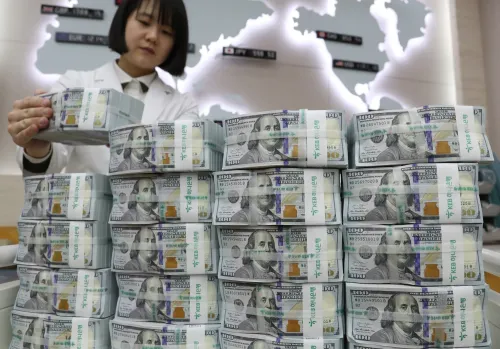
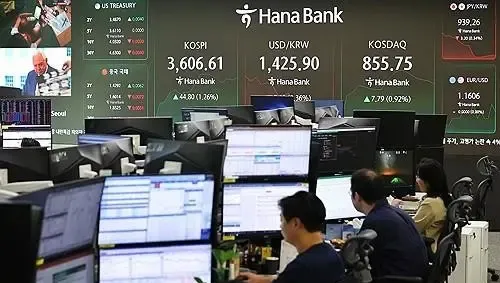
Why Are Foreign Investors Selling South Korean Stocks in January?
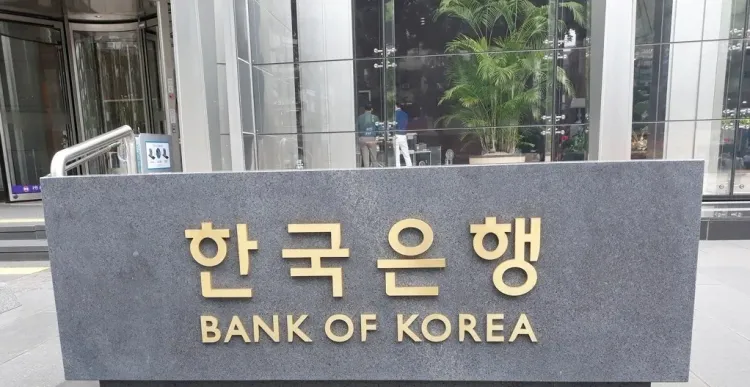
Synopsis
What prompted foreign investors to sell South Korean stocks in January? Discover the trends and insights behind this market shift, including the impact of profit-taking and the performance of semiconductor shares in the KOSPI index.
Key Takeaways
Foreign investors sold a net $50 million in South Korean stocks in January.
Net inflow of $2.39 billion in local securities was recorded.
The KOSPI increased by over 22 percent in January.
Volatility in the won-dollar exchange rate rose to 6.6 won .
Samsung Electronics and SK hynix drove significant gains in the market.
Seoul, Feb 12 (NationPress) In January, foreign investors transitioned to being net sellers of South Korean stocks, a shift attributed to profit-taking after recent climbs in the benchmark index, according to data released by the central bank on Thursday.
Offshore investors divested a net total of US$50 million in local equities last month, reversing the previous month's net purchase of $1.19 billion, as reported by the Bank of Korea (BOK).
Conversely, foreign investors acquired $2.44 billion in bonds during January, culminating in a net inflow of $2.39 billion in local securities. This marks the fifth consecutive month of net foreign inflows into domestic securities, as per Yonhap news agency.
As a BOK official noted, "Equity funds experienced a net outflow, as profit-taking following recent increases in domestic stock prices outweighed positive expectations for the semiconductor sector." He added, "Bond funds saw a deceleration in net inflows due to waning investor sentiment amid rising market interest rates."
Notably, the benchmark Korea Composite Stock Price Index (KOSPI) surged over 22 percent in January.
The central bank also indicated that the daily volatility of the won-dollar exchange rate escalated to an average of 6.6 won in January, up from 5.3 won in December.
"This increase in volatility was influenced by ongoing overseas investments by local investors, coupled with the National Pension Service's recent decision to lower its target allocation to overseas equities," the official elaborated.
In midday trading on Thursday, South Korean stocks exceeded the 5,500-point milestone for the first time, propelled by significant gains in leading tech shares such as Samsung Electronics and SK hynix.
At 10:59 a.m., the KOSPI had risen by 157.13 points, or 2.93 percent, reaching 5,511.62 before briefly dipping below this threshold by 11:20 a.m.
This marks an unprecedented achievement for the KOSPI, breaching the 5,500-point barrier for the first time.
Semiconductor stocks were the primary drivers behind the index's ascent, with Samsung Electronics soaring 6.08 percent and SK hynix climbing 3.26 percent.
Point of View
The recent trend of foreign investors becoming net sellers in South Korea's stock market highlights a significant moment in the financial landscape. This shift, driven by profit-taking, shows the delicate balance of investor sentiment and market performance. It is crucial for stakeholders to closely monitor these developments, as they can have far-reaching implications for the economy.
NationPress
27 Sept 2026
Frequently Asked Questions
What caused foreign investors to sell South Korean stocks?
The shift to net selling was primarily driven by profit-taking after recent gains in the benchmark index.
How much did foreign investors sell in January?
Foreign investors sold a net amount of US$50 million in South Korean equities.
What was the performance of the KOSPI in January?
The Korea Composite Stock Price Index (KOSPI) rose over 22 percent in January.
Did foreign investors buy any other securities in January?
Yes, they bought $2.44 billion worth of bonds, leading to a net inflow of $2.39 billion in local securities.
What impact did local investors have on the market?
Local investors' overseas investments contributed to increased volatility in the won-dollar exchange rate.