Will Global Chip Revenue Reach $793 Billion by 2025 with AI Semiconductors Leading the Charge?
Synopsis
As the tech landscape evolves, the semiconductor industry is poised for explosive growth, driven by AI technologies. The global revenue is forecasted to soar to $793 billion by 2025, with significant contributions from AI semiconductors. Discover how this trend is reshaping the market and what it means for the future of technology.
Key Takeaways
Global semiconductor revenue projected to reach $793 billion by 2025.
AI semiconductors are driving growth, accounting for nearly one-third of total sales.
Nvidia leads the market, surpassing $100 billion in sales.
India's semiconductor demand is expected to rise significantly by 2030 .
Government initiatives are boosting local semiconductor manufacturing capabilities.
New Delhi, Jan 13 (NationPress) The worldwide semiconductor revenue is projected to hit $793 billion in 2025, reflecting a 21% year-on-year growth, according to a report released on Tuesday. The study by tech research firm Gartner emphasized that AI semiconductors, which encompass processors, high-bandwidth memory, and networking components, were the primary catalysts for this growth, contributing to nearly one-third of total sales in 2025.
“The dominance of AI semiconductors is anticipated to grow as spending on AI infrastructure is expected to exceed $1.3 trillion by 2026,” stated Rajeev Rajput, Sr. Principal Analyst at Gartner.
Nvidia solidified its position, outpacing Samsung by $53 billion in 2025, becoming the first vendor to surpass $100 billion in semiconductor sales.
Samsung Electronics maintained its second position with approximately $73 billion in revenue, largely driven by memory sales (up 13%), while SK Hynix advanced to third place with around $61 billion due to soaring demand for High-Bandwidth Memory (HBM) in AI servers, according to the report.
Intel’s market share decreased to about 6%, approximately half of what it was in 2021, as the expansion of AI infrastructure has led to a surge in demand for AI processors, HBM, and networking chips.
In 2025, HBM constituted 23% of the DRAM market, with sales exceeding $30 billion, while sales of AI processors surpassed $200 billion. The research firm forecasts that AI semiconductors could dominate more than 50% of total semiconductor sales by 2029.
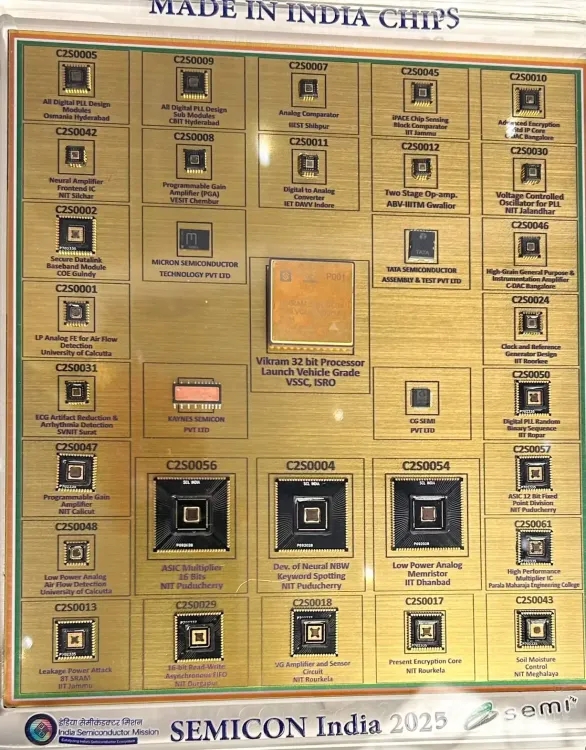
A recent report indicated significant growth in electronics and semiconductors, with India's semiconductor demand expected to rise from $33 billion in 2022 to $117 billion by 2030.
Emerging Tier-2 and Tier-3 cities are likely to become attractive investment destinations for technology companies and talent hubs, as semiconductor and advanced manufacturing initiatives stimulate local economies.
The government's Rs 7,280 crore initiative for Sintered Rare Earth Permanent Magnets (REPM) is anticipated to serve as a catalyst for India's wider semiconductor manufacturing ambitions by securing access to essential materials.
aar/na
Point of View
The semiconductor industry's expansion is a vital indicator of technological advancement and economic growth. As India prepares to enhance its semiconductor capabilities, the government's initiatives may play a crucial role in positioning the country as a leader in this essential sector, fostering innovation and attracting global investment.
NationPress
24 Sept 2026
Frequently Asked Questions
What are AI semiconductors?
AI semiconductors are specialized chips designed to perform tasks related to artificial intelligence, including data processing and machine learning.
How much is the semiconductor market expected to grow?
The global semiconductor market is projected to reach $793 billion by 2025, reflecting a 21% increase from the previous year.
Who are the leading companies in the semiconductor industry?
Nvidia is currently leading with over $100 billion in sales, followed by Samsung and SK Hynix.
What role does India play in the semiconductor market?
India's semiconductor demand is expected to grow significantly, increasing from $33 billion in 2022 to an estimated $117 billion by 2030.
What is the significance of High-Bandwidth Memory?
High-Bandwidth Memory (HBM) is crucial for AI applications, providing the speed and efficiency needed for data-intensive tasks.