Nvidia's Ambitious $1 Trillion Revenue Goal by 2027: Insights from CEO Jensen Huang
Synopsis
Nvidia is on track to revolutionize the AI industry, with CEO Jensen Huang projecting a staggering $1 trillion in revenue from AI chips by 2027. Discover how Nvidia plans to dominate the market with innovative technologies and products.
Key Takeaways
Nvidia aims for $1 trillion revenue from AI chips by 2027.
Introduction of Groq 3 LPU to enhance AI workloads.
Vera Rubin Space One for space-based data centers.
Kyber architecture supports 144 GPUs for improved performance.
Collaboration with major automakers on Level 4 autonomous vehicles.
New Delhi, March 17 (NationPress) Leading semiconductor manufacturer Nvidia revealed significant plans at its annual GTC conference. CEO Jensen Huang announced that the company anticipates generating up to $1 trillion in revenue from AI chips alone by 2027, capitalizing on the swift expansion of the artificial intelligence sector.
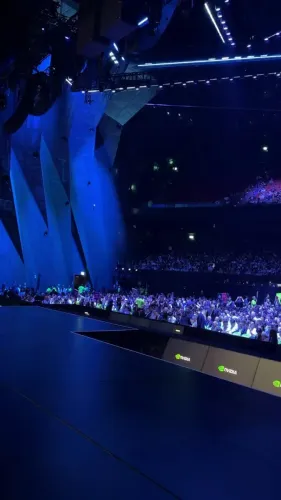
During the event held in San Jose, California, Huang detailed Nvidia’s approach to dominate the AI landscape through the creation of a comprehensive stack of hardware, software, and infrastructure.
A standout moment in the keynote was Huang’s forecast that the overall demand for Nvidia’s next-generation AI platforms, such as Blackwell and Vera Rubin systems, could lead to $1 trillion in revenue by 2027.
"I believe that the demand for computing has surged by 1 million times in the past two years," Huang remarked, highlighting the increase in AI-driven workloads across various industries.
Among the product showcases, Nvidia launched the Groq 3 Language Processing Unit (LPU), engineered to enhance AI inference workloads.
This chip, slated for delivery in the third quarter, is built on Nvidia’s GPU-centric architecture, optimized for speed and efficiency.
The company also presented its advanced computing system, Vera Rubin Space One, which is being developed with partners for use in space-based data centers, with a satellite launch linked to the initiative expected later this year.
“Physical AI has arrived — every industrial company will evolve into a robotics company,” Huang stated. "Nvidia’s complete platform — encompassing computing, open models, and software frameworks — serves as the backbone for the robotics sector, connecting a global ecosystem to create the intelligent machines that will drive the future of manufacturing, logistics, transportation, and infrastructure," he added.
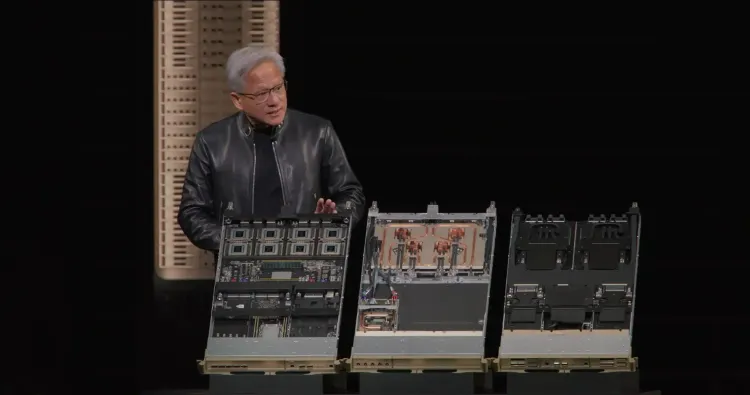
In another major development, Nvidia introduced a prototype of its forthcoming rack-scale architecture, Kyber, set to succeed the Rubin platform. This system is designed to accommodate up to 144 GPUs in vertically stacked configurations to enhance compute density and minimize latency. The architecture is anticipated to be included in the Vera Rubin Ultra system, expected to launch in 2027.
On the automotive front, Huang indicated that Uber plans to deploy a fleet powered by Nvidia’s Drive AV software by 2028 across several cities worldwide, beginning with Los Angeles and San Francisco next year.
Additionally, automakers such as Nissan, BYD, Geely, Isuzu, and Hyundai are collaborating on Level 4 autonomous vehicles utilizing Nvidia’s Drive Hyperion platform.
Nvidia has been rapidly advancing its innovation cycle in recent years, with plans to refresh its core product lineup annually while branching into new AI-powered computing sectors.
Point of View
Nvidia's ambitious plans are a clear indication of the company's commitment to innovation in the AI sector. As they strive to generate $1 trillion in revenue by 2027, their technological advancements will significantly impact various industries, pushing the boundaries of what's possible in computing and robotics.
NationPress
19 Sept 2026
Frequently Asked Questions
What revenue does Nvidia aim to achieve from AI chips by 2027?
Nvidia aims to generate up to $1 trillion in revenue from AI chips alone by 2027.
What new products did Nvidia announce?
Nvidia announced the Groq 3 Language Processing Unit and the Vera Rubin Space One computing system among other innovations.
How many GPUs can the upcoming Kyber architecture support?
The Kyber architecture is designed to integrate up to 144 GPUs.
Which companies are collaborating with Nvidia on autonomous vehicles?
Nissan, BYD, Geely, Isuzu, and Hyundai are among the automakers working with Nvidia on Level 4 autonomous vehicles.
What is the significance of physical AI according to Jensen Huang?
Huang stated that physical AI signifies that every industrial company will transform into a robotics company.