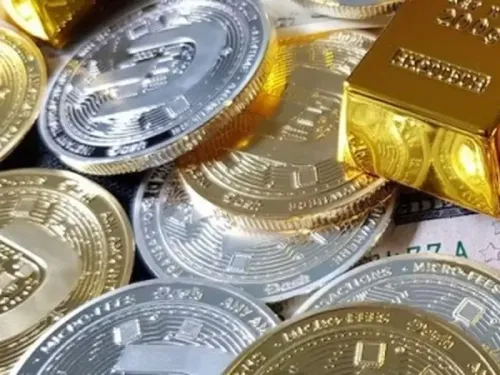
Gold Prices Surge for Fifth Day Amid Middle East Unrest

Synopsis
Gold prices have continued their ascent for five consecutive days due to escalating tensions in the Middle East, causing investors to flock to safe haven assets. With energy prices rising, the market is on alert for potential inflation impacts.
Key Takeaways
Gold prices have increased for the fifth day.
Current spot gold price is $5,360 per ounce.
Geopolitical tensions are driving investors toward safe havens.
The dollar index's rise is impacting gold's affordability.
Investors are monitoring economic indicators for Federal Reserve policy insights.
New Delhi, March 3 (NationPress) Gold prices have increased for the fifth consecutive day in global markets on Tuesday, driven by rising tensions in the Middle East and a surge in energy costs.
On Monday, MCX gold April futures saw a rise of 2.53 percent, reaching Rs 1,66,199 per 10 grams, while MCX silver May futures experienced a slight decline of 0.90 percent, settling at Rs 2,80,090 per kg.
The Multi Commodity Exchange of India will be closed for the first half of trading on Tuesday due to the Holi festival, with evening trading set to resume at 5 PM.
Increased tensions in West Asia have pushed investors towards safe-haven assets, raising inflation concerns in the US and speculation about the Federal Reserve's decision to keep interest rates steady for an extended period.
Spot gold experienced a 0.8 percent increase, reaching $5,360 per ounce. US gold futures rose approximately 1 percent, while spot silver climbed around 1.9 percent to $91.11 per ounce.
The dollar index rose by 0.19 percent to 98.57, making dollar-denominated gold more expensive for buyers using other currencies, which limited additional gains in the precious metal.
US President Donald Trump indicated that military operations against Iran would persist indefinitely. Reports suggest Tehran has targeted Saudi Arabia's oil and gas infrastructure and has threatened shipping in the critical Strait of Hormuz. Concurrently, Israel has initiated a "wave of strikes" aimed at Iranian command centers.
Iran's counter-strikes on oil and gas facilities have amplified worries regarding supply disruptions, thus elevating oil prices and intensifying inflation concerns.
US crude futures experienced a 1.4 percent increase, trading at $72.23, while Brent crude rose 1.87 percent, reaching $79.20 per barrel in early trading on Tuesday.
Investors are closely monitoring upcoming US Manufacturing and Non-Manufacturing PMI, ADP Non-Farm Employment Change, and Unemployment data to understand the Federal Reserve's policy direction.
Gold prices have surged nearly 25 percent in 2026, following a remarkable 64 percent increase last year, attributed to significant central bank purchases, inflows into exchange-traded funds, and worries about the independence of the US Federal Reserve.
aar/na
Point of View
It's crucial to recognize the implications of rising gold prices amidst geopolitical tensions. Investors are understandably cautious, seeking stability in volatile times. The situation in the Middle East warrants close observation, especially its potential impact on inflation and market dynamics.
NationPress
19 Sept 2026
Frequently Asked Questions
Why are gold prices rising?
Gold prices are rising due to escalating tensions in the Middle East and increasing energy prices, prompting investors to seek safer assets.
What factors influence gold prices?
Gold prices are influenced by geopolitical tensions, inflation concerns, central bank policies, and fluctuations in the dollar index.
What is the current price of gold?
As of now, spot gold is priced at approximately $5,360 per ounce.
How is the dollar index affecting gold prices?
An increase in the dollar index makes gold more expensive for buyers using other currencies, which can limit gold's price gains.
What are the predictions for gold prices?
Gold prices may continue to rise if geopolitical tensions and inflation concerns persist.