Will the Govt Achieve 69.7 Million Tonnes in Oilseed Production by 2031?
Synopsis
The Indian government is set to increase oilseed production to 69.7 million tonnes by 2030-31, aiming for self-sufficiency in edible oils. This push, through the National Mission on Edible Oils, aims to address import dependency and enhance rural economies. Discover how this initiative could transform India's agricultural landscape.
Key Takeaways
Target production: 69.7 million tonnes by 2030-31.
Current dependency: India meets only 44% of its edible oil needs domestically.
NMEO initiatives: Focus on oil palm and traditional oilseeds.
Farmer empowerment: Enhanced income and market access.
Economic impact: Aims to strengthen rural economies.
New Delhi, Dec 8 (NationPress) The Indian government announced on Monday that it plans to elevate oilseed production to 69.7 million tonnes by the fiscal year 2030-31, a strategic move aimed at achieving Atmanirbharta in the production of edible oils.
As per a report by NITI Aayog from August 2024, India holds the top position worldwide in the production of rice bran oil, castor seed, safflower, sesame, and niger.
Despite being one of the largest oilseed producers globally, India still heavily relies on imports to satisfy its edible oil requirements. Currently, domestic production meets only 44 percent of the country's edible oil demand.
Though the reliance on imports has decreased from 63.2 percent in 2015-16 to 56.25 percent in 2023-24, the decline is overshadowed by a significant increase in overall consumption.
This dependency poses challenges to both economic stability and agricultural self-sufficiency; hence, the government has launched the National Mission on Edible Oils (NMEO) to bolster the nation's oilseed framework, aiming for Atmanirbharta in edible oil production, as stated in an official announcement.
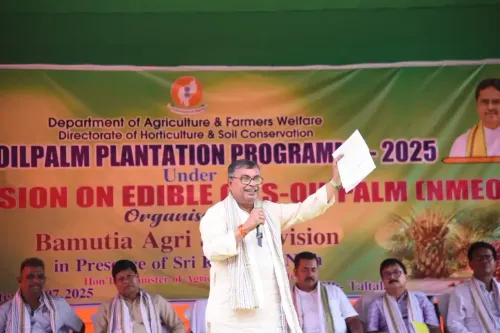
The NMEO-Oil Palm initiative, introduced in 2021, focuses on expanding oil palm cultivation and enhancing domestic crude palm oil production. Meanwhile, the NMEO-Oilseeds initiative, which commenced in 2024, aims to enhance productivity, seed quality, processing, and market connections for traditional oilseed crops.
According to the government, “The NMEO-OS (Oil Seeds) aspires to boost oilseed output from 39 million tonnes to 69.7 million tonnes by 2030-31 through cluster-based strategies and superior seed systems.”
“The NMEO-OP (Oil Palm) aims to cultivate 6.5 lakh hectares of oil palm by 2025-26, targeting an increase in crude palm oil production to 28 lakh tonnes by 2029-30,” the statement further elaborated.
The overarching goal of NMEO is to transform the edible oil sector from its current import dependency to a self-sufficient framework.
“With targeted initiatives in oil palm expansion, yield enhancement in traditional oilseeds, assured pricing mechanisms, advanced seed technologies, and coordinated institutional execution, the mission aspires to construct a resilient and competitive domestic edible oil value chain,” the statement noted.
The NMEO also seeks to diminish import reliance and fortify rural economies by providing farmers with enhanced income opportunities, quality inputs, and market connections.
“The NMEO stands as a pivotal element in India’s agricultural transformation, addressing productivity disparities, encouraging innovation, and propelling the nation’s pursuit of genuine Atmanirbharta in edible oil production,” the official statement concluded.
Point of View
It's essential to acknowledge the government's ambitious plan to enhance oilseed production while also highlighting the challenges of dependency on imports. This initiative reflects a broader strategy for self-sufficiency and economic stability, which is crucial for India's agricultural future.
NationPress
24 Sept 2026
Frequently Asked Questions
What is the target for oilseed production in India?
The Indian government aims to increase oilseed production to 69.7 million tonnes by 2030-31.
Why is Atmanirbharta important for India?
Atmanirbharta, or self-sufficiency, is vital for reducing dependency on imports and enhancing economic stability.
What initiatives are part of the National Mission on Edible Oils?
The NMEO includes initiatives like NMEO-Oil Palm and NMEO-Oilseeds to improve cultivation, productivity, and market access.
How much of India's edible oil demand is met through domestic production?
Currently, India meets only 44% of its domestic demand for edible oils through internal production.
How does the government plan to support farmers?
The NMEO aims to empower farmers by providing better income opportunities, access to quality inputs, and improved market linkages.