Could a Reduction in Greenland Tensions Enhance Market Confidence and Support the Rupee?
Synopsis
As Greenland tensions ease, market confidence is expected to improve, potentially stabilizing the Indian rupee. Despite ongoing volatility, a gradual depreciation is anticipated. With trade negotiations progressing and economic growth remaining strong, this situation could provide a boost for exporters and the overall market landscape. Stay informed on these critical developments.
Key Takeaways
The easing of Greenland tensions is likely to enhance market sentiment.
The rupee has recently rebounded from record lows.
Economic growth remains strong, with projections above 7.5%.
A weaker rupee benefits exporters but can create economic distortions.
Capital flows are a significant concern for the market.
New Delhi, Jan 22 (NationPress) Recent indications of a de-escalation in Greenland-related tensions are set to uplift market confidence. Although rupee volatility may continue in the short term, any depreciation is anticipated to occur more slowly compared to the recent sharp declines, according to a report released on Thursday.
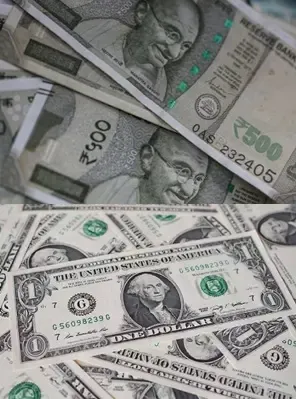
The rupee has bounced back from its record lows, gaining 15 paise to reach 91.50 against the US dollar during early trading on Thursday.
Radhika Rao, Executive Director and Senior Economist at DBS Bank, noted that the negative outlook from last year was exacerbated by a mix of both global and domestic factors.
“The significant rise in the global VIX indicates widespread market weakness, compounded by adverse geopolitical events and a surge in global bond yields. In this scenario, the recent signs of a softening in Greenland tensions are likely to provide a boost to market sentiments,” she highlighted.
A significant trade agreement with the European Union is on the horizon and is expected to be finalized next week, while optimism has emerged regarding US-China trade discussions following positive comments from the World Economic Forum (WEF) in Davos.
On the domestic front, the downward pressure on the rupee coincides with a period of notable economic growth, with the average for the first and second quarters of FY26 projected at 8 percent (year-on-year), and our forecast suggesting growth will exceed 7.5 percent for FY26.
A weaker currency can benefit exporters facing higher tariffs but has created challenges in other areas.
“The annual Current Account Deficit (CAD) is expected to remain manageable at around -1.0% to -1.2% of GDP, but capital flows have been a significant concern. After experiencing net outflows in 2025, equity markets have faced $3 billion in outflows this year, while bond investments have drawn limited interest,” the DBS Bank report stated.
Net Foreign Direct Investment (FDI) has shown improvement compared to last year, but it still lags behind gross FDI due to repatriation pressures.
“The fiscal stimulus will become more evident with the upcoming Budget, as cumulative general government borrowings are predicted to increase in FY27,” it mentioned.
Point of View
It's crucial to remain neutral while reporting on economic fluctuations. The easing of Greenland tensions presents an opportunity for market recovery and rupee stabilization. Our stance is to continuously monitor these developments, ensuring our audience receives balanced, factual information as the situation unfolds.
NationPress
27 Sept 2026
Frequently Asked Questions
What impact do Greenland tensions have on the Indian rupee?
The easing of Greenland tensions is expected to improve market sentiment and help stabilize the Indian rupee, which has been under pressure.
Is the Indian economy growing despite rupee fluctuations?
Yes, the Indian economy continues to show strength with projected growth rates above 7.5% for FY26, despite fluctuations in the rupee.
How does a weak rupee affect exporters?
While a weak rupee can help exporters by cushioning earnings against higher tariffs, it can also lead to distortions in the economy.
What is the expected Current Account Deficit (CAD) for India?
The annual CAD is expected to remain manageable, estimated at around -1.0% to -1.2% of GDP.
What are the prospects for foreign investments in India?
Net FDI is showing improvement over last year but still faces challenges due to repatriation concerns.