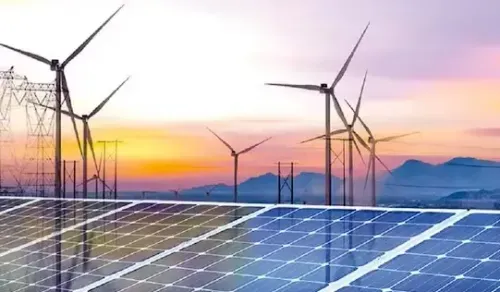
India adds 30.6 GW renewable energy in H1 2026, solar leads at 26.34 GW

Synopsis
India's renewable energy machine is running at full throttle — 30.6 GW added in just six months, with solar clocking 43 per cent year-on-year growth. But beneath the record numbers, offshore wind stagnation and grid stability pressures signal that the easy phase of India's energy transition may be giving way to a harder, more complex one.
Key Takeaways
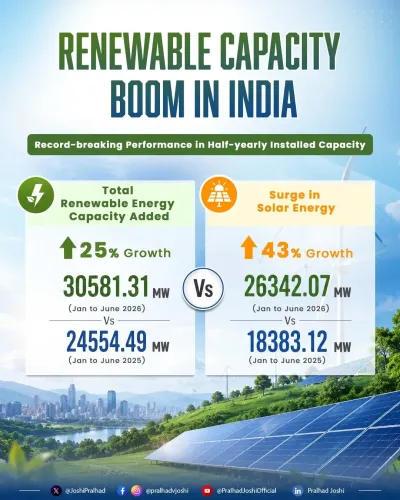
India added 30.6 GW of renewable energy capacity in H1 2026 , a 25 per cent year-on-year increase.
Solar power led additions at 26.34 GW between January and June 2026, up 43 per cent year-on-year.
Total installed renewable capacity including large hydro reached 288 GW as of 30 June 2026 , representing 52 per cent of India's overall power generation capacity.
Solar installed capacity stands at 162 GW ; wind at 57 GW .
India's 2025 renewable additions grew by nearly 60 per cent — the fastest among major global markets, per the IEA .
Offshore wind projects in India continue to face cancellations and delays amid global supply chain and cost pressures.
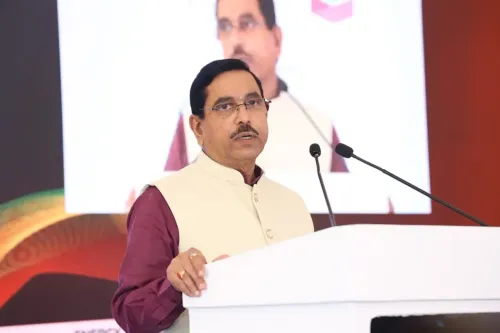
India added 30.6 GW of renewable energy capacity in the first half of 2026, registering a 25 per cent year-on-year increase, with solar power driving the bulk of new installations, Union Minister for New and Renewable Energy Pralhad Joshi announced on Friday, 17 July 2026. The figures underscore India's accelerating clean energy buildout as the country pushes toward its long-term decarbonisation targets.
Solar Leads the Charge
Solar energy accounted for the lion's share of additions, with India commissioning 26.34 GW of solar capacity between January and June 2026 — a 43 per cent year-on-year growth. Joshi shared the milestone in a post on social media platform X, describing the expansion as reflecting 'unprecedented momentum' in India's clean energy journey.
According to data from the Central Electricity Authority (CEA), India's total installed renewable energy capacity — including large hydro — stood at 288 GW as of 30 June 2026, accounting for 52 per cent of the country's overall installed power generation capacity. Solar energy remained the single largest contributor at 162 GW of installed capacity, while wind power reached 57 GW.
Context: Building on a Record 2025
The H1 2026 performance builds on a landmark 2025, when India's annual renewable capacity additions rose by nearly 60 per cent — the fastest growth rate among major global markets, according to the International Energy Agency (IEA). The IEA noted that India commissioned nearly 50 GW of solar photovoltaic (PV) capacity in 2025 alone, almost double the level recorded the previous year. Wind energy additions also doubled in 2025, crossing the 6 GW mark. The current H1 trajectory suggests 2026 could sustain or exceed that momentum on an annualised basis.
Offshore Wind: The Persistent Weak Link
Despite the headline numbers, offshore wind remains a significant gap in India's renewable portfolio. According to the IEA, offshore wind projects in India continue to face setbacks from project cancellations and delays. The global offshore wind industry is grappling with multiple headwinds — developers have scaled back their 2030 deployment targets due to policy shifts in the United States and cost and supply chain pressures affecting projects across Europe, India, and Japan. India's offshore ambitions, which form a key pillar of its longer-term energy mix, remain at risk.
Grid Stability: The Growing Operational Challenge
The rapid scaling of renewable capacity is also intensifying operational stress on India's power grid. Higher penetration of variable renewable energy — solar and wind output that fluctuates with weather — is creating balancing challenges for grid operators. This is a structural tension that policymakers and utilities will need to address as capacity additions continue to outpace grid modernisation investments. Notably, this challenge is not unique to India; it mirrors difficulties faced by Germany, the US, and China as they scaled variable renewables rapidly.
What the Minister Said
'India's clean energy journey continues to gather unprecedented momentum under the visionary leadership of Prime Minister Narendra Modi,' Joshi stated. 'In the first half of 2026, India added 30,581.31 MW of renewable energy capacity, registering an impressive 25 per cent growth over the same period last year,' he added. Joshi further said: 'These milestones reaffirm India's unwavering commitment to accelerating the clean energy transition and building a sustainable, self-reliant future.'
With India's total renewable installed base now at 288 GW and solar alone at 162 GW, the country is firmly on a growth curve — though bridging the offshore wind gap and stabilising the grid will define whether the next phase of expansion is as smooth as the last.
Point of View
But it is almost entirely a solar story — and a utility-scale one at that. India's offshore wind pipeline, which was supposed to diversify the renewable mix and unlock coastal energy potential, remains effectively stalled. The IEA's warning about global offshore headwinds is real, but India's project cancellations also reflect domestic policy and land-acquisition friction that predates the current global cost cycle. Meanwhile, 52 per cent renewable penetration in installed capacity is not the same as 52 per cent in actual generation — the grid balancing challenge is quietly becoming the defining constraint of India's energy transition, and it is not yet receiving the same political attention as the capacity additions headline.
NationPress
16 Oct 2026
Frequently Asked Questions
How much renewable energy capacity did India add in H1 2026?
India added 30.6 GW of renewable energy capacity in the first half of 2026, a 25 per cent increase over the same period in 2025, according to Union Minister Pralhad Joshi.
What is India's total installed renewable energy capacity as of mid-2026?
As of 30 June 2026 , India's total installed renewable energy capacity — including large hydro — stood at 288 GW , accounting for 52 per cent of the country's overall installed power generation capacity, per Central Electricity Authority data.
Why is solar energy leading India's renewable expansion?
Solar energy has become the dominant driver due to rapidly falling module costs, large-scale government procurement programmes, and favourable land availability for utility-scale projects. India added 26.34 GW of solar capacity in H1 2026 alone, reflecting a 43 per cent year-on-year growth rate.
What challenges does India's offshore wind sector face?
Offshore wind projects in India continue to face project cancellations and delays. Globally, developers have scaled back 2030 targets due to US policy shifts and cost and supply chain pressures affecting projects in Europe, India, and Japan, according to the IEA.
How does India's 2025 renewable growth compare globally?
India's annual renewable capacity additions rose by nearly 60 per cent in 2025, making it the fastest-growing major renewable market that year, according to the International Energy Agency. The country commissioned nearly 50 GW of solar PV capacity in 2025, almost double the previous year's level.