PLI scheme draws ₹2.5 lakh crore investment, ₹22 lakh crore output: PM Modi
Synopsis
Modi put hard numbers on the PLI scheme's performance — ₹2.5 lakh crore in investment, ₹22 lakh crore in output, ₹15 lakh crore in exports, and 14 lakh jobs — framing it as proof that India has permanently broken from the Licence Raj's 'Production Linked Punishment' culture. With the IMF backing India as the world's fastest-growing economy, the government is now betting on outcome data to defend the scheme's legacy.
Key Takeaways
PM Narendra Modi on 21 August said the PLI scheme has attracted ₹2.5 lakh crore in investment.
The scheme has generated ₹22 lakh crore in production and sales, and ₹15 lakh crore in exports.
More than 14 lakh jobs have been created under the PLI framework, according to Modi.
Modi contrasted the scheme with the Licence Raj's 'Production Linked Punishment' approach, signalling a philosophical break.
The IMF projects India to remain the world's fastest-growing economy; Modi cited this as a mandate to sustain momentum.
Modi outlined an approach of 'leading with all', stressing global partnerships over economic isolation.
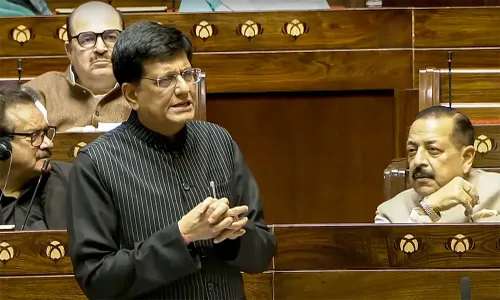
Prime Minister Narendra Modi on Friday, 21 August said India had decisively moved away from what he called the 'Production Linked Punishment' culture of the Licence Raj era, crediting the Production-Linked Incentive (PLI) scheme with transforming the country's manufacturing landscape. Addressing a media event in New Delhi, Modi cited concrete outcomes — ₹2.5 lakh crore in investment, ₹22 lakh crore in production and sales, and more than 14 lakh jobs created — as evidence of a fundamental shift in the government's economic philosophy.
PLI Scheme: Key Numbers
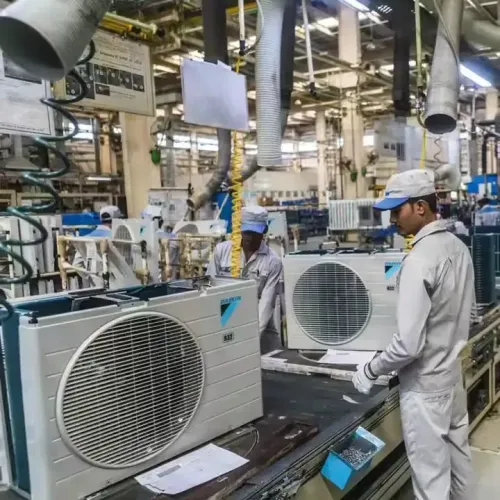
The Prime Minister laid out the scheme's scorecard in detail. Beyond investment and output, the PLI framework has driven ₹15 lakh crore in exports, underscoring its role not just as a domestic manufacturing catalyst but as a driver of India's global trade footprint. Modi argued that these figures reflected a government that had replaced restriction with incentive — moving from a system that penalised production to one that rewards scale.
'Instead of imposing restrictions, the Union government was focusing on creating an environment that encourages companies to expand manufacturing, investment and employment,' he said.
India as a Global Bright Spot
Modi contextualised the PLI performance against a turbulent global backdrop. He noted that the world was grappling with rising distrust and the weaponisation of resources, making stable growth increasingly rare. Against this, he positioned India as 'the light at the end of this tunnel' — a phrase that signals the government's intent to project economic confidence even as major economies face headwinds.
He cited the International Monetary Fund (IMF)'s projection that India would continue to lead as the world's fastest-growing economy, framing it as both validation and responsibility. 'India is leading all efforts to make that happen,' he added.
The 'Leading With All' Doctrine
Notably, Modi stressed that India's growth story could not be built in isolation. He outlined what he described as an approach of 'leading with all' — a formulation that emphasises partnerships and multilateral cooperation over unilateral self-reliance. This comes amid ongoing geopolitical fragmentation, where several economies are retreating into protectionism. India, Modi suggested, was charting a different course: engaging the world even while strengthening domestic production capacity.
What This Signals
The PLI scheme, launched in phases from 2020 onwards, now covers 14 sectors including electronics, pharmaceuticals, textiles, and food processing. Friday's address is among the most comprehensive official tallies of the scheme's outcomes to date. The government's willingness to put specific numbers on the table — investment, output, exports, jobs — signals a shift toward outcome-based accountability, even as critics have previously questioned whether employment figures are independently verified. The next phase of PLI expansion, if any, is expected to be shaped by these performance benchmarks.
Point of View
But the question of independent verification remains open. Employment figures under PLI have historically been self-reported by beneficiary companies, with no third-party audit mechanism publicly disclosed. The ₹22 lakh crore production figure is impressive on its face, yet India's manufacturing share of GDP has barely moved over the past decade — suggesting that aggregate output growth has not yet translated into structural transformation. The 'leading with all' framing is also worth watching: it is a quiet but deliberate departure from the more insular 'Atmanirbhar Bharat' rhetoric of 2020, signalling that the government recognises export competitiveness requires global integration, not just domestic incentives. Whether the next PLI phase ties disbursements to verifiable net-new employment — rather than total headcount — will be the real test of whether this scheme has learned from its own gaps.
NationPress
21 Aug 2026
Frequently Asked Questions
What are the PLI scheme's outcomes as cited by PM Modi?
According to Prime Minister Narendra Modi, the PLI scheme has generated ₹2.5 lakh crore in investment, ₹22 lakh crore in production and sales, and ₹15 lakh crore in exports, while creating more than 14 lakh jobs. He shared these figures at a media event in New Delhi on 21 August.
What did Modi mean by 'Production Linked Punishment'?
Modi used the phrase 'Production Linked Punishment' to describe the restrictive Licence Raj era, when government regulations effectively penalised businesses for scaling up production. He contrasted that approach with the current PLI model, which rewards companies for increasing output and investment.
Which sectors does the PLI scheme cover?
The PLI scheme covers 14 sectors, including electronics, pharmaceuticals, textiles, and food processing, among others. It was launched in phases from 2020 onwards and has since been expanded to drive both domestic manufacturing and export competitiveness.
Why did Modi invoke the IMF's growth projection?
Modi cited the IMF's projection that India would continue to lead as the world's fastest-growing economy to reinforce confidence in India's economic trajectory amid global uncertainty. He framed it as both an endorsement of current policy and a call to sustain the momentum.
What is the 'leading with all' approach Modi described?
'Leading with all' is the phrase Modi used to describe India's strategy of pursuing global partnerships and cooperation rather than economic isolation, even as it builds domestic manufacturing capacity. He stressed this approach as essential for navigating ongoing geopolitical and economic disruptions worldwide.