Manufacturing must hit 25% of GDP by 2047, says EAC-PM chief S Mahendra Dev

Synopsis
India's top economic adviser has put a hard number on the country's manufacturing ambition: 25% of GDP by 2047. EAC-PM chairman S Mahendra Dev told the CII Financing Summit 2026 that hitting that target — from a current 16–17% — is non-negotiable for developed-economy status, and that banks alone cannot fund the journey.
Key Takeaways
EAC-PM chairman S Mahendra Dev said India must raise manufacturing's share of GDP from 16–17% to 25% by 2047 .
India's growth potential is 8–9% per year , but requires an investment rate of 34–35% of GDP ; gross fixed capital formation was 31.9% in 2025–26 .
Gross savings stood at 34.9% of GDP in 2024–25 , with households contributing around 62% of the total.
India's corporate bond market is concentrated, with 85–90% of issuances in the highest-rated securities, limiting access for mid-sized and lower-rated borrowers.
Dev called for diversifying long-term finance through insurance funds , pension funds , corporate bond markets , and equity markets .
Political stability , macroeconomic stability , and a large domestic economy were cited as India's key resilience anchors.
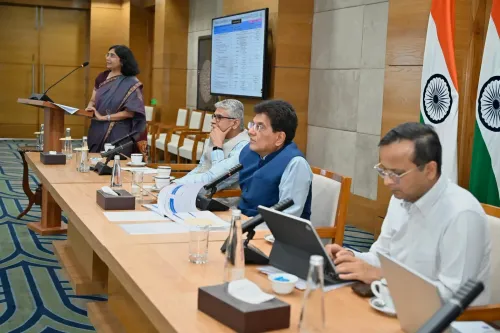
S Mahendra Dev, chairman of the Economic Advisory Council to the Prime Minister (EAC-PM), on Thursday, 19 November 2026, said India must raise manufacturing's share of gross domestic product (GDP) from the current 16–17 per cent to 25 per cent by 2047 if it is to achieve developed-economy status. Dev was addressing the CII Financing Summit 2026 in Mumbai.
Growth Potential and Investment Imperatives
Dev argued that India has the potential to grow at 8–9 per cent annually, but sustaining that pace requires both an expansion in productive capacity and measurable improvements in productivity. He said an investment rate of 34–35 per cent of GDP is essential to support growth over the next two decades. Gross fixed capital formation stood at 31.9 per cent of GDP in 2025–26, leaving a gap that policymakers must bridge.
He underscored the importance of greater private sector participation, contending that public investment in infrastructure — by improving connectivity and reducing production and transportation costs — can catalyse private capital. However, he was explicit that public spending alone would be insufficient to meet India's development requirements.
Household Savings as the Backbone of Financing
According to revised national income accounts data, gross savings stood at 34.9 per cent of GDP in 2024–25, with the household sector accounting for approximately 62 per cent of the total. Dev stressed that how these household savings are channelled has a direct bearing on how investment across the broader economy is financed. 'Since households account for nearly two-thirds of India's domestic savings, the way these savings are used has an important bearing on how investment elsewhere in the economy is financed,' he said.
Diversifying Long-Term Finance Beyond Banks
Dev called for a deliberate diversification of long-term financing sources, warning that the banking system alone cannot absorb the scale of capital India's ambitions demand. 'Different investments require different kinds of finance. These requirements cannot all be met through conventional bank lending,' he said. He highlighted the untapped potential of insurance funds, pension funds, corporate bond markets, and equity markets in channelling patient capital into infrastructure and manufacturing.
Notably, he flagged a structural skew in India's corporate bond market, where 85–90 per cent of issuances are concentrated in the highest-rated securities. Mid-sized companies and lower-rated borrowers continue to face restricted access — a constraint that limits credit democratisation and stunts the growth of smaller industrial enterprises.
Structural Transformation and Resilience Factors
Beyond finance, Dev emphasised the need for structural transformation across agriculture, manufacturing, and services, supported by greater deployment of technology and digital public infrastructure. On the farm side, he called for raising agricultural productivity through diversification, post-harvest activities, agro-processing, and stronger farmer producer organisations.
Anchoring his outlook on macroeconomic fundamentals, Dev identified 'political stability, macroeconomic stability and a large domestic economy' as the three pillars of India's resilience even as global geopolitical and macroeconomic uncertainty persists. He said these factors gave India a structural advantage, but warned that the window to build productive capacity is not indefinitely open.
Point of View
And the needle has barely moved. Dev's remarks are technically sound — the investment-rate arithmetic, the household-savings channel, the bond-market skew — but the diagnosis is not new. The harder question is why private investment has remained reluctant despite successive infrastructure pushes, and whether the corporate bond market's concentration problem can be fixed without regulatory intervention that successive governments have been cautious about. The 2047 horizon gives policymakers room to defer urgency; the real test is whether the next five-year period shows structural movement, not just summit-level consensus.
NationPress
19 Nov 2026
Frequently Asked Questions
What did EAC-PM chairman S Mahendra Dev say about India's manufacturing target?
S Mahendra Dev said India must increase manufacturing's share of GDP from the current 16–17% to 25% by 2047 to achieve developed-economy status. He made the remarks at the CII Financing Summit 2026 in Mumbai on 19 November 2026.
What investment rate does India need to sustain 8–9% GDP growth?
According to Dev, India needs an investment rate of around 34–35% of GDP to sustain high growth over the next two decades. Gross fixed capital formation stood at 31.9% of GDP in 2025–26, indicating a gap that must be closed through greater private and public investment.
Why can banks alone not finance India's development needs?
Dev argued that different types of long-term investments require different financing instruments, and conventional bank lending cannot meet them all. He called for a greater role for insurance funds, pension funds, corporate bond markets, and equity markets to supply patient, long-term capital.
What is the problem with India's corporate bond market?
Around 85–90% of issuances in India's corporate bond market are concentrated in the highest-rated securities, leaving mid-sized companies and lower-rated borrowers with limited access to market financing. Dev highlighted this as a structural constraint on credit availability for smaller industrial firms.
What role do household savings play in India's investment financing?
Household savings account for approximately 62% of India's total gross savings, which stood at 34.9% of GDP in 2024–25. Dev stressed that how these savings are intermediated — whether into productive investment or low-yielding assets — has a direct impact on overall economic financing.