India needs 1.32 million EV charging points by 2030: Report
Synopsis
India has just 67,657 EV chargers today but needs 1.32 million by 2030 — a nearly 20-fold gap. With utilisation stuck at 1–5% and 73% of chargers rated below 30 kW, the sector faces a dual challenge: building at scale while cracking a revenue model that actually works for charge point operators.
Key Takeaways
India needs 1.32 million EV charging points by 2030 , against 67,657 installed as of August 2026 , according to a Rubix Data Sciences report citing CII estimates.
Public EV charging stations grew nearly six-fold since 2022 , from 5,000 to 29,151 as of December 2025 .
Charger utilisation remains critically low at just 1–5 per cent , raising questions about station economics and CPO revenue models.
Approximately 73 per cent of India's 66,518 non-BSS chargers are rated below 30 kW ; only nine chargers exceed 240 kW .
Karnataka , Maharashtra , and Uttar Pradesh lead deployment; the top 10 states hold 78 per cent of the network.
EV penetration stands at 8.88% for two-wheelers, 60.77% for three-wheelers, and 5.70% for four-wheelers.
India will require 1.32 million EV charging points by 2030, compared to just 67,657 chargers installed as of August 2026, according to a new report by Rubix Data Sciences citing estimates from the Confederation of Indian Industry (CII). The gap underscores a massive infrastructure build-out opportunity — and challenge — for the country's fast-evolving electric vehicle ecosystem.
How Far the Network Has Come
Public EV charging stations in India have grown nearly six-fold since 2022, rising from approximately 5,000 to 29,151 as of December 2025, according to data from the Ministry of Heavy Industries. The pace of expansion reflects accelerating EV adoption and targeted government support, yet the installed base remains a fraction of what projections demand by the decade's end.
Geographically, the network is heavily concentrated. Karnataka, Maharashtra, and Uttar Pradesh lead in deployment, while the top 10 states collectively account for 78 per cent of the national charging network — a lopsidedness that raises equity and range-anxiety concerns for EV users in smaller states and rural corridors.
The Utilisation Problem
Despite the rapid station count growth, charger utilisation remains strikingly low. According to the Rubix Data Sciences report, utilisation stands at just 1–5 per cent by most estimates, raising pointed questions about station economics. Charge point operators (CPOs) are reportedly experimenting with a range of revenue models — including subscriptions, fleet contracts, roaming arrangements, and site-host revenue sharing — to make the business viable. Electricity costs remain a persistent pressure point in these calculations.
The Power-Rating Gap
The composition of India's charging infrastructure also reveals a structural mismatch with future demand. As of 7 August 2026, India had 67,657 EV chargers in total, including 1,139 associated with Battery Swapping Stations (BSS). Excluding BSS chargers, approximately 73 per cent of the remaining 66,518 chargers — or 48,709 units — are rated below 30 kW.
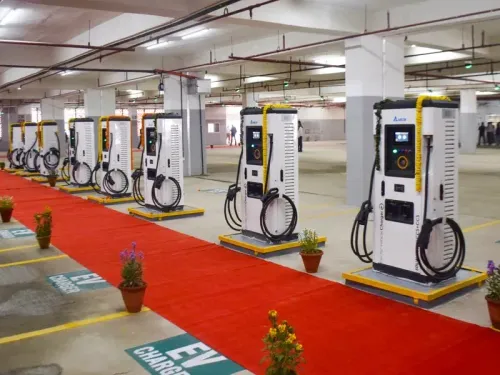
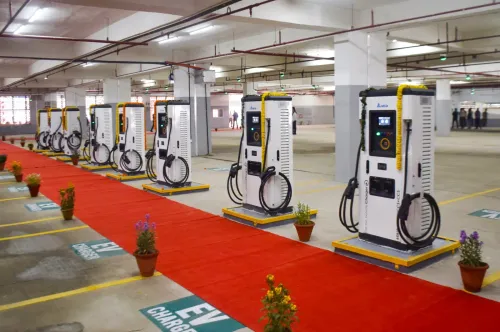
A further 15,753 chargers fall in the 30–60 kW range, while only 1,513 are rated between 61 and 120 kW. Higher-power infrastructure is markedly thin: just 534 chargers are rated at 121–240 kW, and a mere nine exceed 240 kW. The report notes this distribution is broadly consistent with India's current EV mix, which skews heavily toward two- and three-wheelers that carry lower charging-power requirements.
EV Penetration and What It Signals
EV penetration currently stands at approximately 8.88 per cent for two-wheelers and 60.77 per cent for three-wheelers, against a comparatively modest 5.70 per cent for four-wheelers. As passenger EV adoption scales, demand for faster, higher-power charging is expected to surge. "The limited penetration of higher-power infrastructure creates potential headroom for CPOs as passenger EV adoption scales and demand for faster charging increases," the report stated.
Notably, nearly 73 per cent of chargers being sub-30 kW suggests significant room for DC fast and ultra-fast charging expansion, particularly along highways and urban corridors where four-wheeler range requirements are greatest. The runway from 67,657 chargers today to the 1.32 million target by 2030 represents one of the largest infrastructure mandates in India's clean energy transition.
Point of View
But the utilisation figure — 1 to 5 per cent — is the number that should worry policymakers most. A network built ahead of demand is capital-inefficient; one that lags demand kills EV adoption momentum. India is currently threading that needle poorly, with geographic concentration in 10 states leaving large swaths of the country effectively range-locked. The real policy gap is not just in charger count but in the absence of a viable CPO business model — without which private capital will not flow at the scale the 2030 target demands.
NationPress
17 Oct 2026
Frequently Asked Questions
How many EV charging points does India need by 2030?
India needs 1.32 million EV charging points by 2030, according to a Rubix Data Sciences report citing CII estimates. As of August 2026, only 67,657 chargers had been installed, pointing to a nearly 20-fold build-out requirement in under five years.
How fast has India's EV charging network grown?
India's public EV charging stations grew nearly six-fold between 2022 and December 2025, rising from around 5,000 to 29,151, according to Ministry of Heavy Industries data cited in the report. Despite this growth, the installed base remains far short of the 2030 target.
Why is EV charger utilisation so low in India?
Charger utilisation in India stands at just 1–5 per cent by most estimates, reflecting a network built ahead of current demand. The report highlights concerns around station economics, electricity costs, and the revenue models that charge point operators are still experimenting with, including subscriptions, fleet contracts, and site-host revenue sharing.
Which states lead India's EV charging deployment?
Karnataka, Maharashtra, and Uttar Pradesh are the top three states for EV charger deployment. The top 10 states together account for 78 per cent of India's entire charging network, leaving most of the country significantly underserved.
What is the current EV penetration rate in India?
EV penetration in India stands at approximately 8.88 per cent for two-wheelers and 60.77 per cent for three-wheelers, while four-wheelers lag at 5.70 per cent, according to the Rubix Data Sciences report. The dominance of two- and three-wheelers partly explains why 73 per cent of installed chargers are low-power units below 30 kW.