How Will the India-Oman Trade Pact Transform Market Access and Jobs?

Synopsis
The recent signing of the India-Oman CEPA represents a pivotal moment in trade relations, promising to enhance market access and create jobs. This comprehensive agreement opens new avenues for Indian businesses, especially in labor-intensive sectors. Experts anticipate growth in various industries, making this pact crucial for India’s economic future.
Key Takeaways
CEPA enhances market access for Indian goods with duty-free benefits.
Job creation is expected across labor-intensive sectors.
Strategic location of Oman as a gateway to Gulf and Africa .
Strong support for MSMEs, artisans, and women-led businesses .
Bilateral trade growth projected to exceed $10 billion .
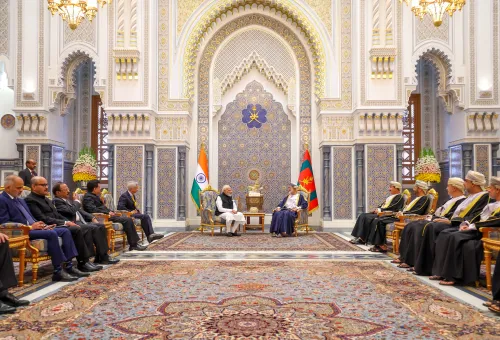
New Delhi, Dec 19 (NationPress) The execution of the India–Oman Comprehensive Economic Partnership Agreement (CEPA) marks a significant achievement in India’s trade relations with the Gulf region, which is poised to enhance market access, generate employment, and unlock new prospects for Indian enterprises across various sectors, as indicated by industry analysts.
The Federation of Indian Export Organisations (FIEO), the leading organization representing Indian exporters, asserted that the CEPA is a groundbreaking agreement that will bolster India’s export competitiveness and promote inclusive, job-oriented growth.
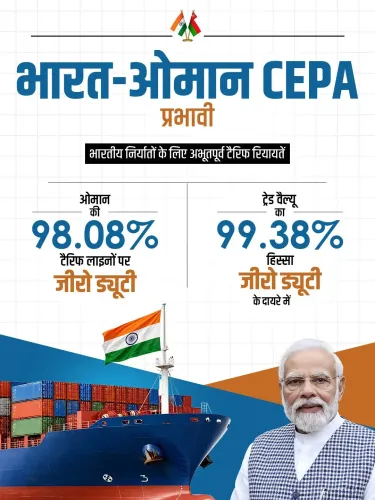
FIEO President SC Ralhan emphasized that the agreement ensures nearly universal duty-free access for Indian products, featuring zero-duty advantages on over 98% of Oman’s tariff lines, thereby encompassing over 99% of India’s exports by value.
This development is anticipated to significantly enhance the competitiveness of Indian goods in the Omani market.
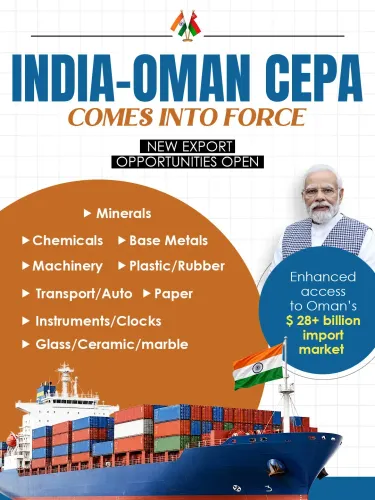
“Sectors that rely heavily on labor, such as textiles and apparel, leather and footwear, gems and jewellery, engineering products, plastics, furniture, agricultural and food products, pharmaceuticals, medical devices, automobiles, and sports goods are expected to benefit the most,” Ralhan noted.
“The agreement will foster job creation and provide robust support to MSMEs, artisans, women-led businesses, and farmers throughout India,” he added.
The CEPA guarantees exceptional market access for Indian exports, with zero-duty access on 98.08% of Oman’s tariff lines, covering 99.38% of India’s exports by value.
This nearly universal duty-free access is set to greatly improve the competitiveness of Indian products and benefit crucial labor-intensive sectors like textiles and apparel, leather and footwear, gems and jewellery, engineering goods, plastics, furniture, agricultural and food products, pharmaceuticals, medical devices, automobiles, and sports goods.
The FIEO Chief pointed out that Oman’s strategic location renders it an essential gateway to the Gulf and Africa, and the CEPA will enable Indian exporters to integrate more effectively into regional value chains, diversify markets, and expand India’s export presence.
With bilateral trade already surpassing $10 billion, the agreement lays a strong foundation for rapid growth in merchandise trade.
The CEPA also offers ambitious and forward-thinking commitments in services, covering 127 sub-sectors, including IT and computer-related services, business and professional services, R&D, education, health, and audiovisual services, unlocking high-value opportunities for Indian service providers.
Prashant Mehra, Partner and India–Middle East Corridor Leader at Grant Thornton Bharat, stated that this is a significant milestone, not only because India has strengthened its bilateral trade connections in the Gulf region following the FTA with the UAE in February 2022 but also because Oman has demonstrated similar confidence in India as a market and business ally, akin to its relationship with the USA in 2006.
“The agreement will further enhance corridor growth not just for goods but also importantly for services, with improved mobility for Indian professionals. This, combined with 100% FDI in major service sectors in Oman through commercial presence, opens new pathways for outbound investment from India,” he noted.
Point of View
I firmly believe that the India-Oman CEPA is a strategic advancement in our trade relations. This agreement not only promises enhanced market access but also ensures job creation across various sectors, thereby fostering economic growth. Nations must continue to build such partnerships to thrive in an interconnected global economy.
NationPress
26 Sept 2026
Frequently Asked Questions
What is the India-Oman Comprehensive Economic Partnership Agreement?
The India-Oman CEPA is a trade agreement aimed at enhancing bilateral trade relations by providing duty-free access to a majority of goods and services, thereby facilitating economic cooperation.
How will the CEPA affect employment?
The CEPA is expected to generate significant employment opportunities across various sectors, particularly in labor-intensive industries such as textiles, agriculture, and pharmaceuticals.
What sectors will benefit the most from the CEPA?
Key sectors expected to benefit include textiles and apparel, leather, gems and jewellery, engineering products, and pharmaceuticals, among others.
What is the current state of bilateral trade between India and Oman?
Bilateral trade between India and Oman has already exceeded $10 billion, and the CEPA aims to accelerate this growth further.
What services are covered under the CEPA?
The CEPA covers 127 sub-sectors, including IT, business services, R&D, education, and health services, providing extensive opportunities for Indian service providers.