Is Trump's H-1B Fee Legal? Judge Raises Questions
Synopsis
In a critical hearing, a federal judge examined whether President Trump’s authority under immigration law justifies a controversial $100,000 fee on H-1B visa applications. The implications of this ruling could reshape the future of foreign skilled labor in the U.S. economy.
Key Takeaways
The H-1B program allows U.S. firms to hire skilled foreign workers.
A new $100,000 fee on H-1B visas has been imposed by the Trump administration.
The legality of this fee is currently under judicial review.
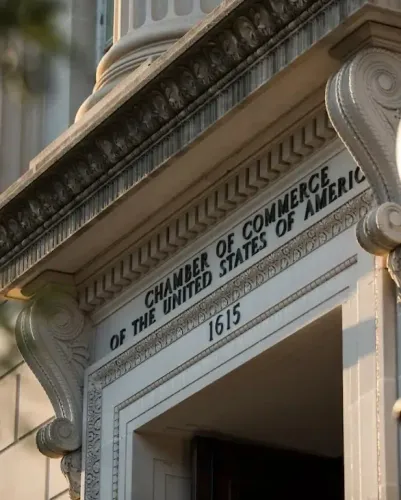
Chamber of Commerce is at the forefront of challenging this fee.
The outcome may reshape immigration policies regarding foreign labor.
Washington, Dec 20 (NationPress) A federal judge indicated that US President Donald Trump might possess extensive authority under immigration law, even as she scrutinized a legal challenge against his administration’s decision to impose a $100,000 fee on businesses applying for new H-1B visas for highly skilled foreign labor.
US District Judge Beryl Howell questioned attorneys representing the US Chamber of Commerce and other plaintiffs who are urging the court to halt the enforcement of the presidential proclamation or invalidate it entirely. The policy, introduced earlier this year, significantly increases the expenses for employers hiring foreign workers through the H-1B program.
Howell, an appointee of former President Barack Obama, frequently referenced the extensive powers that Congress has granted to the president to manage the entry of foreign nationals. She pointed to statutory language that empowers the executive branch to impose restrictions on entry and inquired whether there are any substantial limits to that power.
“Congress has handed (those powers) to the president with a red ribbon on it,” Howell stated, highlighting that the law allows the president to implement any restrictions on the entry of aliens deemed appropriate.
The judge remarked that it was “pretty hard to see limiting principles” within the relevant provisions and suggested that the Chamber of Commerce might find it more beneficial to seek legislative reforms rather than court intervention. Describing the business group as a significant political entity, Howell noted that it understands “how to engage Congress and get Congress to amend statutes.”
The proclamation mandates a $100,000 fee for each new H-1B visa application. The administration contends that the increase is essential to address what it characterizes as “systemic abuse” of the program, which has compromised US economic and national security interests.
Zachary Schauf, an attorney at Jenner & Block representing the plaintiffs, countered that the president’s authority has never been used to impose such a fee. He argued that this action effectively regulates domestic employment, which he believes lies outside the president’s unilateral powers.
Justice Department attorney Tiberius Davis defended the policy, asserting that exemptions for certain foreign nationals already residing in the United States demonstrate that the proclamation does not negate the H-1B program itself. He claimed that the fee acts as a restriction on entry, which Congress has permitted, rather than a rewrite of immigration law.
Howell also raised the question of whether the Chamber has the standing to sue, suggesting that nonprofit organizations and other entities not subject to the H-1B cap might have “more clear standing.” The Chamber’s lawsuit is one of several challenging the new fee.
The H-1B program enables US employers to recruit foreign workers in specialty occupations and is heavily utilized by the technology sector. It grants 65,000 visas annually, along with an additional 20,000 visas for workers with advanced degrees from US universities. Before the proclamation, total H-1B-related fees generally ranged from approximately $2,000 to $5,000.
Trump has claimed that the program has been exploited by employers seeking lower labor costs and has mandated enhanced scrutiny of H-1B applicants, while proposing modifications that would prioritize higher-skilled and better-compensated workers.
Point of View
I believe this unfolding legal challenge reflects the complexities of immigration policy in the United States. The balance of power between the executive branch and Congress regarding immigration control is fundamental. The potential impact of the H-1B fee on businesses and skilled labor must be evaluated with careful consideration of its broader economic implications.
NationPress
19 Sept 2026
Frequently Asked Questions
What is the H-1B program?
The H-1B program allows U.S. employers to hire foreign workers in specialty occupations, providing 65,000 visas annually, plus 20,000 additional visas for workers with advanced degrees from U.S. universities.
Why was the $100,000 fee imposed?
The fee was introduced to address what the administration describes as systemic abuse of the H-1B program, which has purportedly undermined U.S. economic and national security interests.
What are the implications of this legal challenge?
The outcome could significantly affect the landscape of foreign labor in the U.S., potentially influencing future immigration policies and visa regulations.
Who is challenging the fee?
The U.S. Chamber of Commerce and several other plaintiffs are challenging the fee in court, seeking to block its enforcement.
What is the judge's stance on the president's authority?
U.S. District Judge Beryl Howell acknowledged the broad powers Congress has granted to the president regarding immigration but expressed skepticism about the legitimacy of such a fee.