India commits €7 million to Elettra 2.0 synchrotron project in Italy
Synopsis
India is deepening one of its most consequential — and least publicised — international science partnerships. With a €7 million commitment to Italy's Elettra 2.0 synchrotron, India is not just funding new beamlines; it is cementing its position as the second-largest user of a world-class research facility, building on 25 years of uninterrupted scientific engagement.
Key Takeaways
India has committed over €7 million to the Elettra 2.0 synchrotron programme in Trieste, Italy , announced on 13 November 2025 .
Investment will be disbursed over five years beginning 2026-27 .
India is the second-largest user of Elettra after Italy, with over 1,100 experimental proposals submitted by Indian research groups.
Existing India-centric beamlines XRD2 and XPRESS , built with a ₹22 crore DST contribution, will be decommissioned and replaced by two upgraded beamlines.
Approximately 50–60 Indian scientists visit Trieste annually to conduct research at the facility.
A Letter of Intent has already been signed between DST and Elettra Sincrotrone Trieste for the redevelopment.
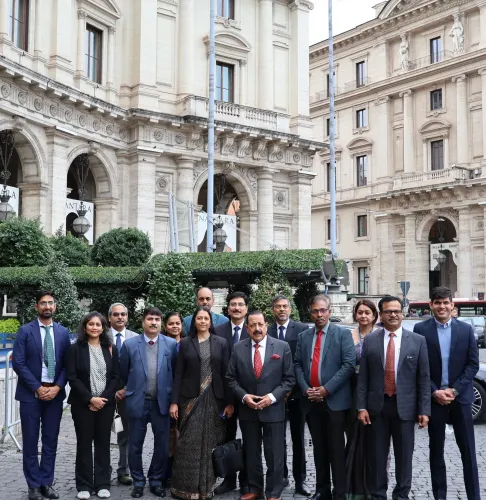
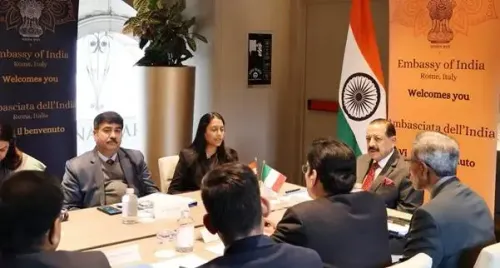
Union Minister of State for Science & Technology and Earth Sciences Dr. Jitendra Singh on 13 November 2025 announced that India has committed over €7 million as a co-partner in the Elettra 2.0 programme at Elettra Sincrotrone Trieste, Italy, for the development of next-generation synchrotron beamlines. The investment, to be disbursed over five years beginning 2026-27, marks a significant new chapter in the longstanding scientific partnership between India and Italy.
Key Developments
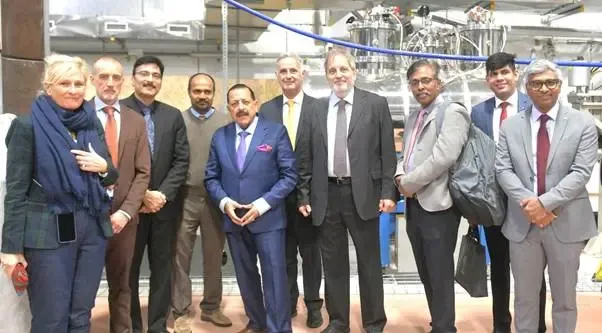
Dr. Singh made the announcement during an official visit to the Elettra Sincrotrone Trieste facility. According to an official statement from the Ministry of Science & Technology, India's participation will fund advanced research infrastructure and strengthen human resource capacity in cutting-edge scientific disciplines including chemistry, physics, advanced materials, and structural biology.
Notably, India is currently the second-largest user of Elettra after Italy — a reflection of the Indian scientific community's sustained engagement with the facility over more than two decades.
India's Deep Scientific Roots at Elettra
India's association with the Trieste facility stretches back to 1998, when Indian scientists first began conducting research experiments there. Over the years, Indian research groups have submitted over 1,100 experimental proposals to Elettra, placing India second globally in proposals submitted — behind Italy's 54,140 proposals and ahead of France's 1,098.
The Department of Science and Technology (DST) had earlier co-funded two dedicated India-centric beamlines — XRD2 and XPRESS — contributing approximately ₹22 crore alongside the Italian side. Since their commissioning, these beamlines have been utilised by roughly 50–60 Indian scientists visiting Trieste annually.
What Changes Under Elettra 2.0
Under the upgraded Elettra 2.0 programme, the existing XRD2 and Xpress beamlines will be decommissioned and replaced by two new beamlines with significantly enhanced capabilities. A Letter of Intent (LoI) between DST and the Italian facility has already been signed to formalise India's participation in this redevelopment.
The EPOC 2025–2027 framework also includes a proposed allocation of ₹1.5 crore over three years to support Indian researchers in conducting experiments at the upgraded facility.
What This Means for Indian Science
The enhanced beamlines are expected to open new frontiers for Indian researchers in materials science, structural biology, and physics — areas with direct implications for pharmaceutical development, semiconductor research, and clean energy. The upgrade consolidates India's status as a preferred international partner for large-scale scientific infrastructure projects.
With disbursements set to begin in 2026-27, the focus will now shift to translating financial commitment into accelerated research output and expanded access for Indian institutions beyond the current cohort of regular users.
Point of View
But it reflects a quietly consistent strategy of embedding Indian science into global research infrastructure rather than building isolated domestic facilities. The fact that India is already Elettra's second-largest user — ahead of France — after 25 years of engagement suggests this is not performative diplomacy but functional scientific investment. The real question is whether DST's access frameworks are keeping pace: with 50–60 scientists visiting annually from a country of 1.4 billion researchers, the utilisation pipeline looks underleveraged. Scaling researcher access, not just financial contribution, should be the benchmark for the next phase.
NationPress
14 Nov 2026
Frequently Asked Questions
What is the Elettra 2.0 programme and why is India investing in it?
Elettra 2.0 is an upgrade programme at the Elettra Sincrotrone Trieste synchrotron facility in Italy, aimed at building next-generation beamlines for advanced scientific research. India is investing over €7 million as a co-partner because it has been a major user of the facility since 1998 and seeks to maintain and expand dedicated research infrastructure for Indian scientists.
How much has India committed and over what period?
India has committed over €7 million to the Elettra 2.0 programme, to be disbursed over five years beginning 2026-27. The Department of Science and Technology (DST) has already signed a Letter of Intent with the Italian facility to formalise participation.
What will happen to the existing India-centric beamlines at Elettra?
The existing XRD2 and Xpress beamlines, which were jointly funded by DST with a contribution of approximately ₹22 crore, will be decommissioned under the Elettra 2.0 upgrade. They will be replaced by two new beamlines with significantly enhanced capabilities.
How significant is India's engagement with the Elettra facility?
India is the second-largest user of Elettra after Italy. Indian research groups have submitted over 1,100 experimental proposals, placing India ahead of France in total proposals. Around 50–60 Indian scientists visit the Trieste facility every year to conduct experiments.
Which areas of science will benefit from the upgraded Elettra beamlines?
The upgraded beamlines are expected to advance research in chemistry, physics, advanced materials, structural biology, and related scientific fields. These areas have direct applications in pharmaceuticals, semiconductor research, and clean energy development.