Dr. Jitendra Singh Highlights India-Spain Ties on Astrophysics
Synopsis
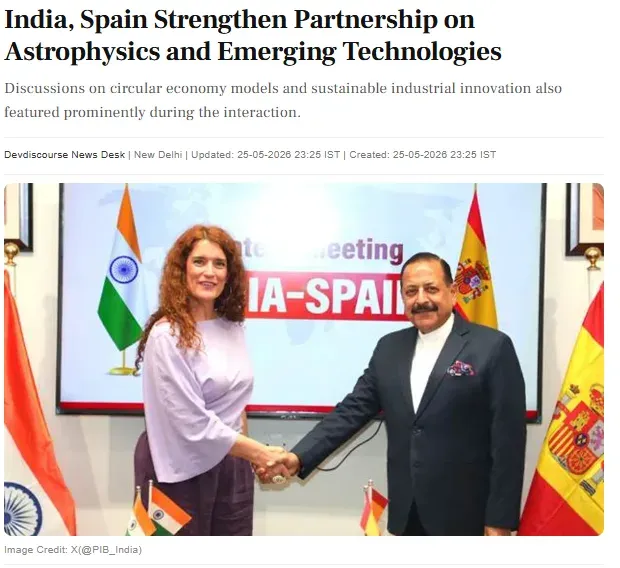
Union Science Minister Dr. Jitendra Singh has spotlighted the strengthening of India-Spain bilateral ties in astrophysics and emerging technologies, building on a formal cooperation agreement in place since the early 2000s and India's wider strategy of targeted science partnerships with EU member states.
Key Takeaways
Jitendra Singh , Union Minister of State (Independent Charge) for Science and Technology, highlighted India-Spain cooperation in astrophysics and emerging technologies on 26 May 2026 .
India and Spain have maintained a formal Science and Technology Cooperation Agreement since the early 2000s, reviewed periodically through joint committee meetings.
Astrophysics is a key focus area, with Spain hosting world-class observatories that could give Indian researchers access to advanced facilities.
Emerging technologies — including artificial intelligence, quantum computing, and clean energy — form the second pillar of the bilateral agenda.
The partnership fits India's broader strategy of building targeted bilateral science and technology alliances with individual EU member states .
Follow-up joint calls for proposals between India's Department of Science and Technology and Spanish counterparts are the immediate next step to watch.
Union Science and Technology Minister Dr. Jitendra Singh on Tuesday, 26 May 2026 highlighted the strengthening of bilateral ties between India and Spain in the domains of astrophysics and emerging technologies, sharing coverage of the development on his official X account.
Context
The post shared by Dr. Jitendra Singh draws attention to deepening science and technology cooperation between India and Spain, two countries that have maintained a formal Science and Technology Cooperation Agreement since the early 2000s. The agreement has been periodically reviewed through joint committee meetings, providing an institutional backbone for collaborative research. The current focus on astrophysics and emerging technologies marks a more targeted evolution of that relationship.
India has in recent years pursued sharply focused bilateral technology partnerships with individual European Union member states, seeking access to advanced instrumentation, joint observatory projects, and co-development opportunities in frontier technology sectors. Spain, with its established presence in astronomy and high-technology research, represents a natural partner in this strategy.
Policy Backdrop
India's Department of Science and Technology has been the nodal agency for executing bilateral S&T agreements, and its Spanish counterpart has been an active participant in joint research calls. These bilateral engagements complement larger multilateral frameworks, including India-EU science and innovation partnerships, by allowing more granular, project-level collaboration.
Astrophysics has emerged as a significant area of India's international scientific outreach, with the country operating and planning major observational facilities. Collaboration with Spain — home to world-class observatories, including those on the Canary Islands — offers Indian researchers access to advanced telescopic infrastructure and shared data pipelines. Emerging technologies, spanning artificial intelligence, quantum computing, and clean energy, form the second pillar of the bilateral agenda.
Stakeholders and Impact
The primary beneficiaries of a stronger India-Spain science partnership are researchers and institutions in astrophysics and frontier technology fields in both countries. Indian universities, national laboratories, and science agencies stand to gain access to European research networks, co-authorship opportunities, and joint funding mechanisms.
For Spain, deeper ties with India offer a growing market for high-technology collaboration and a scientifically active partner in the Global South. Industry stakeholders in emerging technology sectors — from space-tech startups to renewable energy firms — could also benefit as the partnership matures beyond pure academia into applied research and commercialisation.
What's Next
Observers will watch for follow-up joint calls for proposals or working-group meetings between India's Department of Science and Technology and its Spanish counterparts, particularly on shared astrophysics facilities and co-funded research programmes. The ministerial attention signalled by Dr. Jitendra Singh's post suggests the partnership is being actively pushed at the political level, which typically accelerates bureaucratic and institutional follow-through.
If the current momentum translates into concrete agreements — such as joint observatory access protocols or co-development mandates in emerging technologies — India-Spain scientific ties could serve as a template for similar targeted bilateral engagements with other EU member states, reinforcing India's broader strategy of building a diversified web of science and technology alliances across Europe.
Point of View
Not just through large multilateral forums. The focus on astrophysics is strategically astute: it pairs India's growing observational infrastructure ambitions with Spain's established telescope networks, creating a complementary rather than competitive dynamic. Framing emerging technologies alongside astrophysics in a single bilateral narrative also reflects a deliberate effort to broaden the partnership's commercial and industrial relevance beyond pure academia. Taken together, this positions India-Spain S&T cooperation as a potential model for how New Delhi engages individual EU capitals on science diplomacy.
NationPress
11 Oct 2026
Frequently Asked Questions
What is the India-Spain science and technology partnership about?
India and Spain have a formal Science and Technology Cooperation Agreement that covers joint research in areas including astrophysics and emerging technologies such as artificial intelligence and renewable energy. The partnership is executed primarily through India's Department of Science and Technology and its Spanish counterparts.
What did Dr. Jitendra Singh say about India-Spain cooperation?
Dr. Jitendra Singh shared coverage highlighting that India and Spain are strengthening their partnership in astrophysics and emerging technologies, signalling active ministerial interest in deepening bilateral science ties.
Why is Spain an important science partner for India?
Spain hosts world-class astronomical observatories, including those on the Canary Islands, and has strong capabilities in renewable energy and high-technology research, making it a complementary partner for India's growing scientific and technological ambitions.
How does the India-Spain science deal fit into India's broader EU strategy?
India pursues targeted bilateral science partnerships with individual EU member states to access advanced instrumentation and joint research opportunities, complementing larger India-EU multilateral frameworks. The Spain partnership is one such focused bilateral engagement.
What are the next steps in India-Spain science cooperation?
Analysts expect follow-up joint calls for research proposals and working-group meetings between India's Department of Science and Technology and Spanish agencies, particularly on shared astrophysics facilities and co-funded emerging technology programmes.