Jitendra Singh meets Spain S&T chief on astrophysics tie-up
Synopsis
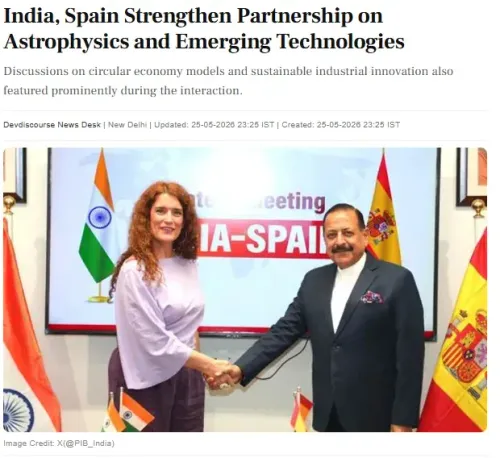
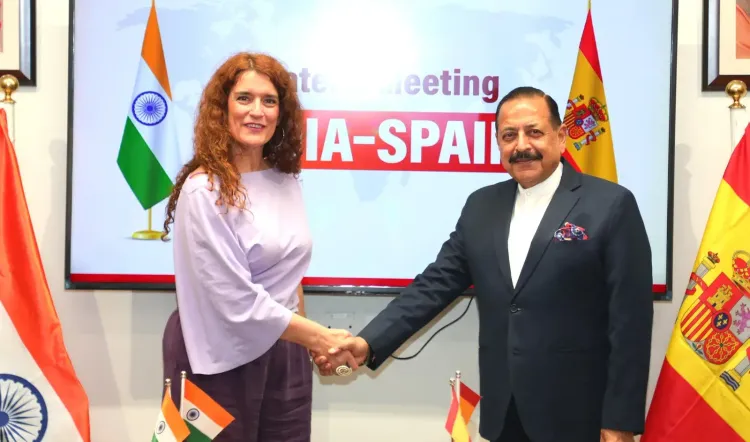
Union Science and Technology Minister Dr. Jitendra Singh met Spain's Secretary General Dr. Eva Ortega-Paíno and a high-level delegation on 25 May 2026. Talks focused on astrophysics collaboration and expanding India-Spain S&T ties to include startups, industry and research institutions under the bilateral cooperative framework.
Key Takeaways
Jitendra Singh hosted Spain's Secretary General for Science Dr.
Eva Ortega-Paíno and a high-level delegation on 25 May 2026 .
Discussions centred on astrophysics collaboration as a key new area of India-Spain science cooperation.
Both sides agreed to explore new thematic areas for startups, industry, innovators and research institutions under the bilateral framework.
The India-Spain Programme of Cooperation in Science and Technology has been operational since the mid-2000s, covering renewable energy, biotechnology and space research.
The meeting aligns with India's policy of internationalising its innovation ecosystem by mandating private-sector participation in bilateral S&T agreements.
Next steps include potential issuance of a joint call for proposals and possible new working groups on astrophysics infrastructure.
Union Science and Technology Minister Dr. Jitendra Singh met Dr. Eva Ortega-Paíno, Secretary General of Spain's Ministry of Science, Innovation and Universities, on Monday, 25 May 2026, along with a high-level Spanish delegation, to advance bilateral cooperation in science, technology and innovation.
Context
The discussions centred on astrophysics collaboration and the broader strengthening of India-Spain ties in science and technology. Both sides acknowledged the long-standing bilateral framework that has evolved significantly over the years. The meeting also explored new thematic areas for participation of startups, industry, innovators and research institutions under the India-Spain collaborative framework.
Dr. Jitendra Singh, who holds independent charge of the Ministries of Science and Technology and Earth Sciences and also serves as Minister of State in the Prime Minister's Office, has been at the forefront of expanding India's network of international S&T partnerships. The visit by the Spanish delegation signals renewed momentum in a relationship that spans multiple scientific domains.
Policy Backdrop
India and Spain have maintained a bilateral Programme of Cooperation in Science and Technology since the mid-2000s, which has funded periodic joint research calls and institutional exchanges. The programme covers domains ranging from renewable energy and biotechnology to space research, making astrophysics a natural extension of existing collaboration.
India's successive Science, Technology and Innovation Policy frameworks have increasingly emphasised internationalising the domestic innovation ecosystem. A defining feature of recent bilateral engagements has been the explicit mandate to draw in private-sector actors — startups, industry partners and independent innovators — alongside traditional research institutions, moving beyond purely academic exchanges.
Stakeholders and Impact
For Indian research institutions, deeper astrophysics collaboration with Spain opens access to European observational infrastructure and joint funding mechanisms. Indian startups and innovators stand to benefit from new thematic areas identified under the bilateral framework, potentially gaining pathways into European Union-linked science programmes.
Spain, as a European Union member with advanced capabilities in space and astrophysics research, brings complementary strengths. The inclusion of industry and startups on both sides reflects a shared policy preference for translating research cooperation into applied and commercial outcomes.
What's Next
Attention will now turn to whether the meeting produces a formal joint call for proposals in astrophysics or leads to the constitution of new working groups under the bilateral framework. The two sides have agreed to explore new thematic areas, suggesting structured follow-up mechanisms are under discussion.
If formalised, expanded startup and industry participation under the India-Spain framework could serve as a template for similar bilateral arrangements with other European Union partners, reinforcing India's strategy of building a diversified international science and innovation network.
Point of View
Not merely accumulate institutional MOUs. For Spain, the engagement offers a channel to deepen EU-India science linkages at a time when both sides are exploring broader technology partnerships. How quickly a formal joint call for proposals materialises will be the real test of whether this meeting produces durable outcomes.
NationPress
9 Oct 2026
Frequently Asked Questions
What did Dr. Jitendra Singh and Spain's science delegation discuss?
The two sides primarily discussed astrophysics collaboration and the broader strengthening of India-Spain cooperation in science, technology and innovation, including new thematic areas for startups, industry and research institutions.
Who is Dr. Eva Ortega-Paíno?
Dr. Eva Ortega-Paíno is the Secretary General of Spain's Ministry of Science, Innovation and Universities, who led a high-level Spanish delegation to meet Dr. Jitendra Singh on 25 May 2026.
What is the India-Spain science and technology agreement?
India and Spain have maintained a bilateral Programme of Cooperation in Science and Technology since the mid-2000s, funding joint research calls and institutional exchanges across domains including renewable energy, biotechnology and space research.
Why is astrophysics a focus of India-Spain cooperation?
Astrophysics represents a natural extension of the existing bilateral framework, given Spain's advanced capabilities in space and observational research within the European Union and India's growing investments in astronomy infrastructure.
How does this meeting fit into India's broader science diplomacy?
It aligns with India's Science, Technology and Innovation Policy objective of internationalising its innovation ecosystem by engaging European partners and mandating participation of startups and industry — not just academic institutions — in bilateral S&T frameworks.