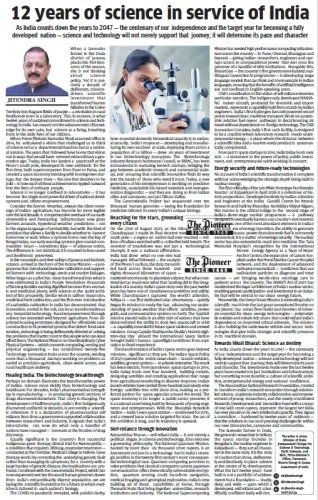
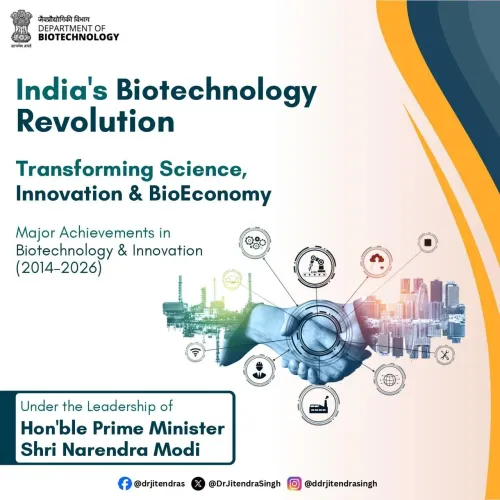
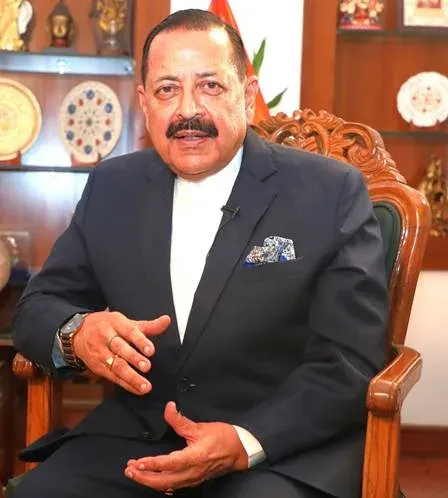
Dr. Jitendra Singh marks 12 years of science policy gains under Modi
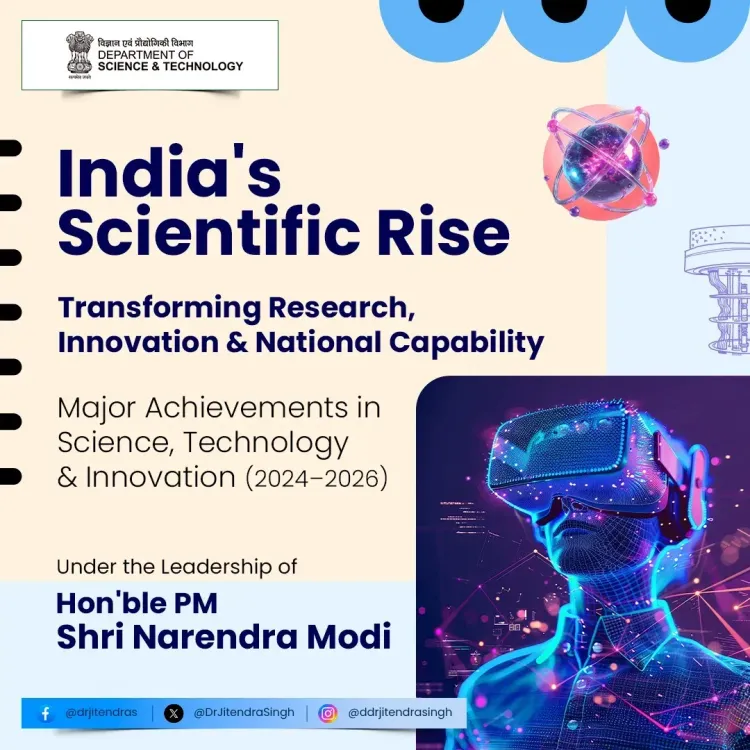
Synopsis
Union Science and Technology Minister Dr. Jitendra Singh marked 12 years of the Modi government on 31 May 2026, calling the period a 'quantum jump' in India's scientific capabilities and citing advances in indigenous technology, manufacturing and public-private collaboration as drivers of the Viksit Bharat vision.
Key Takeaways
Jitendra Singh posted on 31 May 2026 marking 12 years of the Modi government's science and technology agenda.
The minister described the period as a 'quantum jump,' citing research, indigenous technologies, manufacturing and employment generation.
The Atmanirbhar Bharat campaign (launched 2020 ) and the Viksit Bharat vision (target year 2047 ) were both invoked as policy anchors.
Key institutions including DRDO , ISRO and CSIR have received successive budget increases alongside production-linked incentive schemes for electronics and semiconductors.
The post highlights deeper public-private collaboration as a defining feature of India's evolving science governance model.
The next Union Budget and any new missions in quantum computing or semiconductor fabrication will be closely watched as indicators of continued momentum.
Union Science and Technology Minister Dr. Jitendra Singh on Sunday, 31 May 2026 took to X to mark what he called '12 years of quantum jump' in India's scientific progress under Prime Minister Narendra Modi, citing advances in research, indigenous technology, manufacturing and employment as pillars of the country's evolving science vision.
Context
The post, tagged #12YearsOfRiseInScience, marks the completion of 12 years of the Modi government — which assumed office in May 2014 — and frames the period as a decisive shift in how India approaches sovereign scientific capability. Dr. Singh wrote that 'strong scientific nations are built through vision, policy and sustained investment,' positioning the last decade-plus as a structured, policy-driven effort rather than incremental drift.
Policy Backdrop
The government's science push has unfolded across several interconnected programmes. The Make in India initiative, announced in September 2014, opened the door to domestic design and manufacturing in technology sectors, while the Science, Technology and Innovation Policy (STIP) process — initiated in 2020 — was designed to replace the 2013 framework and align research priorities with national development goals.
Successive Union Budgets have raised allocations for flagship bodies including DRDO, ISRO, CSIR and biotechnology missions. Production-linked incentive schemes for electronics and semiconductors have further tied R&D investment to strategic sectors such as defence, space and digital infrastructure. The Atmanirbhar Bharat campaign, launched in 2020, formalised the link between domestic research, manufacturing and a reduction in import dependence — a thread Dr. Singh explicitly invoked in his post.
Dr. Singh also referenced the long-term Viksit Bharat vision — a developed India by 2047 — describing science and innovation as central enablers of that goal. 'From research and indigenous technologies to manufacturing and employment generation,' he wrote, 'the journey towards an #AtmanirbharBharat is accelerating the vision of a #ViksitBharat.'
Stakeholders and Impact
The constituencies most directly addressed by this policy arc include research institutions, technology startups and manufacturing industries — all of whom have been drawn into closer collaboration with government through public-private partnership frameworks. For startups in deep-tech sectors such as quantum computing, semiconductors and space, the policy environment of the last 12 years has expanded both funding pathways and regulatory room to operate.
Employment generation, highlighted by Dr. Singh, reflects a deliberate effort to connect upstream scientific investment with downstream job creation — a political as much as a policy priority for a government that has consistently linked innovation with economic self-reliance. Deeper public-private collaboration, which the minister specifically mentioned, signals continued intent to draw private capital into areas that were historically the preserve of state-funded institutions.
What's Next
Observers will watch the next Union Budget for signals on science allocations, particularly in emerging areas such as quantum computing and semiconductor fabrication — two domains where India has announced ambitions but where the translation of policy intent into operational infrastructure remains a work in progress. Any new missions announced in those sectors will be an early indicator of whether the momentum Dr. Singh describes is being matched by fresh institutional commitment.
The 12-year milestone also sets a political baseline ahead of what will be a crowded legislative and electoral calendar, with the government likely to use science and technology achievements as a measure of developmental governance.
Point of View
He connects a mid-term campaign slogan to a longer civilisational aspiration, a rhetorical move the BJP has deployed consistently across ministries. The emphasis on public-private collaboration is notable: it signals that the government is conscious of the limits of state-led R&D and is actively courting private capital into strategic sectors. Whether the 12-year arc translates into measurable outcomes in quantum computing and semiconductors — areas where India still trails global leaders — will determine how durable this narrative proves to be.
NationPress
18 Oct 2026
Frequently Asked Questions
What is the '12 years of quantum jump' that Dr. Jitendra Singh mentioned?
Dr. Jitendra Singh used the phrase to mark 12 years of the Narendra Modi government (since May 2014) and to describe what he characterised as a significant leap in India's scientific capabilities, covering research, indigenous technology, manufacturing and employment.
What is Viksit Bharat and how does it relate to science policy?
Viksit Bharat is India's national vision to become a developed country by 2047. Science, technology and innovation are positioned as central enablers of this goal, with increased R&D investment and indigenous manufacturing forming the policy backbone.
What is the Atmanirbhar Bharat campaign?
Atmanirbhar Bharat, or Self-Reliant India, was launched in 2020 to reduce import dependence by boosting domestic research, manufacturing and technology development. It has become a cross-ministerial framework linking science policy to economic sovereignty.
Which Indian science institutions have received increased funding under the Modi government?
Institutions including DRDO, ISRO and CSIR have seen successive budget increases. The government has also introduced production-linked incentive schemes for electronics and semiconductors to align private investment with strategic R&D goals.
What should we watch for next in India's science and technology policy?
The next Union Budget's science allocation and any new government missions in quantum computing or semiconductor fabrication will be key indicators of whether India's stated ambitions in sovereign technology are being matched by fresh institutional and financial commitment.