Dr. Jitendra Singh: Modi Govt Prioritised Himalayas in 12 Years

Synopsis
Union Science and Technology Minister Dr. Jitendra Singh has highlighted the Modi government's 12-year record of prioritising previously unexplored sectors, with the Himalayas cited as a flagship example of this strategic and scientific shift in national policy.
Key Takeaways
Jitendra Singh shared an article on June 7, 2026 under #12YearsOfModiGovernment , spotlighting the government's focus on frontier sectors.
The Himalayas are specifically cited as an example of a previously under-prioritised zone now central to national policy.
The National Mission for Sustaining the Himalayan Ecosystem , launched under the 2008 National Action Plan on Climate Change , forms part of the policy lineage.
The Ministry of Science and Technology and Earth Sciences , under Dr.
Jitendra Singh's independent charge, is the primary institutional driver of this agenda.
Himalayan communities, high-altitude researchers, and border-region institutions are the key stakeholders of this policy direction.
Further budget allocations or scheme announcements for Himalayan research centres are expected in the next parliamentary session.
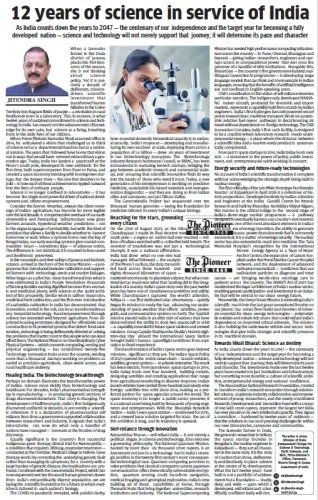
Union Science and Technology Minister Dr. Jitendra Singh on Sunday, June 7, 2026, shared an article highlighting that a defining achievement of the Modi government's 12 years in power has been its focus on previously unexplored sectors, with the Himalayas cited as a prime example of this strategic shift.
Context
The minister shared the article under the hashtag #12YearsOfModiGovernment, marking over a decade since Prime Minister Narendra Modi assumed office in May 2014. The article's central argument, as amplified by Dr. Jitendra Singh, is that the government has systematically brought frontier and ecologically sensitive zones — long neglected in national policy — into the mainstream of scientific and developmental planning.
The Himalayas, spanning India's northern border regions, are specifically identified as a sector that received renewed institutional attention under the current dispensation. This framing positions the mountain range not merely as a geographical feature but as a zone of scientific, ecological, and strategic priority.
Policy Backdrop
The roots of formal Himalayan policy predate the current government. India's National Action Plan on Climate Change (2008) included the National Mission for Sustaining the Himalayan Ecosystem, which sought to address the range's ecological vulnerabilities. The Modi government, from 2014 onwards, built on this framework while broadening the mandate to encompass high-altitude research, biotechnology, and sustainable infrastructure in border regions.
The Ministry of Science and Technology, under Dr. Jitendra Singh's independent charge, has been a key institutional vehicle for channelling scientific resources toward such frontier zones. The ministry's remit also covers Earth Sciences, a domain with direct relevance to Himalayan glaciology, seismology, and climate monitoring — areas of both scientific interest and national security concern.
Stakeholders and Impact
The communities living across the Himalayan belt — spanning states such as Jammu and Kashmir, Himachal Pradesh, Uttarakhand, Sikkim, and the northeastern states — stand as the most immediate stakeholders of any policy shift in this direction. Improved research infrastructure and ecological programmes in these regions translate into livelihood support, disaster preparedness, and connectivity for millions of residents in high-altitude and border areas.
For the scientific community, the emphasis on previously 'unexplored sectors' signals sustained funding and institutional support for niche research disciplines, from cryosphere studies to high-altitude biology. Researchers at institutions such as the Wadia Institute of Himalayan Geology and the Snow and Avalanche Study Establishment are among those whose work aligns directly with this policy orientation.
What's Next
Observers will watch the forthcoming parliamentary session and the annual Ministry of Science and Technology review for concrete announcements — whether new research centres, dedicated budget allocations, or expanded mission frameworks — that would give institutional weight to the 12-year governance narrative being articulated by the minister. The broader pattern of integrating remote ecological zones into national scientific priorities suggests further scheme-level activity is likely in the near term.
Point of View
Strategic, and electoral resonance — the minister is connecting governance achievements to a geography that matters to voters in Jammu and Kashmir, Uttarakhand, and the northeast. The framing of 'unexplored sectors' also serves a dual purpose: it implicitly critiques pre-2014 policy neglect while positioning the current government as a pioneer in frontier science. This pattern of using ministerial social media to reinforce a broader political narrative around governance anniversaries has become a standard instrument in the ruling party's communications playbook.
NationPress
21 Oct 2026
Frequently Asked Questions
What is Dr. Jitendra Singh's role in the Indian government?
Dr. Jitendra Singh is the Union Minister of State (Independent Charge) for Science and Technology and Earth Sciences, and also holds the position of Minister of State in the Prime Minister's Office and for Personnel.
What has the Modi government done for the Himalayas in 12 years?
According to the article shared by Dr. Jitendra Singh, the Modi government has prioritised the Himalayas as part of a broader push to develop previously unexplored sectors, building on existing missions such as the National Mission for Sustaining the Himalayan Ecosystem.
What is the National Mission for Sustaining the Himalayan Ecosystem?
It is a mission launched under India's National Action Plan on Climate Change in 2008, aimed at addressing the ecological vulnerabilities of the Himalayan range, and forms part of the policy lineage that the current government has built upon.
Why is the Himalayas considered a strategic priority for India?
The Himalayas are significant for their ecological sensitivity, glaciology, seismology, and proximity to India's northern borders, making them relevant to both scientific research and national security.
What can we expect next from the Ministry of Science and Technology on Himalayan policy?
Observers anticipate further announcements on Himalayan research centres, dedicated budget allocations, or expanded mission frameworks in the forthcoming parliamentary session or the ministry's annual review.