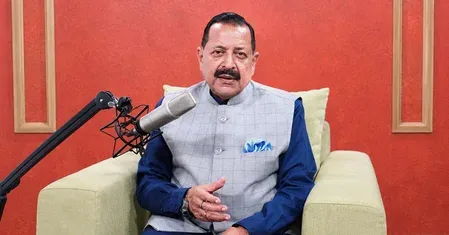
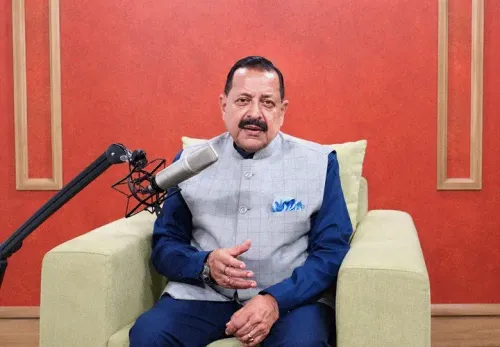
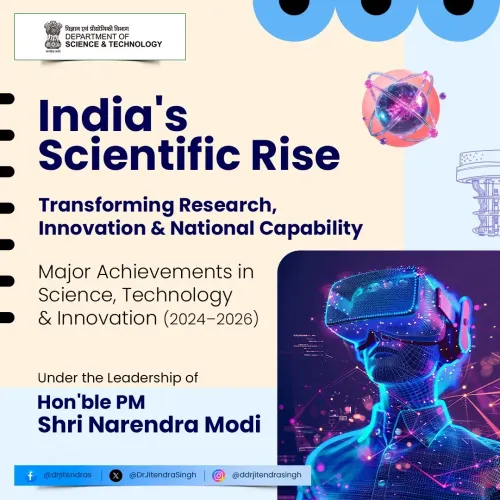
Dr. Jitendra Singh: 12 Years of Modi Govt Built Tech Foundation
Synopsis
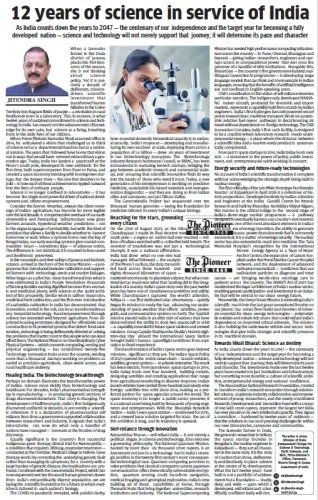
Union Science and Technology Minister Dr. Jitendra Singh on June 1, 2026, amplified an assessment crediting twelve years of Modi government policy — spanning Digital India, Startup India, and Atmanirbhar Bharat — with building a technological foundation for a developed India by 2047.
Key Takeaways
Jitendra Singh , Union Minister for Science and Technology, shared the article on June 1, 2026 under #12YearsOfModiGovernment .
The assessment covers the period since May 2014 , citing flagship programmes including Digital India (launched July 2015) and Startup India (announced January 2016).
The Atmanirbhar Bharat campaign (May 2020) and the National Education Policy (July 2020) are part of the policy lineage framed as foundational to technological self-reliance.
ISRO missions such as Chandrayaan-2 and Mangalyaan are cited as markers of indigenous capability developed during this period.
The government's long-term target is a 'Viksit Bharat' — developed India — by 2047 , with technology policy positioned as a core enabler.
Parliamentary consideration of the National Research Foundation and Science, Technology and Innovation Policy updates are expected in the 2026-27 legislative cycle.
Union Science and Technology Minister Dr. Jitendra Singh on Monday, June 1, 2026, shared an assessment arguing that technological transformation over the past twelve years under the Modi government has laid the groundwork for a developed India, amplifying coverage under the hashtag #12YearsOfModiGovernment.
Context
The post, shared from Dr. Singh's official X account, points to a feature article that frames the period since May 2014 as a sustained arc of technology-driven national development. The minister's amplification of this narrative coincides with the ruling coalition marking twelve years in office, with science and technology policy positioned as a central pillar of that record.
Dr. Jitendra Singh holds the independent charge of the Ministry of Science and Technology and the Ministry of Earth Sciences, and also serves as Minister of State in the Prime Minister's Office. His portfolio places him at the intersection of research, innovation, space science, and governance reform.
Policy Backdrop
The twelve-year period referenced spans several landmark policy interventions. The Digital India programme, launched in July 2015, set out to expand broadband connectivity, e-governance infrastructure, and digital service delivery across the country. The Startup India initiative, announced in January 2016, introduced tax incentives and institutional support to encourage technology entrepreneurship.
The Atmanirbhar Bharat campaign, launched in May 2020, extended the self-reliance framework to manufacturing and strategic technology sectors, while the National Education Policy approved in July 2020 embedded technology integration into higher education and research priorities. Together these initiatives form the policy lineage that official communications now describe as foundational to a 'Viksit Bharat' — a developed India — by 2047.
ISRO, the Indian Space Research Organisation, has also featured prominently in the government's technology narrative, with missions such as Chandrayaan-2 and Mangalyaan cited as markers of indigenous capability built over this period.
Stakeholders and Impact
The constituencies most directly implicated in this narrative include technology startups, research and academic institutions, digital-service users — estimated in the hundreds of millions — and STEM students entering a labour market increasingly shaped by digital public infrastructure. Policymakers have consistently argued that investments in digital infrastructure reduce friction for small businesses and expand financial inclusion in rural areas.
Critics and independent analysts have noted that while aggregate digital adoption metrics have improved significantly, questions around data governance, platform regulation, and equitable access to high-speed internet in remote regions remain active policy debates. The government's framing of a 'foundation for a developed India' is thus both a record of achievement and a statement of ongoing intent.
What's Next
Looking ahead, parliamentary consideration of the National Research Foundation and updates to the Science, Technology and Innovation Policy are expected in the 2026-27 budget and legislative cycle. Budget allocations for emerging technology missions — including semiconductors, artificial intelligence, and biotechnology — will serve as concrete indicators of whether the momentum described in the twelve-year assessment is being institutionalised for the next phase.
The broader trajectory points toward India seeking a larger role in global technology value chains, a goal that will require sustained public investment, regulatory clarity, and international partnerships to translate political narrative into measurable outcomes.
Point of View
Timed to consolidate the ruling coalition's identity as the architect of India's digital and scientific rise. The post connects routine ministerial communication to the larger Viksit Bharat 2047 arc, signalling that S&T policy will remain central to the government's electoral and governance brand. By anchoring the message in a curated article rather than a press release, the communication sidesteps scrutiny of specific metrics while still claiming the terrain of national transformation. The real test of this narrative will come in the 2026-27 budget, where allocations for AI, semiconductors, and the National Research Foundation will reveal whether the rhetoric is matched by institutional investment.
NationPress
16 Oct 2026
Frequently Asked Questions
What did Dr. Jitendra Singh post about 12 years of Modi government?
Dr. Jitendra Singh shared an article on June 1, 2026, arguing that technological transformation over the past twelve years under the Modi government has laid the foundation for a developed India, posting it under the hashtag #12YearsOfModiGovernment.
What are the key technology schemes launched under the Modi government since 2014?
Key schemes include Digital India (July 2015), which expanded broadband and e-governance; Startup India (January 2016), which supported tech entrepreneurship; and Atmanirbhar Bharat (May 2020), which promoted indigenous technology manufacturing.
What is Viksit Bharat 2047 and how does technology relate to it?
Viksit Bharat 2047 is the government's vision for India to become a fully developed nation by the centenary of independence. Technology policy — including digital infrastructure, space capabilities, and innovation ecosystems — is positioned as a foundational pillar of achieving that goal.
What is Dr. Jitendra Singh's role in the Indian government?
Dr. Jitendra Singh is the Union Minister of State with Independent Charge of the Ministry of Science and Technology and the Ministry of Earth Sciences. He also serves as Minister of State in the Prime Minister's Office and in the Ministry of Personnel.
What science and technology policy decisions are expected in India in 2026-27?
Parliamentary consideration of the National Research Foundation and updates to the Science, Technology and Innovation Policy are expected in the 2026-27 session. Budget allocations for AI, semiconductor, and biotechnology missions will be closely watched as indicators of policy continuity.