Dr. Jitendra Singh Highlights J&K Transformation Under Modi Govt
Synopsis
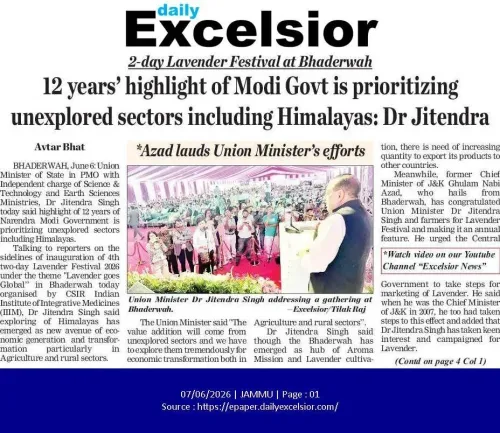
Union Minister Dr. Jitendra Singh marked twelve years of the Modi government on 7 June 2026 by asserting that Jammu and Kashmir has seen 'unprecedented transformation' since 2014, pointing to administrative mainstreaming, welfare scheme extension and infrastructure expansion following the 2019 abrogation of Article 370.
Key Takeaways
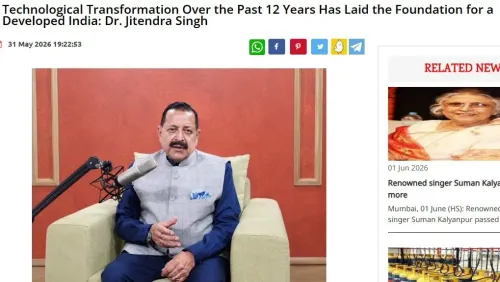
Jitendra Singh , Union Minister and Udhampur MP, posted on 7 June 2026 to mark 12 years of the Modi government, focusing on Jammu and Kashmir .
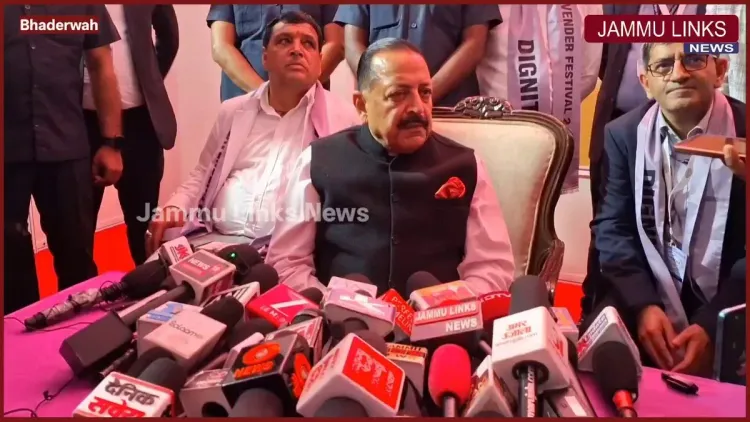
He described J&K's transformation over the past 12 years as 'unprecedented', sharing a video alongside the post.
The abrogation of Article 370 on 5 August 2019 was the pivotal policy step enabling uniform application of central laws and schemes in J&K.
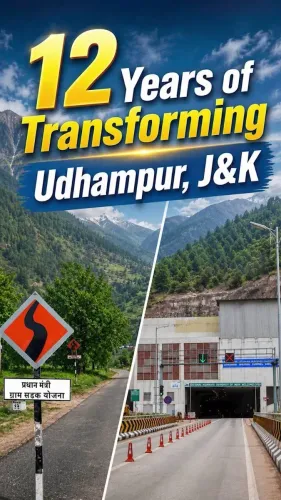
Central flagship programmes including PMGSY , PMAY and Ayushman Bharat were extended to J&K following the 2019 reorganisation .
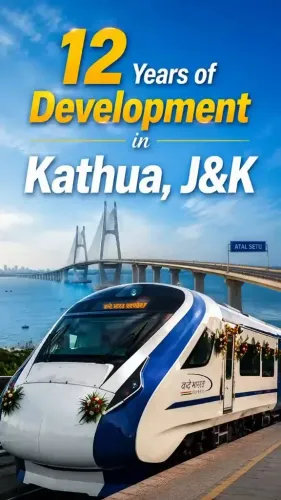
Key infrastructure projects such as the Udhampur-Srinagar-Baramulla Rail Link remain central to the government's connectivity agenda for the region.
Restoration of full statehood for Jammu and Kashmir remains an unresolved and politically active question.
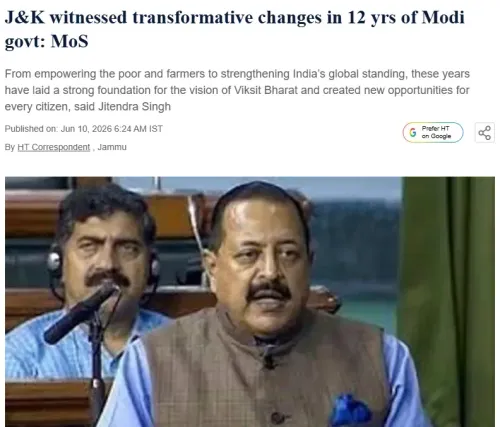
Union Science and Technology Minister Dr. Jitendra Singh on Sunday, 7 June 2026 marked twelve years of the Modi government by asserting that Jammu and Kashmir has witnessed 'an unprecedented transformation' over the past decade-plus, sharing a video on the occasion of the #12YearsOfModiGovernment anniversary.
Context
Dr. Jitendra Singh, who represents the Udhampur constituency in the Jammu region and serves as Union Minister of State (Independent Charge) for Science and Technology and Earth Sciences as well as Minister of State in the Prime Minister's Office, posted the message as part of a wider ruling-party commemoration of the government's twelfth year in office. The post, accompanied by a video, carries the hashtag marking the milestone and centres specifically on the Union Territory of Jammu and Kashmir.
Singh's post is notable for its geographic specificity: rather than cataloguing national achievements broadly, it focuses on J&K — the region his parliamentary constituency is part of and one the central government has treated as a flagship demonstration of its governance model since 2014.
Policy Backdrop
The Modi government, which assumed office in May 2014, has pursued a sustained policy of administrative mainstreaming and infrastructure expansion in Jammu and Kashmir. The most consequential single step was the abrogation of Article 370 on 5 August 2019, which ended the former state's special constitutional status and enabled the direct application of central laws and flagship welfare programmes across the region.
Following the 2019 reorganisation — which bifurcated the former state into two Union Territories, Jammu and Kashmir and Ladakh — the central government extended schemes including PMGSY (Pradhan Mantri Gram Sadak Yojana), PMAY (Pradhan Mantri Awas Yojana) and Ayushman Bharat uniformly to the territory. Infrastructure projects such as the Udhampur-Srinagar-Baramulla Rail Link (USBRL) have been among the most closely watched symbols of connectivity investment in the region.
The broader pattern reflects a deliberate policy shift: replacing region-specific autonomy arrangements with direct central oversight, accompanied by increased development spending and security consolidation.
Stakeholders and Impact
Residents of Jammu and Kashmir — spanning the Jammu division, the Kashmir Valley, and border districts — are the primary stakeholders in any assessment of governance transformation. Local businesses, investors, and the tourism sector have all been cited by the government as beneficiaries of the post-2019 administrative environment, with the tourism industry in particular registering significant visitor growth in the years following reorganisation.
Critics and opposition voices have, in contrast, raised concerns about the democratic deficit created by the prolonged absence of an elected state government and the downgrading of the region's status from a full state to a Union Territory. Both narratives continue to shape public debate around J&K's political future.
What's Next
The government's stated priorities for Jammu and Kashmir include completing the Udhampur-Srinagar-Baramulla Rail Link — one of the most complex rail engineering projects in the country — and ensuring full funding utilisation for ongoing infrastructure and welfare schemes announced in successive Union Budgets. The question of full statehood restoration for J&K remains a politically active issue that will continue to draw scrutiny from all sides of the debate.
Point of View
He is reinforcing the BJP's core governance narrative in the one region where the party's administrative record is most distinctively its own. The reference to 'unprecedented transformation' is a direct invocation of the post-Article 370 policy architecture, positioning the 2019 reorganisation as the centrepiece of a twelve-year arc rather than a standalone event. For a minister who represents a Jammu constituency, the messaging also serves a local constituency-building function, signalling continued central attention to the region. The post fits a broader pattern in which BJP leaders use milestone anniversaries to consolidate the party's ownership of the J&K narrative ahead of any future electoral or statehood-related developments.
NationPress
21 Oct 2026
Frequently Asked Questions
What did Dr. Jitendra Singh say about Jammu and Kashmir on the Modi government's 12th anniversary?
Dr. Jitendra Singh stated that Jammu and Kashmir has witnessed 'an unprecedented transformation' over the last 12 years, sharing a video to mark the #12YearsOfModiGovernment milestone on 7 June 2026.
What is Article 370 and why is it relevant to J&K's transformation?
Article 370 was a constitutional provision granting Jammu and Kashmir special status. Its abrogation on 5 August 2019 by the Modi government enabled the direct application of central laws and flagship welfare schemes across the region, which the government cites as a key driver of transformation.
What central government schemes were extended to Jammu and Kashmir after 2019?
Following the 2019 reorganisation, central schemes including PMGSY (rural roads), PMAY (housing) and Ayushman Bharat (health insurance) were extended uniformly to Jammu and Kashmir.
What is the Udhampur-Srinagar-Baramulla Rail Link?
The Udhampur-Srinagar-Baramulla Rail Link (USBRL) is a major ongoing railway project connecting Jammu and Kashmir to the national rail network; it is one of the most complex rail engineering undertakings in India and a key symbol of central government infrastructure investment in the region.
Has Jammu and Kashmir been granted full statehood again?
As of the available information, Jammu and Kashmir continues to function as a Union Territory following the 2019 reorganisation; the restoration of full statehood remains a politically active and unresolved question.