Jitendra Singh Marks 12 Years of India's Biotech Rise
Synopsis
Union Science and Technology Minister Dr. Jitendra Singh marked 12 years of India's biotechnology advances on June 8, 2026, highlighting vaccines, indigenous antibiotics, gene sequencing, and homegrown medical devices, and crediting PM Modi's BioE3 Policy and private-sector engagement for the transformation.
Key Takeaways
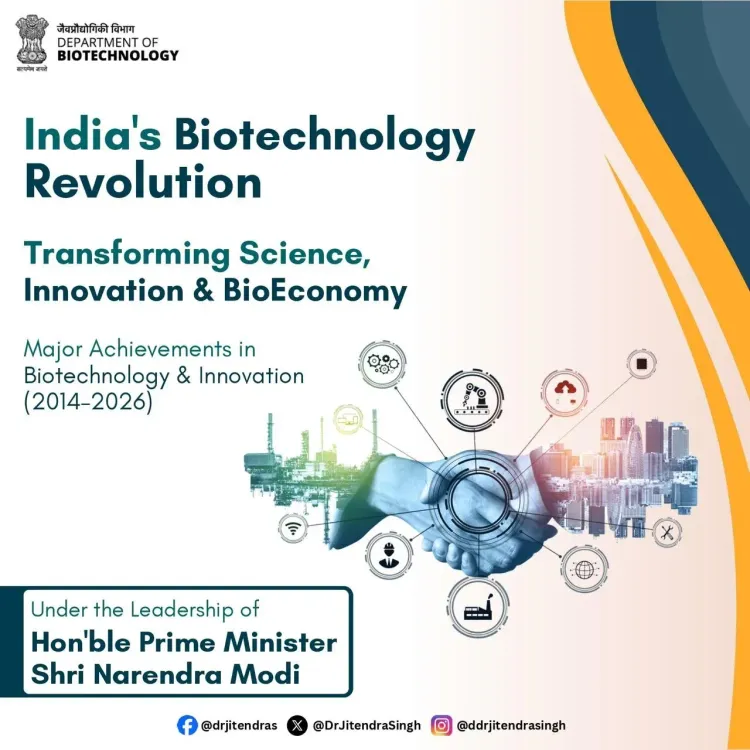
Jitendra Singh on June 8, 2026 , posted a comprehensive review of 12 years of India's biotechnology progress under the hashtag #12YearsOfRiseInScience .
Milestones cited include vaccines, indigenous antibiotics, biotech startups, gene sequencing, rare genetic disease breakthroughs, and domestically manufactured equipment such as heart valves .
The minister attributed the progress substantially to the BioE3 Policy launched by Prime Minister Narendra Modi and to sustained private-sector participation.
The Department of Biotechnology , operating under the Ministry of Science and Technology, has served as the nodal agency coordinating national biotech programmes throughout this period.
Earlier policy scaffolding — including Startup India (2016) , Make in India (2014) , and the National Biotechnology Development Strategy (2015–2020) — underpinned the sector's expansion.
Parliamentary discussion on BioE3 implementation rules and the next Union Budget 's allocation for biotechnology parks are the immediate policy events to watch.
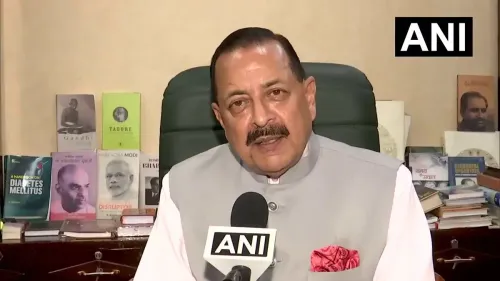
Union Science and Technology Minister Dr. Jitendra Singh on Monday, June 8, 2026, hailed 12 years of what he described as India's biotechnology revolution, citing advances in vaccines, indigenous antibiotics, gene sequencing, rare genetic disease research, and homegrown medical devices including heart valves, crediting the momentum to Prime Minister Narendra Modi's BioE3 Policy and sustained private-sector engagement.
Context
Posting under the hashtag #12YearsOfRiseInScience, Dr. Singh described the period as one that 'startled the world with India's Biotechnology Revolution by transforming research, innovation, and bioeconomy.' The minister pointed to a broad sweep of milestones — from biotech startups to indigenous equipment — calling the story 'long and punctuated with milestone after milestone.'
The post arrives as the ruling dispensation marks a political anniversary, situating scientific progress within the governance record of the past twelve years. Dr. Singh holds independent charge of the Ministry of Science and Technology and the Ministry of Earth Sciences, and also serves as Minister of State in the Prime Minister's Office.
Policy Backdrop
The BioE3 Policy — Biotechnology for Economy, Environment and Employment — was launched by Prime Minister Modi as a framework to integrate biotech research with industrial scale-up and job creation. It builds on earlier initiatives including the National Biotechnology Development Strategy (2015–2020), which expanded research infrastructure and industry linkages, and the Startup India initiative of 2016, which extended tax benefits and funding pathways to biotech entrepreneurs.
The Make in India programme, launched in 2014, provided an additional policy scaffold prioritising indigenous manufacturing of medical devices and biologics — a thread Dr. Singh explicitly picked up in his reference to domestically produced heart valves and other equipment. The nodal body coordinating these efforts, the Department of Biotechnology under the Ministry of Science and Technology, has channelled public funding into genomics, vaccine platforms and biotech parks across the country.
Stakeholders and Impact
The beneficiaries of the policy arc span a wide ecosystem: biotech startups that leveraged Startup India incentives, pharmaceutical manufacturers scaling indigenous biologics, and research institutions working on rare genetic diseases and next-generation gene sequencing. India's vaccine manufacturing capacity, stress-tested and globally recognised during the COVID-19 pandemic, is frequently cited as a flagship output of this combined public-private model.
Dr. Singh's emphasis on private-sector engagement mirrors patterns visible across other strategic sectors — space, electronics and renewable energy — where the government has progressively opened participation to industry while retaining policy direction. For patients, the domestic production of specialised medical devices such as heart valves carries direct implications for affordability and supply-chain resilience.
What's Next
Attention will now turn to parliamentary scrutiny of BioE3 implementation rules and to the allocation for biotechnology parks in the next Union Budget. Analysts tracking the sector will watch whether the policy rhetoric translates into expanded public funding lines and whether regulatory frameworks keep pace with the speed of innovation in areas such as gene therapy and synthetic biology.
As India positions itself as a global bioeconomy hub, the government's ability to sustain the public-private partnership model — and to demonstrate verifiable, independently audited outcomes — will determine whether the 'revolution' narrative holds up to international scrutiny.
Point of View
Anchoring a scientific narrative to the ruling government's twelve-year record ahead of what is likely a broader communication push. By foregrounding BioE3 and private-sector partnership, the minister is reinforcing a governance brand built on technology-led self-reliance — a frame that has proven electorally resonant across sectors from space to semiconductors. The breadth of claims, spanning vaccines to heart valves, is designed to project systemic transformation rather than isolated wins, though independent verification of the full list of milestones remains outstanding. The post signals that biotechnology will continue to be a front-line narrative in the government's science-and-economy messaging in the months ahead.
NationPress
20 Sept 2026
Frequently Asked Questions
What is the BioE3 Policy launched by PM Modi?
The BioE3 Policy — Biotechnology for Economy, Environment and Employment — is a government framework designed to integrate biotech research, industrial scale-up, and job creation. It was launched by Prime Minister Narendra Modi to give strategic direction to India's biotechnology sector and is administered by the Department of Biotechnology under the Ministry of Science and Technology.
What has India achieved in biotechnology in the last 12 years?
According to Union Minister Dr. Jitendra Singh, India's biotechnology sector has seen advances in vaccine development, indigenous antibiotic production, gene sequencing, breakthroughs in rare genetic diseases, the growth of biotech startups, and domestic manufacturing of medical equipment including heart valves, over the past 12 years.
What is the Department of Biotechnology and what does it do?
The Department of Biotechnology is the nodal government agency under India's Ministry of Science and Technology. It funds and coordinates national biotech programmes, supports research institutions, and facilitates the translation of scientific discoveries into industrial and medical applications.
How did Startup India help the biotech sector?
The Startup India initiative, launched in 2016, provided tax benefits and dedicated funding mechanisms that supported biotech entrepreneurship, enabling a new generation of companies to commercialise research in areas such as diagnostics, genomics, and biologics.
What comes next for India's biotechnology policy?
Key developments to watch include parliamentary discussion on the implementation rules for the BioE3 Policy and the allocation for biotechnology parks in the next Union Budget, both of which will determine the scale and pace of the sector's continued growth.