India's Bio-Economy to Hit $1 Trillion by 2047: Dr Jitendra Singh
Synopsis
India's bio-economy has exploded from $10 billion in 2014 to over $165 billion today — growing 220-fold in startups and targeting $1 trillion by 2047. Union Minister Dr Jitendra Singh's address at IIT Roorkee reveals a nation betting its centenary future on biology, quantum tech, and deep-sea exploration.
Key Takeaways
India's bio-economy is projected to reach $1 trillion by 2047 , placing it among the top three global bio-economies, as announced by Union Minister Dr Jitendra Singh at IIT Roorkee .
The sector grew from $10 billion in 2014 to over $165 billion today , at a ~18% annual growth rate , with an interim target of $300 billion by 2030 .
Biotech startups in India surged from ~50 to over 11,000 in the past decade, representing a 220-fold increase in the innovation ecosystem.
India's Global Innovation Index ranking improved from 81 to 39 , and R&D expenditure has more than doubled over the last ten years.
The government has committed Rs 50,000 crore via ANRF and a Rs 1 lakh crore RDI Fund to provide long-term financing for deep-tech and scientific innovation.
Major scientific milestones cited include Genome India, indigenous CAR-T cell therapy, mRNA vaccine platforms, India's first homegrown antibiotic , and the Samudrayaan deep ocean mission .
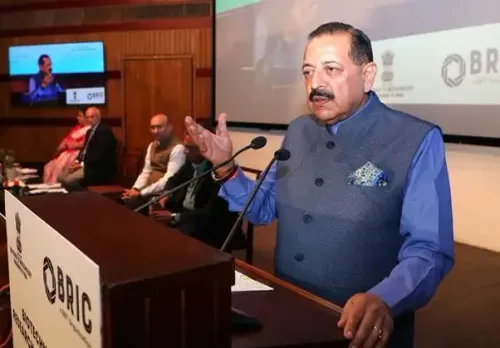
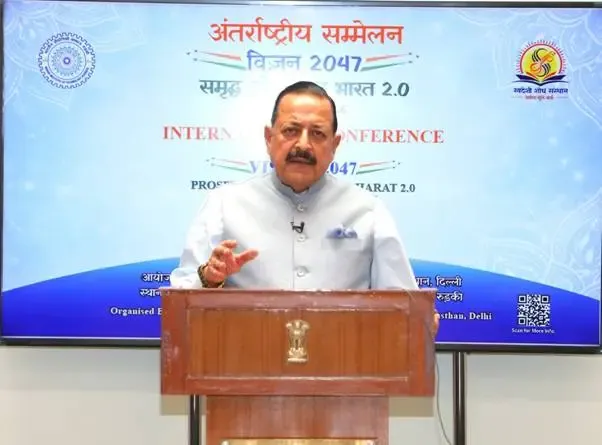
India's bio-economy is on course to become a $1 trillion powerhouse by 2047, positioning the country among the top three global bio-economies, Union Minister Dr Jitendra Singh declared on Friday, April 25 at an international conference hosted by IIT Roorkee, Uttarakhand. The minister's remarks signal a decisive shift in India's economic identity — from a services-led nation to a biology-and-innovation-driven global force. This projection comes as India accelerates investments across biotechnology, deep-tech, and quantum research.
India's Bio-Economy: From $10 Billion to $165 Billion in a Decade
Dr Jitendra Singh highlighted one of the most striking economic transformations in recent Indian history. India's bio-economy grew from just $10 billion in 2014 to over $165 billion today, clocking a compound annual growth rate of nearly 18 per cent. The government has set an interim target of $300 billion by 2030, before the ultimate goal of $1 trillion by 2047 — coinciding with India's centenary of independence.
Equally remarkable is the explosion in the startup ecosystem. The number of biotech startups surged from approximately 50 in 2014 to over 11,000 today, according to the Ministry of Science and Technology. This 220-fold increase reflects not just policy support but a generational shift in how young Indians are channelling scientific ambition into enterprise.
National Quantum Mission and Global Innovation Index Gains
The minister noted that India's technological ambitions extend well beyond biology. The National Quantum Mission has achieved key milestones ahead of schedule, placing India in the top ranks globally in critical technology domains. He described India's trajectory as advancing toward full-spectrum technological capability — from gene to qubit, from ocean depths to outer space.
India's Global Innovation Index ranking improved dramatically from 81 to 39 over recent years, a 42-place leap that reflects sustained institutional investment. Research and development expenditure has more than doubled over the past decade, signalling that science and innovation have become non-negotiable national priorities rather than aspirational footnotes in budget speeches.
Key Scientific Breakthroughs Cited by the Minister
Dr Jitendra Singh presented a series of landmark scientific advances that underpin this optimism. These include significant progress under the Genome India initiative, the development of indigenous CAR-T cell therapy, the creation of mRNA vaccine platforms, and the successful development of India's first indigenously produced antibiotic. Each of these represents not just a scientific milestone but a potential export and public health asset.
He also drew attention to the expansion of nuclear medicine facilities aimed at delivering affordable cancer care to a broader population — a critical intervention given that India accounts for a significant share of global cancer burden. Progress in deep ocean exploration through the Samudrayaan mission was also highlighted as part of India's push into frontier science.
Funding Architecture: ANRF and the RDI Fund
Backing these ambitions is a robust financial architecture. The minister referenced the Anusandhan National Research Foundation (ANRF), endowed with a corpus of Rs 50,000 crore, alongside the Research, Development and Innovation (RDI) Fund worth Rs 1 lakh crore. Both instruments are designed to provide long-term, low-cost financing for deep-tech innovation, addressing a historically chronic gap in India's R&D funding landscape.
This is a structural departure from India's past approach, where public R&D spending as a percentage of GDP consistently lagged behind China, South Korea, and Israel. Critics have long argued that India's innovation potential was throttled by underfunding — the ANRF and RDI Fund are direct policy responses to that critique.
Why This Matters: The Bigger Picture
India's bio-economy ambitions arrive at a pivotal geopolitical moment. As global supply chains for pharmaceuticals, agricultural biotech, and medical devices are being restructured away from overdependence on China, India is positioning itself as the credible alternative. The 21st century as India's century, as Dr Singh framed it, is not merely rhetorical — it is backed by a convergence of demographic dividend, policy reform, and institutional capacity-building that few nations can replicate at this scale.
The next critical milestones to watch include India's performance in the 2025 Global Innovation Index, progress updates on the National Quantum Mission, and the government's mid-term review of the $300 billion bio-economy target by 2030. How India translates these projections into ground-level outcomes — particularly in rural healthcare, agricultural productivity, and export competitiveness — will determine whether 2047 ambitions remain aspirational or become transformational.
Point of View
But the real test lies in execution — not projection. While the leap from 50 to 11,000 biotech startups is extraordinary, India's R&D-to-GDP ratio still trails global innovation leaders, and the gap between policy announcements and ground-level outcomes has historically been wide. The ANRF and RDI Fund are structurally sound responses to chronic underfunding, but their impact will depend entirely on governance quality and insulation from political interference. If India can convert this momentum into export dominance in biologics, quantum hardware, and agri-biotech, the $1 trillion target by 2047 is not just achievable — it could redefine the global economic order.
NationPress
21 Sept 2026
Frequently Asked Questions
What is India's bio-economy target by 2047?
India's bio-economy is projected to reach $1 trillion by 2047 , making it one of the top three bio-economies in the world. Union Minister Dr Jitendra Singh announced this at an international conference at IIT Roorkee on April 25, 2025.
How much has India's bio-economy grown since 2014?
India's bio-economy grew from $10 billion in 2014 to over $165 billion today , expanding at nearly 18 per cent annually. The government has set an interim target of $300 billion by 2030.
How many biotech startups does India have in 2024?
India now has over 11,000 biotech startups , up from approximately 50 in 2014 — a 220-fold increase in a decade. This growth reflects strong policy support and a rapidly expanding innovation ecosystem.
What is the Anusandhan National Research Foundation (ANRF)?
The Anusandhan National Research Foundation (ANRF) is a government-backed body with a corpus of Rs 50,000 crore designed to fund long-term scientific research in India. It works alongside the Rs 1 lakh crore RDI Fund to finance deep-tech innovation.
What is India's current Global Innovation Index ranking?
India's Global Innovation Index ranking has improved from 81 to 39 , reflecting a significant leap in research output, startup activity, and institutional capacity. R&D expenditure has also more than doubled over the past decade.