Anurag Thakur: India fastest growing and poverty reducer
Synopsis
BJP MP Anurag Thakur claims India is now both the fastest-growing major economy and the fastest poverty reducer, arguing that anti-corruption welfare reforms — anchored in DBT and Jan Dhan — have redirected funds once lost to scams into genuine public benefit.
Key Takeaways
Anurag Thakur posted on 5 November 2026 asserting India is simultaneously the fastest-growing economy and fastest poverty reducer.
He contrasted current welfare spending with earlier periods when funds were allegedly lost to scams and corruption.
Direct Benefit Transfer (DBT) , expanded after 2014 and linked to Aadhaar, was the core mechanism designed to eliminate welfare leakages.
Pradhan Mantri Jan Dhan Yojana (2014) created bank accounts for the unbanked, enabling DBT at scale.
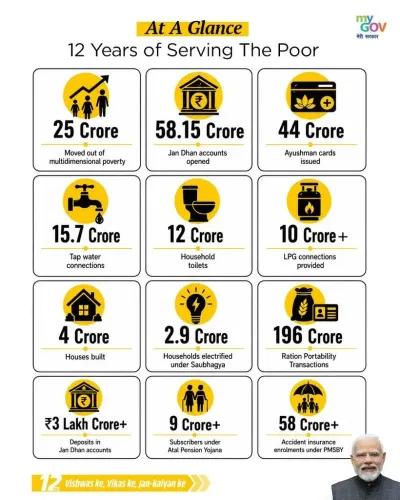
NITI Aayog's Multidimensional Poverty Index reports (2023) documented a decline in India's poverty headcount on composite health, education, and living-standard metrics.
The 'fastest poverty reducer' ranking is metric- and time-window-dependent; the broader poverty-decline trend on MPI is documented, though the precise superlative requires current cross-country comparison data.
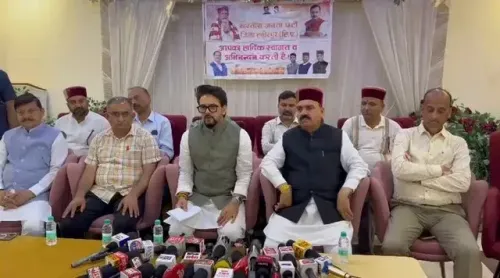
India's economy now wears two badges at once — fastest growing major economy and fastest poverty reducer — and BJP MP Anurag Thakur wants that dual achievement front and centre in the national conversation. On Thursday, 5 November 2026, the former Union Minister posted on X, drawing a sharp contrast between the welfare-fund leakages of earlier governments and what he called a new era of direct, corruption-free development spending.
Thakur wrote in Hindi: 'आज भारत वो देश है जो Fastest Growing भी है और Fastest Poverty Reducer भी है।' — 'Today India is the country that is both the fastest growing and the fastest poverty reducer.' He added that money which earlier 'went as an offering to scams' is now flowing into development and public-welfare schemes.
The leakage problem DBT was built to solve
The claim about redirected funds points directly to the architecture of welfare delivery that was overhauled after 2014. The expansion of Aadhaar-linked Direct Benefit Transfer (DBT) was designed to cut out the chain of middlemen through which subsidies had historically been siphoned. By routing payments straight into beneficiaries' bank accounts, the government argued that every rupee saved from diversion could be deployed for actual development. Pradhan Mantri Jan Dhan Yojana, launched in 2014, created the financial plumbing — zero-balance bank accounts at scale — that made DBT operationally possible for hundreds of millions of previously unbanked households.
What NITI Aayog's poverty data actually shows
The 'fastest poverty reducer' claim draws its ammunition from NITI Aayog's Multidimensional Poverty Index (MPI) reports, which track deprivation across health, education, and living standards — not just income alone. Reports published in 2023 documented a sharp decline in India's poverty headcount on this composite measure, citing improvements in sanitation access, cooking fuel, nutrition, and schooling simultaneously. The MPI framing allows the government to show progress on a broader canvas than a single income-poverty line, reinforcing the narrative that welfare-scheme efficiency is translating into tangible quality-of-life gains.
Growth plus equity: the political argument Thakur is making
Thakur's post is a compressed version of a larger governing argument: that high GDP growth and poverty reduction are no longer two separate policy tracks but are running in parallel, powered by the same anti-leakage reforms. The messaging deliberately distinguishes the current administration from earlier periods by anchoring the contrast on the word 'scam' — a reference widely understood to invoke the high-profile corruption controversies of the pre-2014 era. It is a consistent strand in BJP's governance communication, linking technology-driven welfare delivery to both economic efficiency and moral accountability.
The specific ranking of India as the 'fastest poverty reducer' depends on the metric and time window chosen, and independent verification of that precise superlative requires the latest cross-country data. What the institutional record does confirm is a documented decline in multidimensional poverty indicators over the period in question — and a structural shift in how welfare funds reach the poor.
India's growth story is no longer just a GDP headline. It is increasingly being argued — and contested — on the ground of who the growth is actually reaching.
Point of View
The 'fastest' superlative remains politically loaded: rival parties and independent economists periodically challenge the methodology, ensuring this remains a live front in India's economic-policy discourse. As elections and budget cycles approach, expect the poverty-reduction data to be deployed more aggressively on both sides of the aisle.
NationPress
5 Nov 2026
Frequently Asked Questions
Is India really the fastest poverty reducer in the world?
The claim is based primarily on NITI Aayog's Multidimensional Poverty Index data, which showed a sharp decline in India's poverty headcount on composite indicators by 2023. Whether India ranks first globally depends on the specific metric and time period used; the MPI decline is documented, but the precise superlative requires current cross-country data for full verification.
What is Direct Benefit Transfer and how does it reduce corruption?
Direct Benefit Transfer (DBT) routes government subsidies and welfare payments directly into beneficiaries' Aadhaar-linked bank accounts, eliminating the middlemen and administrative layers through which funds were historically diverted. It was significantly expanded after 2014 as a central anti-leakage tool.
What is the NITI Aayog Multidimensional Poverty Index?
NITI Aayog's Multidimensional Poverty Index (MPI) measures poverty across three dimensions — health, education, and living standards — using ten indicators including nutrition, sanitation, cooking fuel, and schooling. It offers a broader picture of deprivation than a single income-poverty line.
What is Pradhan Mantri Jan Dhan Yojana and why does it matter for poverty reduction?
Pradhan Mantri Jan Dhan Yojana, launched in 2014, created zero-balance bank accounts for previously unbanked Indians, providing the financial infrastructure necessary for DBT to function at scale and ensuring welfare funds reach the intended beneficiaries directly.
What was Anurag Thakur referring to when he mentioned 'scams' swallowing funds?
Thakur's reference to money being 'offered to scams' is widely understood as an allusion to the high-profile corruption controversies associated with the pre-2014 UPA government era, a contrast the BJP regularly uses to frame its governance reforms on welfare delivery.