Odisha Govt Sends 26 MT Cattle Feed to Flood-Hit Ganjam
Synopsis
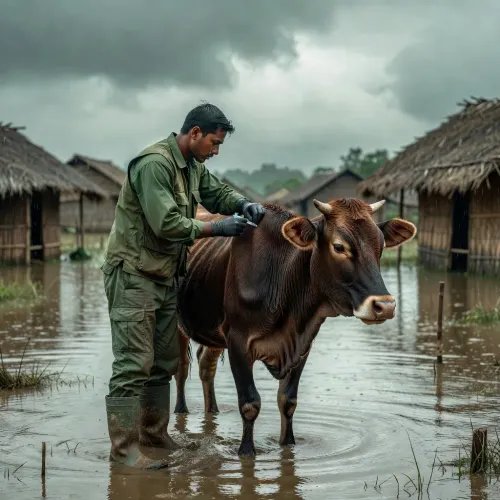
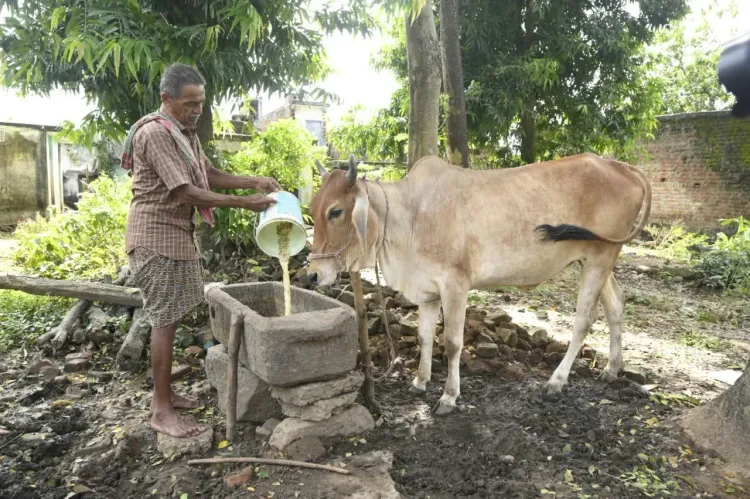
The Odisha government has distributed 26 metric tonnes of cattle feed in Dharakote block of Ganjam district to support flood-hit livestock and provide relief to animal rearers, extending its disaster response framework explicitly to the animal-husbandry sector.
Key Takeaways
26 metric tonnes of cattle feed distributed in Dharakote block, Ganjam district by the Odisha state government.
Relief targets flood-affected animal rearers whose livestock face fodder shortages after inundation of pastures.
Ganjam district is a coastal district in southern Odisha frequently struck by riverine and cyclonic flooding each monsoon season.
The distribution activates Odisha's standing protocols under the Department of Fisheries and Animal Resources Development for disaster-time fodder aid.
The state government described livestock protection in flood-hit zones as a special priority , not secondary to human relief operations.
Authorities and observers will watch for further fodder distributions, veterinary camps, and compensation packages across other affected blocks.
When floodwaters recede in Odisha's coastal districts, the damage they leave behind isn't counted only in human losses — the livestock that millions of farming families depend on suffer just as acutely. Responding to that reality, the Chief Minister's Office of Odisha announced on 5 November 2026 that the state government has distributed 26 metric tonnes of cattle feed in Dharakote block, Ganjam district, targeting flood-affected animal rearers who risk losing their livelihoods alongside their homes.
The post, shared in both Odia and English, states: 'The Government has distributed 26 metric tonnes of cattle feed in Dharakote block of Ganjam district to support livestock and provide relief to animal rearers in flood-affected areas.' The state government underlined that protecting and caring for domesticated animals in flood-hit zones is being treated as a swatantra gutwa — a priority in its own right, not an afterthought to human relief operations.
Why Ganjam's livestock rearers are especially vulnerable
Ganjam district, hugging Odisha's southern coastline, sits in the crosshairs of both riverine overflow and cyclonic weather systems that build in the Bay of Bengal every monsoon season. For farming households in blocks like Dharakote, cattle are not just animals — they are capital. A milch cow or a draught bullock represents savings, income, and the means to cultivate the next season's crop. When flood-submerged pastures wipe out available fodder, the secondary blow to rural livelihoods can outlast the flood itself by months.
Odisha's Department of Fisheries and Animal Resources Development has standing protocols for fodder distribution and veterinary aid during monsoon emergencies — a framework built up over years of responding to the state's near-annual flood cycles. The 26 metric tonnes dispatched to Dharakote block represents the activation of that machinery at the ground level.
A relief framework that counts every animal
Odisha has long drawn national attention for its relatively sophisticated disaster-response architecture — evacuation logistics, pre-positioning of relief materials, and coordination across multiple departments. What the Dharakote distribution signals is that the current government is extending that rigour explicitly to the animal-husbandry sector, ensuring cattle feed reaches rearers before malnutrition and disease compound the flood damage.
Livestock deaths during prolonged floods not only impoverish individual families but also depress agricultural productivity in the following planting season, creating a slow-burn economic wound in rural districts. By front-loading fodder distribution, the state aims to cut that chain of consequences before it sets in.
Authorities and observers will watch whether similar distributions are rolled out in other flood-affected blocks of Ganjam and neighbouring coastal districts — and whether veterinary camps and compensation packages follow as the full scale of livestock losses is assessed.
In Odisha's flood calendar, the relief operation for cattle isn't a footnote. It's the second chapter.
Point of View
The Odisha government signals a more holistic understanding of rural disaster economics — one that recognises livestock loss as a slow-burn poverty trap, not a secondary concern. This aligns with a broader national push to integrate animal-husbandry welfare into state disaster-management frameworks. For a district like Ganjam, where farming households are perennially exposed to cyclonic and riverine flooding, pre-emptive fodder delivery is both a humanitarian and an economic intervention. If the model scales to other affected blocks and is paired with veterinary camps, it could become a template for livestock-sensitive flood response across India's coastal states.
NationPress
5 Nov 2026
Frequently Asked Questions
How much cattle feed did Odisha distribute in Ganjam flood relief?
The Odisha government distributed 26 metric tonnes of cattle feed in Dharakote block of Ganjam district to support flood-affected livestock and their owners.
Which block in Ganjam received cattle feed during the floods?
Dharakote block in Ganjam district received the 26 metric tonnes of cattle feed distributed by the Odisha state government.
Why is Ganjam district frequently flood-affected?
Ganjam district lies on Odisha's southern coast and is regularly impacted by both riverine overflow and cyclonic weather systems forming in the Bay of Bengal during the monsoon season.
Which Odisha department handles livestock relief during floods?
The Department of Fisheries and Animal Resources Development maintains standing protocols for distributing fodder and providing veterinary aid during Odisha's annual monsoon flood events.
Why is cattle feed distribution important for flood-hit farmers?
Flood inundation destroys pastures and cuts off fodder supplies; without timely cattle feed, livestock face malnutrition and disease, inflicting a secondary economic blow on farming families who depend on animals for income and agricultural work.