Anurag Thakur Slams Congress on Poverty, Cites 12 Years of Modi Welfare
Synopsis
BJP MP Anurag Thakur, from Hamirpur, attacked Congress for three generations of 'Garibi Hatao' sloganeering and credited the Modi government's 12-year welfare record — spanning Jan Dhan, Ujjwala, and direct benefit transfers — with delivering real change for India's poor.
Key Takeaways
Anurag Thakur , BJP Lok Sabha MP from Hamirpur, Himachal Pradesh , posted on 23 June 2026 criticising Congress's poverty-alleviation record.
He accused three generations of Congress leadership of limiting poverty reduction to the slogan 'Garibi Hatao' , first used in the 1971 elections.
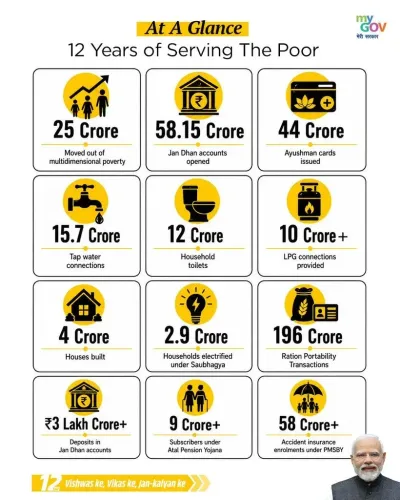
Thakur credited 12 years of the Modi government with 'unprecedented' welfare and upliftment work for the poor.
Key schemes underpinning the BJP's welfare narrative include PM Jan Dhan Yojana (2014) , PM Ujjwala Yojana (2016) , and the PM Garib Kalyan Anna Yojana .
The Direct Benefit Transfer system has been central to routing subsidies directly to beneficiaries, reducing leakage.
The remarks were made from Hamirpur , signalling continued BJP focus on welfare messaging in the Congress-governed state of Himachal Pradesh .
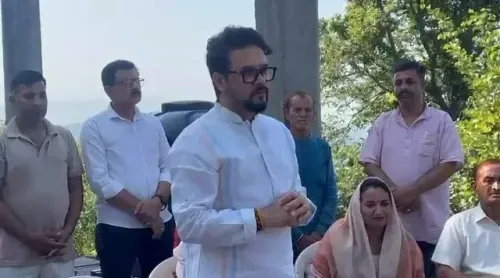
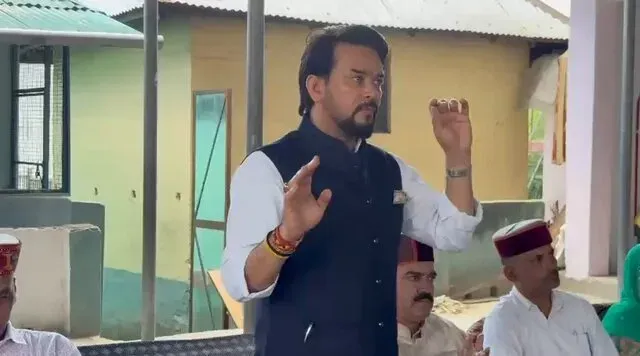
BJP MP Anurag Thakur on Tuesday, 23 June 2026, attacked the Indian National Congress for what he called decades of empty sloganeering on poverty, while crediting the Modi government's 12 years in office with delivering unprecedented welfare measures for the poor. The remarks were made from Hamirpur, Himachal Pradesh, Thakur's own parliamentary constituency.
In his post on X, Thakur wrote: 'Kांग्रेस की तीन पीढ़ियों ने ग़रीबी हटाओ का बस नारा ही दिया' — 'Three generations of Congress gave only the slogan of Garibi Hatao.' He contrasted this with what he described as 'unprecedented work for the welfare and upliftment of the poor' under the Modi government.
Context
The phrase 'Garibi Hatao' (Remove Poverty) was first made famous by the Congress during the 1971 Lok Sabha elections under Indira Gandhi. Thakur's reference to 'three generations' points to the successive leadership of the Gandhi-Nehru family across decades of Congress governance. The BJP has long argued that the slogan remained aspirational rather than actionable.
Thakur, a former Union Minister of Information & Broadcasting and Youth Affairs & Sports, represents Hamirpur — a constituency where BJP messaging on central welfare delivery has been a consistent electoral theme against the Congress-led state government in Himachal Pradesh.
Policy Backdrop
Since 2014, the central government has rolled out a series of targeted welfare programmes. The Pradhan Mantri Jan Dhan Yojana, launched in 2014, brought millions of unbanked households into the formal financial system. The Pradhan Mantri Ujjwala Yojana, introduced in 2016, extended LPG connections to below-poverty-line families, replacing dependence on firewood and kerosene.
The PM Garib Kalyan Anna Yojana expanded free foodgrain distribution significantly, particularly during the COVID-19 period, reaching hundreds of millions of beneficiaries. The Direct Benefit Transfer system, scaled up post-2014, has been used to route subsidies and cash assistance directly into the bank accounts of intended recipients, reducing leakage. These programmes form the policy spine behind Thakur's assertion.
Stakeholders and Impact
The primary beneficiaries of the schemes cited in Thakur's post are rural and semi-urban poor households, particularly those in states like Himachal Pradesh where terrain and connectivity have historically made welfare delivery difficult. For the BJP, the welfare record is a central plank in differentiating itself from Congress both nationally and in state-level contests.
For the Congress, the criticism is politically pointed: the party's identity has been closely tied to its poverty-alleviation rhetoric since the Indira Gandhi era. The opposition has countered that structural poverty and inequality persist, and that scheme-based delivery does not substitute for employment and income growth — but Thakur's post does not engage with that counter-argument.
What's Next
With Himachal Pradesh budget sessions and parliamentary debates on food security allocations on the horizon, welfare spending is likely to remain a live political flashpoint between the BJP-led Centre and the Congress-governed state. Thakur's post, made from his home constituency, signals continued BJP focus on converting the welfare narrative into electoral ground in Hamirpur and the broader hill-state electorate.
Point of View
' he targets not just past policy but the dynastic character of Congress leadership itself. The timing, from his home constituency in a Congress-governed state, suggests the message is as much about local electoral positioning as national political scoring. The post fits a broader BJP pattern of using welfare scheme milestones to shift the poverty debate from aspiration to delivery metrics.
NationPress
22 Sept 2026
Frequently Asked Questions
What did Anurag Thakur say about Congress and poverty?
Anurag Thakur said that three generations of Congress leadership gave only the slogan 'Garibi Hatao' (Remove Poverty) without real action, while the Modi government has delivered unprecedented welfare work for the poor over 12 years.
What is 'Garibi Hatao' and which party used it?
'Garibi Hatao' meaning 'Remove Poverty' was a slogan popularised by the Indian National Congress during the 1971 Lok Sabha elections under Indira Gandhi. It became one of the most recognised political slogans in Indian history.
What welfare schemes has the Modi government launched for the poor?
Key schemes include the Pradhan Mantri Jan Dhan Yojana for financial inclusion (2014), Pradhan Mantri Ujjwala Yojana for LPG access to BPL families (2016), PM Garib Kalyan Anna Yojana for free foodgrain, and a scaled-up Direct Benefit Transfer system.
Who is Anurag Thakur and where is he from?
Anurag Thakur is a BJP Lok Sabha MP from Hamirpur, Himachal Pradesh. He is a former Union Minister who held the portfolios of Information & Broadcasting and Youth Affairs & Sports.
Why did Anurag Thakur make this statement from Hamirpur?
Hamirpur is Thakur's own parliamentary constituency in Himachal Pradesh, a state currently governed by the Congress. His remarks reflect BJP's ongoing effort to contrast central welfare delivery with the state government's record.