Giriraj Singh Slams Congress on Poverty, Cites 4 Cr PMAY Homes
Synopsis
Union Textiles Minister Giriraj Singh marked twelve years of BJP governance on 19 June 2026 by contrasting Congress's 'Garibi Hatao' slogan with PM Modi's record, citing over 4 crore pucca houses delivered under PMAY as tangible proof of poor-welfare prioritisation.
Key Takeaways
Giriraj Singh posted on X on 19 June 2026 attacking Congress's decades-old 'Garibi Hatao' slogan as rhetoric without results.
He claimed more than 4 crore families have received pucca houses since 2014 under PM Modi's government.
The post is tagged #12YearsOfSeva and #12YearsOfGaribKalyan , marking twelve years of BJP-led NDA rule.
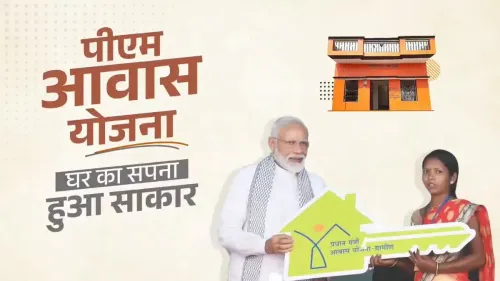
The flagship housing vehicle cited is Pradhan Mantri Awas Yojana (PMAY) , launched in the 2015-16 Union Budget .
Singh linked current welfare delivery to the long-term Viksit Bharat 2047 goal of a developed India.
The 'Garibi Hatao' slogan was originally launched by Indira Gandhi ahead of the 1971 Lok Sabha elections.
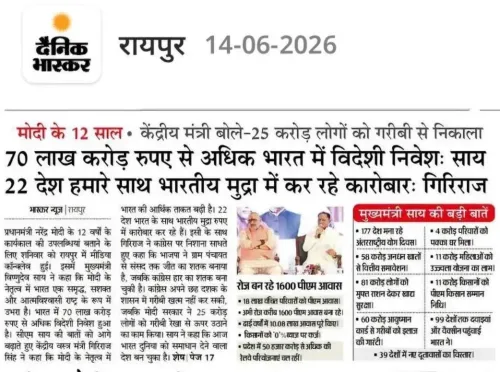
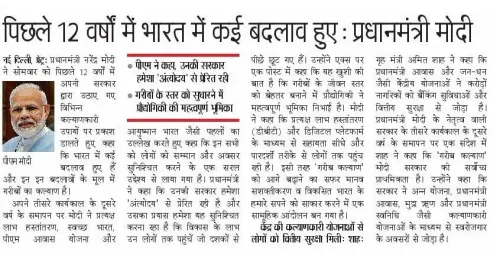
Union Textiles Minister Giriraj Singh on Friday, 19 June 2026, sharply attacked the Indian National Congress over its decades-long 'Garibi Hatao' slogan, contrasting it with what he described as measurable welfare delivery under Prime Minister Narendra Modi since 2014. Posting on X, Singh cited the provision of pucca houses to more than 4 crore families as evidence of a fundamental shift in anti-poverty policy.
Context
Singh's post, written in Hindi, carries a pointed political barb: 'Garibi toh nahi miti, garib mit gaya' — 'Poverty was not eliminated; it was the poor who were eliminated.' The line is a direct indictment of the Congress-era 'Garibi Hatao' ('Eliminate Poverty') slogan, first raised by Indira Gandhi ahead of the 1971 Lok Sabha elections and repeatedly invoked by the party across subsequent decades. Singh argues the slogan produced rhetoric without relief.
The post is tagged #12YearsOfSeva, #12YearsOfGaribKalyan, and #VikasitBharat2047, marking twelve years since the BJP-led NDA government came to power in May 2014 and tying current welfare delivery to the long-term Viksit Bharat 2047 vision of a developed India.
Policy Backdrop
The centrepiece of Singh's claim is the Pradhan Mantri Awas Yojana (PMAY), the flagship housing scheme announced in the 2015-16 Union Budget under the 'Housing for All' mandate. The programme — covering both rural (PMAY-Gramin) and urban streams — replaced earlier fragmented rural housing efforts and introduced revised unit costs alongside beneficiary identification through Socio-Economic Caste Census (SECC) data. The scheme's deadline, originally set for 2022, has since been extended to accommodate continuing construction and sanction pipelines.
Post-2014 welfare policy more broadly has emphasised saturation of individual entitlements — pucca housing, toilets under the Swachh Bharat Mission, LPG connections under Ujjwala Yojana, and bank accounts under Jan Dhan Yojana — framing these as direct, verifiable transfers rather than top-down programmatic spending. Cumulative house completions under PMAY have been presented in successive budget reviews as a concrete metric of poverty reduction.
Stakeholders and Impact
The primary beneficiaries of PMAY are rural and urban poor households identified through SECC data and local body surveys. A pucca house — a permanent, weather-proof dwelling — represents a significant asset transfer for families previously living in kutcha or semi-permanent structures, with downstream effects on health, safety, and economic stability. Women are co-owners or sole owners in a large share of PMAY-sanctioned houses, a design feature intended to strengthen property rights.
Politically, the post is directed at a national audience ahead of what the BJP is framing as a 'twelve years of service' milestone. By invoking the Congress slogan and juxtaposing it with a specific housing number, Singh is sharpening the BJP's welfare-delivery narrative against the principal opposition's historical record on poverty alleviation.
What's Next
The next PMAY progress report and any fresh housing targets in the 2026-27 Union Budget will be closely watched to substantiate or update the figures cited in Singh's post. Parliamentary questions on houses sanctioned versus completed remain a live accountability mechanism. More broadly, the Viksit Bharat 2047 framework — which Singh's hashtag references — is expected to set the welfare and infrastructure benchmarks that will define BJP's campaign narrative through the next general election cycle.
Point of View
Designed to reframe the poverty debate around measurable outputs rather than ideological intent. By invoking the 1971 'Garibi Hatao' slogan and flipping it rhetorically, Singh is targeting a Congress legacy that spans five decades and multiple prime ministers — far beyond any single policy failure. The timing, pegged to a twelve-year governance milestone and the Viksit Bharat 2047 hashtag, signals that welfare delivery will remain the BJP's central electoral argument as the party builds toward the next general election. The sharpness of the language also suggests the BJP is keen to pre-empt any Congress attempt to reclaim a poverty-alleviation narrative.
NationPress
20 Sept 2026
Frequently Asked Questions
What did Giriraj Singh say about Congress and Garibi Hatao?
Giriraj Singh said Congress spent decades chanting 'Garibi Hatao' but poverty was never eliminated — instead, he argued, it was the poor themselves who were erased from policy priority. He contrasted this with what he described as tangible welfare delivery under PM Modi since 2014.
How many houses have been built under PMAY since 2014?
Giriraj Singh's post claims more than 4 crore families have been provided pucca houses since 2014 under the Modi government's Pradhan Mantri Awas Yojana. The exact verified completion figure is subject to the latest official PMAY progress reports.
What is the 'Garibi Hatao' slogan and who started it?
'Garibi Hatao' meaning 'Eliminate Poverty' was the campaign slogan launched by Congress leader Indira Gandhi ahead of the 1971 Lok Sabha elections. It became one of the most recognisable political slogans in Indian history and was associated with Congress for decades.
What is Viksit Bharat 2047?
Viksit Bharat 2047 is the Indian government's long-term vision to make India a developed nation by 2047, the centenary of independence. It encompasses targets across infrastructure, welfare, manufacturing, and economic growth, and is frequently cited by BJP leaders as the overarching policy goal.
What is Pradhan Mantri Awas Yojana (PMAY)?
Pradhan Mantri Awas Yojana is the central government's flagship housing scheme, announced in the 2015-16 Union Budget under the 'Housing for All' mandate. It has two streams — PMAY-Gramin for rural beneficiaries and PMAY-Urban — and aims to provide permanent pucca houses to eligible poor households.