Giriraj Singh: 25 Crore Out of Poverty Under Modi in 12 Years
Synopsis
Union Textiles Minister Giriraj Singh on 15 June 2026 credited PM Modi's 12-year tenure with lifting over 25 crore people out of poverty, building 4 crore pucca homes, and placing India second globally in renewable energy, citing PMAY, Swachh Bharat and Jal Jeevan Mission as the policy pillars.
Key Takeaways
Union Textiles Minister Giriraj Singh posted on X on 15 June 2026 highlighting welfare gains under PM Narendra Modi .
More than 25 crore people have reportedly exited poverty in the last 12 years , according to the minister.
Over 4 crore pucca houses have been delivered to the poor; 3 crore more are said to be under way under PMAY .
The government's welfare resolve extends beyond housing to include toilets ( Swachh Bharat Mission ), clean drinking water ( Jal Jeevan Mission ), and uninterrupted electricity.
India is claimed to rank second globally in renewable energy capacity, with the minister asserting it will soon lead the world.
Updated PMAY completion data and India's position in international renewable energy rankings will be key benchmarks to watch.
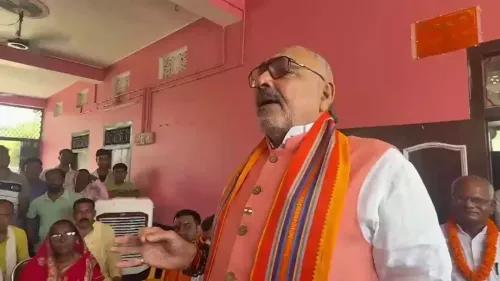
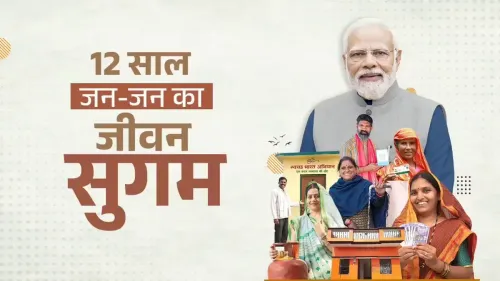
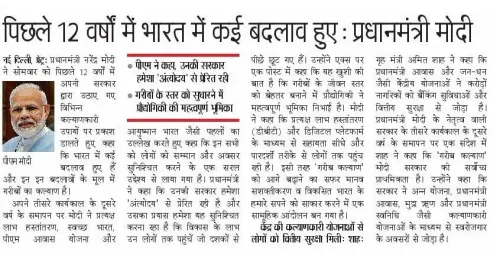
Union Textiles Minister Giriraj Singh on Monday, 15 June 2026 credited Prime Minister Narendra Modi's government with lifting more than 25 crore people out of poverty over the past 12 years, while highlighting the delivery of over 4 crore pucca houses to the poor and India's rise to second place globally in renewable energy capacity.
Context
Posting on X, Giriraj Singh wrote — 'आदरणीय प्रधानमंत्री श्री नरेन्द्र मोदी जी के नेतृत्व में बीते 12 वर्षों में देश के 25 करोड़ से अधिक लोग गरीबी रेखा से बाहर आए हैं' ['Under the leadership of respected Prime Minister Narendra Modi, more than 25 crore people have come out of poverty in the last 12 years']. He contrasted this with the previous government, which he said built a limited number of houses over a longer tenure.
The minister added that the current government has dedicated more than 4 crore pucca (permanent) houses to the poor in just 12 years, and that 3 crore additional homes are on their way. He framed the housing push as part of a wider welfare commitment encompassing toilets, clean drinking water, and uninterrupted electricity.
Policy Backdrop
The claims reference a cluster of flagship programmes. The Pradhan Mantri Awas Yojana (PMAY), launched in 2015, is the central housing scheme targeting both rural and urban poor with pucca dwellings. Alongside it, the Swachh Bharat Mission, initiated in 2014, drove nationwide sanitation coverage and toilet construction, while the Jal Jeevan Mission, announced in 2019, aimed to supply piped tap-water connections to every rural household.
Together, these schemes represent what the government has described as an integrated welfare architecture — linking shelter with basic amenities rather than treating them as separate interventions. Giriraj Singh's post explicitly echoes this framing, stating the government's resolve is 'not limited to giving houses' but extends to making life easier through toilets, clean water, and electricity.
Renewable Energy Claim
The minister also asserted that India today stands second in the world in the field of renewable energy and 'will soon be at the top.' This aligns with the government's broader positioning of solar and wind capacity expansion as a route to global clean-energy leadership. India has significantly scaled up its installed renewable capacity since 2014, with solar power forming the largest share of new additions.
The renewable energy reference, while included in a welfare-themed post, underlines the government's narrative of linking economic transformation — poverty reduction, housing, sanitation — with environmental ambition under the Viksit Bharat (Developed India) framework.
Stakeholders and Impact
The primary beneficiaries of the schemes cited are poor rural and urban households across India. Housing under PMAY has disproportionately benefited Scheduled Castes, Scheduled Tribes, women-headed households, and those below the poverty line. Sanitation and water access programmes have similarly targeted the most marginalised communities.
The poverty-reduction figure of 25 crore people is among the largest cited by government representatives and, if borne out by independent measurement, would represent one of the most significant poverty-reduction episodes in modern Indian history. Updated PMAY completion figures and India's standing in the next international renewable energy capacity rankings will be closely watched by analysts.
What's Next
With 3 crore additional homes said to be under construction or in the pipeline, the government's housing agenda remains a live political and administrative priority heading into the next phase of PMAY. Giriraj Singh's post signals that welfare delivery — housing, sanitation, water, power, and clean energy — will remain central to the ruling party's public communication as it approaches future electoral cycles. Independent verification of the poverty and housing numbers will be key to assessing the full weight of these claims.
Point of View
Sanitation, water, electricity, and clean energy into a single BJP governance narrative ahead of what is likely to be an intensifying political cycle. By juxtaposing the current government's 12-year record against an unnamed 'previous government,' the minister invokes a well-worn BJP contrast frame without naming the Congress — a rhetorical choice that keeps the focus on delivery rather than attack. The inclusion of the renewable energy ranking alongside poverty and housing data is notable: it signals an attempt to fuse the 'Viksit Bharat' development brand with ground-level welfare, broadening the party's appeal across both aspirational and subsistence-level voters. Independent verification of the 25-crore poverty-exit figure will ultimately determine whether this narrative holds up to scrutiny.
NationPress
21 Sept 2026
Frequently Asked Questions
How many people have come out of poverty under PM Modi according to Giriraj Singh?
According to Union Textiles Minister Giriraj Singh, more than 25 crore people have exited poverty in India over the past 12 years under Prime Minister Narendra Modi's leadership.
How many pucca houses have been built under PMAY?
Giriraj Singh stated that more than 4 crore pucca (permanent) houses have been delivered to the poor under the Modi government, with 3 crore additional homes said to be in progress under the Pradhan Mantri Awas Yojana .
What is India's rank in renewable energy in the world?
Union Textiles Minister Giriraj Singh claimed on 15 June 2026 that India currently ranks second in the world in renewable energy and will 'soon be at the top.'
What is the Pradhan Mantri Awas Yojana?
Pradhan Mantri Awas Yojana (PMAY) is a central government housing scheme launched in 2015 to provide pucca dwellings to rural and urban poor households across India.
What welfare schemes did Giriraj Singh mention in his post?
Giriraj Singh referenced housing under PMAY , sanitation under the Swachh Bharat Mission , clean drinking water under the Jal Jeevan Mission , uninterrupted electricity access, and India's growth in renewable energy as part of the Modi government's integrated welfare agenda.