Giriraj Singh Hails 12 Years of Modi Govt Welfare Push
Synopsis
Union Textiles Minister Giriraj Singh on 14 June 2026 marked 12 years of the Modi government, highlighting housing, sanitation, free rations, Jan Dhan, and Ayushman Bharat as programmes that have delivered dignity and security to crores of poor and marginalised Indians.
Key Takeaways
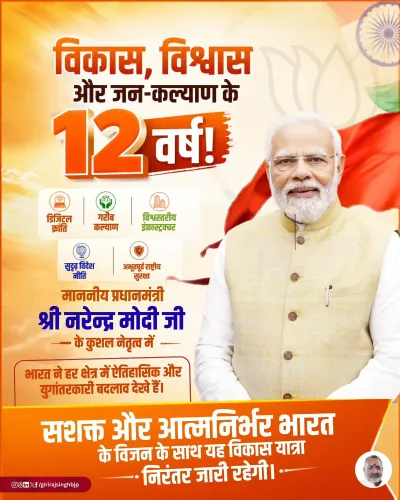
Giriraj Singh posted on 14 June 2026 to mark 12 years of the Modi government , calling the period one of unprecedented transformation.
He cited five flagship schemes: Pradhan Mantri Awas Yojana , Swachh Bharat Mission , Garib Kalyan Anna Yojana , Jan Dhan Yojana , and Ayushman Bharat .
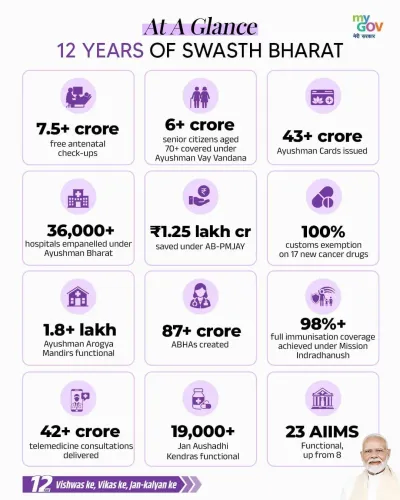
Ayushman Bharat provides health coverage of up to Rs 5 lakh per family to economically vulnerable households.
Pradhan Mantri Jan Dhan Yojana , launched in August 2014 , expanded banking access to previously unbanked citizens.
The post was part of a coordinated party messaging drive under #12YearsOfSeva and #12YearsOfModiGovernment .
The minister framed inclusive growth and social justice as twin pillars of what he called a 'New India' .
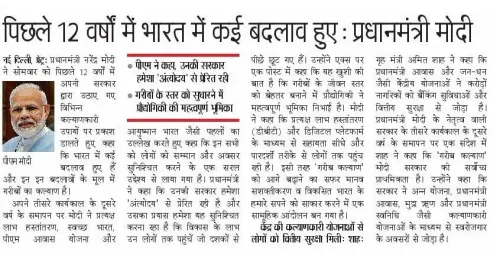
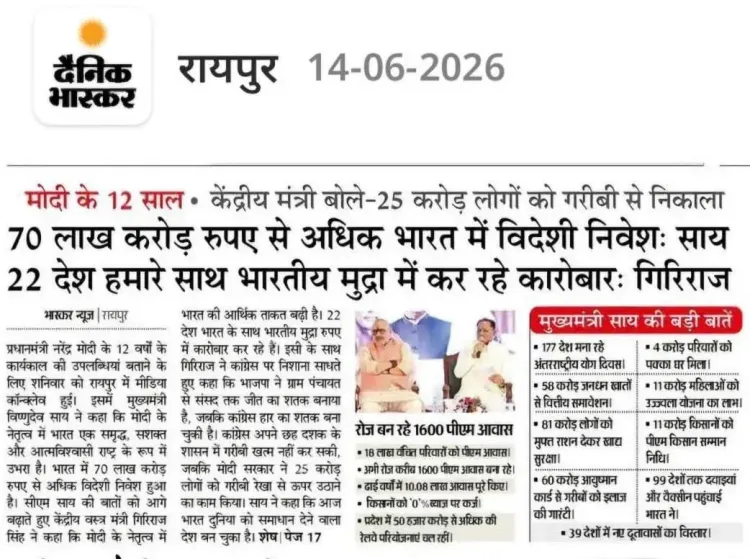
Union Textiles Minister Giriraj Singh on Sunday, 14 June 2026, took to X to mark 12 years of the Narendra Modi government, crediting its welfare programmes with delivering dignity and security to crores of Indians living in poverty. The minister highlighted flagship schemes spanning housing, sanitation, food security, financial inclusion, and health insurance as evidence of what he called an unprecedented transformation of the country.
Context
Writing in Hindi, Giriraj Singh said the past 12 years had been 'गरीब कल्याण, सुशासन और जनसेवा को समर्पित' ('dedicated to welfare of the poor, good governance, and public service'). He argued that Prime Minister Narendra Modi had understood poverty not merely as a policy subject but at close quarters, and that this personal understanding had kept the interests of the poor, the deprived, and the person standing in the last row as the highest priority in every scheme and policy.
The post was shared under the hashtags #12YearsOfSeva, #12YearsOfModiGovernment, #GaribKalyan, and #NewIndia, reflecting a coordinated ruling-party messaging effort to mark the government's anniversary milestone.
Policy Backdrop
The minister specifically named five programmes as transformative: Pradhan Mantri Awas Yojana (housing), Swachh Bharat Mission (toilets), Pradhan Mantri Garib Kalyan Anna Yojana (free rations), Pradhan Mantri Jan Dhan Yojana (banking access), and Ayushman Bharat (health insurance). Each of these was rolled out in distinct phases: Jan Dhan in August 2014, Swachh Bharat in October 2014, Pradhan Mantri Awas Yojana in 2015, Ayushman Bharat in 2018, and Garib Kalyan Anna Yojana first introduced in March 2020 and subsequently extended.
Together, these schemes form part of the government's overarching 'Sabka Saath, Sabka Vikas' ('Together with all, development for all') framework, which has relied on direct-benefit-transfer mechanisms, Aadhaar linkage, and digital tracking to reduce leakage and improve last-mile delivery.
Stakeholders and Impact
The primary beneficiaries of the schemes cited by Giriraj Singh are poor households, marginalised communities, and previously unbanked citizens. Ayushman Bharat offers health coverage of up to Rs 5 lakh per family to economically vulnerable households, while Jan Dhan opened banking access to millions who had previously operated entirely outside the formal financial system.
The minister framed the cumulative effect of these programmes as injecting 'सम्मान, सुरक्षा और नई आशा' ('dignity, security, and new hope') into the lives of crores of people. He concluded by asserting that a 'New India' is advancing simultaneously on development, social justice, and inclusive progress.
What's Next
With the government marking its 12th year, attention will turn to the next Union Budget for signals on fresh allocations and the continuation or expansion of these welfare programmes. Parliamentary discussions on performance audits and updated beneficiary data are also expected to test the government's claims of scheme effectiveness in the months ahead.
Point of View
Designed to consolidate the BJP's narrative around welfare delivery ahead of any upcoming electoral or budgetary cycle. By invoking schemes that span housing, health, food, and finance, the minister reinforces the government's claim to a 'last-mile' governance identity rather than a purely growth-centric one. The emphasis on dignity and social justice also signals a deliberate effort to contest opposition narratives on inequality. Whether the messaging translates into policy momentum — fresh allocations, expanded coverage, or performance audits — will be the real test in the months ahead.
NationPress
21 Sept 2026
Frequently Asked Questions
What did Giriraj Singh say about 12 years of the Modi government?
Giriraj Singh said the past 12 years had been dedicated to welfare of the poor, good governance, and public service, and that PM Modi's schemes had brought dignity, security, and new hope to crores of Indians.
Which welfare schemes did Giriraj Singh mention in his post?
He specifically mentioned Pradhan Mantri Awas Yojana (housing), Swachh Bharat Mission (toilets), Pradhan Mantri Garib Kalyan Anna Yojana (free rations), Jan Dhan Yojana (banking), and Ayushman Bharat (health insurance).
What is Ayushman Bharat and who does it cover?
Ayushman Bharat is a government health insurance scheme launched in 2018 that provides coverage of up to Rs 5 lakh per year to economically vulnerable families.
When was Pradhan Mantri Jan Dhan Yojana launched?
Pradhan Mantri Jan Dhan Yojana was launched in August 2014 to expand banking access to millions of previously unbanked citizens across India.
What is the significance of the hashtag 12YearsOfModiGovernment?
The hashtag marks the 12th anniversary of the Narendra Modi government, which took office in May 2014, and is part of a coordinated BJP messaging campaign highlighting welfare achievements over the period.