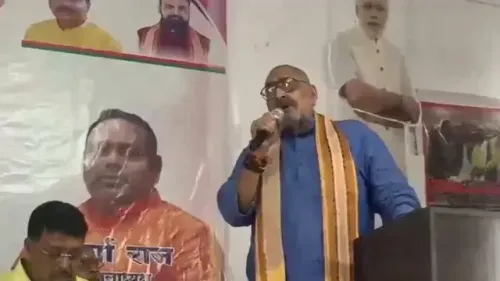
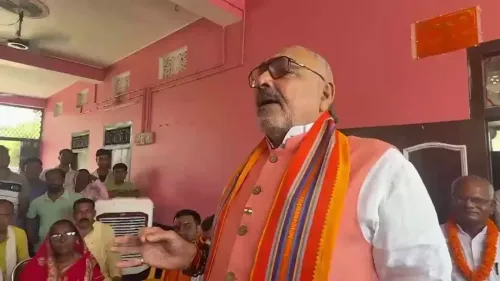
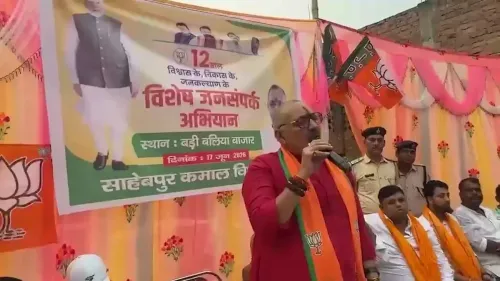
Giriraj Singh fires back at 'regime change' talk, cites Modi welfare wins
Synopsis
Union Textiles Minister Giriraj Singh challenged opposition 'regime change' rhetoric on 31 October 2026, asking critics to explain why they oppose homes, free healthcare and ration for the poor, asserting PM Modi governs with the trust of millions.
Key Takeaways
Giriraj Singh posted a pointed counter to opposition 'regime change' rhetoric on 31 October 2026 .
He challenged critics to explain their opposition to welfare outcomes: homes, free healthcare and free ration for the poor, and jobs for youth.
Pradhan Mantri Awas Yojana (2015), Ayushman Bharat (2018, up to Rs 5 lakh annual cover), and PM Garib Kalyan Anna Yojana (2020) were the three schemes invoked.
Singh asserted that governments are not changed by opposition demands but by popular trust — which he says remains with PM Narendra Modi .
The messaging mirrors the BJP's consistent post-2014 strategy of grounding political legitimacy in direct benefit delivery to poor households.
A sharp political counter-punch landed on social media on Saturday, 31 October 2026, when Union Textiles Minister Giriraj Singh turned the opposition's 'regime change' rhetoric back on itself — demanding critics explain exactly what troubles them: is it the poor receiving homes, free healthcare and ration, or young Indians finding jobs?
Posting in Hindi, Singh wrote: 'Rijeem chenj ka raag alapne wale bataen ki unhe dard kis baat se hai' — 'Let those singing the 'regime change' tune tell us what their real pain is.' The minister's message was unambiguous: welfare delivery, not opposition pressure, is what defines electoral legitimacy in India today.
Three welfare pillars Singh put front and centre
Singh's post name-checked three of the BJP-led NDA government's most visible welfare instruments. Pradhan Mantri Awas Yojana, launched in 2015, has been the government's flagship effort to give pucca — permanent brick-and-mortar — homes to economically weaker sections in both rural and urban India. Ayushman Bharat, rolled out in 2018, extended government-funded health insurance of up to Rs 5 lakh per family per year to hundreds of millions of citizens. And PM Garib Kalyan Anna Yojana, introduced in 2020 during the pandemic and extended repeatedly since, has kept free food grains flowing to eligible poor households.
Together, these three schemes form the core of what the BJP frames as 'direct benefit delivery' — governance felt in a kitchen, a clinic, a new front door. Singh's implicit argument: these are not abstractions. They are things opposition voices would have to explain away.
The 'regime change' jibe and what it says about the political moment
Singh's post does not name who is 'singing the regime change tune', but the framing is pointed. The phrase 'regime change' — borrowed from geopolitical discourse — has been circulating in Indian opposition commentary as shorthand for demanding a change of government at the Centre. Singh's retort is that governments are not changed by opposition demands; they are sustained by the trust of crores of citizens.
'Prime Minister Modi is serving the country with the blessings of millions of people, and the public's trust is with him,' Singh stated, closing his post with a confident assertion of popular mandate rather than a defensive crouch.
A consistent BJP playbook — and why it keeps working
This is not an improvised response. Since 2014, the BJP's core political communication has consistently anchored the government's legitimacy in tangible welfare outputs — a home, a gas cylinder, a Jan Dhan account — rather than in elite consensus or media endorsement. Singh's post fits that architecture exactly: pivot every opposition attack back to a question of who actually delivered for the poor.
For a Lok Sabha MP from Begusarai, Bihar — a constituency where welfare scheme penetration is both high and politically decisive — this is not merely national messaging. It is a live wire back to his own voter base.
The opposition now faces the same challenge it has faced for over a decade: to argue against a government, one must first answer the counter-question Singh just posted publicly — and that answer is never easy when the person you are trying to move voted for the pucca roof over their head.
Point of View
Ayushman Bharat and free ration in a single breath, he ties electoral mandate directly to scheme delivery, a frame that has proven durable across multiple election cycles. The 'regime change' framing also signals that the BJP sees geopolitically-tinged opposition language as an electoral vulnerability for its critics, not for itself. For Singh, a senior leader representing a Bihar constituency deeply penetrated by these schemes, the post doubles as local constituency communication and national political positioning.
NationPress
31 Oct 2026
Frequently Asked Questions
What did Giriraj Singh say about 'regime change' in India?
On 31 October 2026, Singh challenged those using 'regime change' language to explain what hurts them — whether it is the poor receiving homes, free treatment and ration, or youth getting employment — and stated that PM Modi governs with the blessings of millions of citizens.
What is Pradhan Mantri Awas Yojana?
Pradhan Mantri Awas Yojana is a government housing scheme launched in 2015 to provide permanent pucca homes to economically weaker sections in rural and urban India.
What is Ayushman Bharat and how much does it cover?
Ayushman Bharat is a national health protection scheme launched in 2018 that provides government-funded health insurance of up to Rs 5 lakh per family per year to eligible poor households.
What is PM Garib Kalyan Anna Yojana?
PM Garib Kalyan Anna Yojana is a free food grains scheme introduced in 2020 during the pandemic and extended periodically to provide free ration to eligible poor families across India.
Who is Giriraj Singh and which constituency does he represent?
Giriraj Singh is a senior BJP leader, Union Minister of Textiles and Lok Sabha MP from Begusarai, Bihar.