Giriraj Singh Hails 12 Years of Health Reforms Under Modi
Synopsis
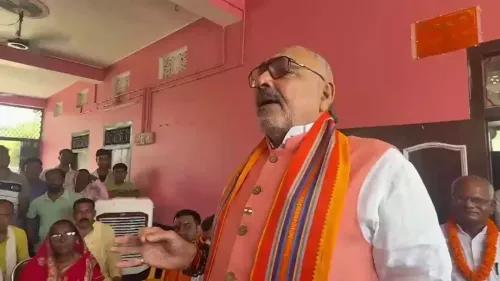
Union Textiles Minister Giriraj Singh on 14 June 2026 credited PM Narendra Modi's 12-year tenure with transforming India's healthcare landscape, spotlighting Ayushman Bharat, Jan Aushadhi Kendras, e-Sanjeevani, and Swachh Bharat as drivers of accessible, affordable, and inclusive health services for crores of citizens.
Key Takeaways
Giriraj Singh , Union Textiles Minister, posted on 14 June 2026 praising 12 years of health-sector transformation under PM Narendra Modi .
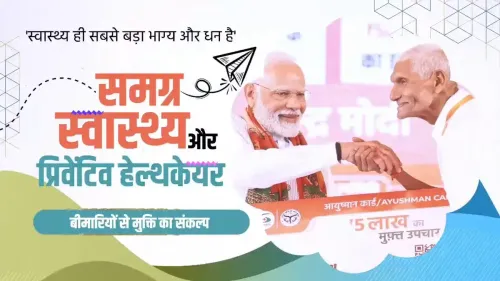
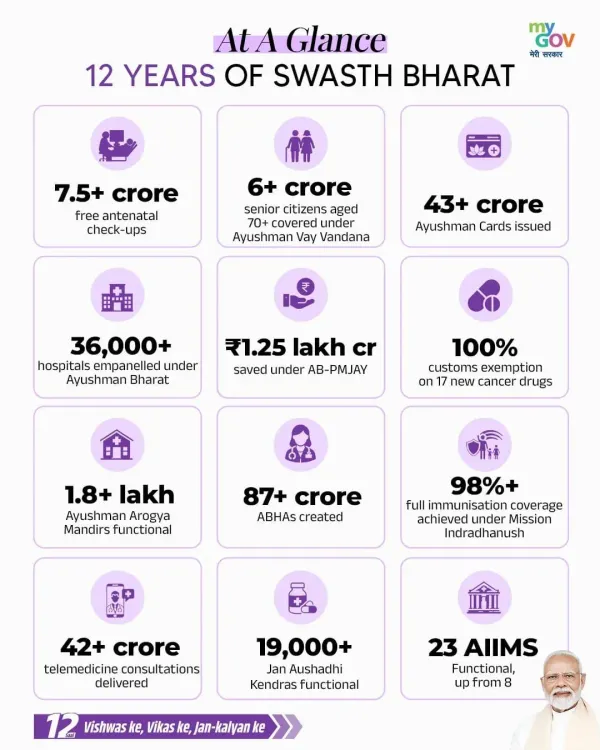
Ayushman Bharat PM-JAY , launched 23 September 2018 , provides up to Rs 5 lakh annual health cover to economically vulnerable families.
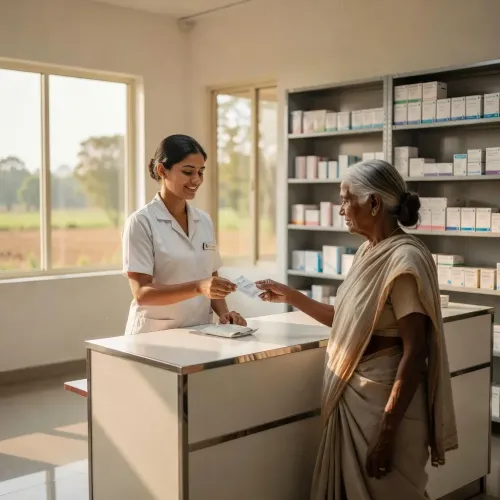
Jan Aushadhi Kendras sell quality generic medicines at 50 to 90 per cent lower prices than branded drugs. e-Sanjeevani telemedicine platform, introduced in 2019 , offers free remote consultations and is integrated into the Ayushman Bharat Digital Mission .
Swachh Bharat Mission , launched 2 October 2014 , improved sanitation and helped reduce water-borne diseases across the country.
The post is part of a coordinated BJP communication campaign under the #12YearsOfSwasthBharat and #ViksitBharat hashtags.
Union Textiles Minister Giriraj Singh on Sunday, 14 June 2026, highlighted what he described as remarkable transformation in India's health sector over the past 12 years, crediting Prime Minister Narendra Modi's leadership for expanding access to affordable and inclusive healthcare across the country.
Context
Posting in Hindi on X, Singh wrote: 'बीते 12 वर्षों में भारत के स्वास्थ्य क्षेत्र में उल्लेखनीय परिवर्तन देखने को मिला है' ('In the last 12 years, remarkable transformation has been witnessed in India's health sector'). He underlined that steps have been taken to make health services more accessible, affordable, and comprehensive, with public welfare at the centre. The post was tagged under the hashtags #12YearsOfSwasthBharat, #12YearsOfSeva, and #ViksitBharat, signalling a coordinated government communication push marking a decade-plus of the Modi administration.
Policy Backdrop
Singh specifically named three flagship initiatives — Ayushman Bharat, Jan Aushadhi Kendras, and e-Sanjeevani — alongside the Swachh Bharat Mission as pillars of this health transformation. Ayushman Bharat Pradhan Mantri Jan Arogya Yojana, launched on 23 September 2018, provides up to Rs 5 lakh annual health insurance cover to economically vulnerable families and is widely regarded as the world's largest government-funded health assurance scheme. The Pradhan Mantri Bhartiya Janaushadhi Pariyojana, relaunched and expanded from 2015, set up Jan Aushadhi Kendras selling quality generic medicines at 50 to 90 per cent lower prices than branded alternatives.
The e-Sanjeevani telemedicine platform, introduced in 2019 and later integrated into the Ayushman Bharat Digital Mission, enabled free remote consultations and was scaled significantly during the COVID-19 period. The Swachh Bharat Mission, announced on 2 October 2014 with the goal of making India open-defecation-free, contributed to improved sanitation and a reduction in water-borne diseases — a factor Singh linked directly to health outcomes for crores of citizens.
Stakeholders and Impact
The primary beneficiaries of the schemes Singh cited are low-income families, rural patients, and those who previously lacked access to formal health insurance. By combining insurance coverage under Ayushman Bharat, low-cost medicines through Jan Aushadhi Kendras, and remote consultations via e-Sanjeevani, the government has attempted to address multiple barriers — financial, geographic, and infrastructural — simultaneously. Singh's post, coming from a minister holding the Textiles portfolio rather than Health, reflects the cross-government amplification strategy employed by the BJP to highlight welfare delivery under the Viksit Bharat framework.
Since 2014, the central government has also established new AIIMS institutes across states and steadily increased health outlays in successive Union Budgets, reinforcing the infrastructure backbone that these digital and insurance-linked schemes rely upon.
What's Next
The coordinated social media messaging around #12YearsOfSwasthBharat is expected to continue as the government approaches key policy milestones. Attention will now turn to the next Union Health Budget allocations and any parliamentary discussion on expanding the Ayushman Bharat Digital Mission's beneficiary base. The government's ability to sustain and deepen these programmes — particularly in aspirational districts with weak health infrastructure — will be the real test of the transformation Singh and other ministers are publicly celebrating.
Point of View
Jan Aushadhi, and e-Sanjeevani, the communication sidesteps harder questions about rural health infrastructure gaps and post-2023 beneficiary data that remain difficult to independently verify. The broader pattern points to a government increasingly confident in using digital health achievements as a replicable template for Viksit Bharat's social-sector storytelling.
NationPress
22 Sept 2026
Frequently Asked Questions
What is Ayushman Bharat and who benefits from it?
Ayushman Bharat Pradhan Mantri Jan Arogya Yojana is a government-funded health insurance scheme launched on 23 September 2018 that provides up to Rs 5 lakh annual cover to economically vulnerable Indian families, making it the world's largest scheme of its kind.
What are Jan Aushadhi Kendras?
Jan Aushadhi Kendras are government-backed outlets set up under the Pradhan Mantri Bhartiya Janaushadhi Pariyojana that sell quality generic medicines at 50 to 90 per cent lower prices than branded medicines, improving affordability for low-income patients.
What is e-Sanjeevani telemedicine?
e-Sanjeevani is a free government telemedicine platform introduced in 2019 that allows patients to consult doctors remotely; it was scaled up during COVID-19 and later integrated into the Ayushman Bharat Digital Mission.
Why is Giriraj Singh, a Textiles Minister, commenting on health policy?
Singh holds the Union Textiles portfolio but, like other BJP ministers, amplified health-sector achievements as part of a coordinated government campaign marking 12 years of the Modi administration under hashtags like #12YearsOfSwasthBharat and #ViksitBharat.
What is the Swachh Bharat Mission's link to health?
Swachh Bharat Mission, launched on 2 October 2014, focused on building toilets and eliminating open defecation, which directly reduced water-borne and sanitation-related diseases, forming an indirect but significant pillar of India's public health improvement.