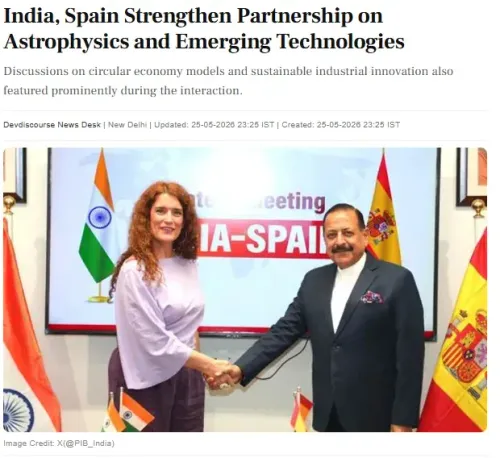
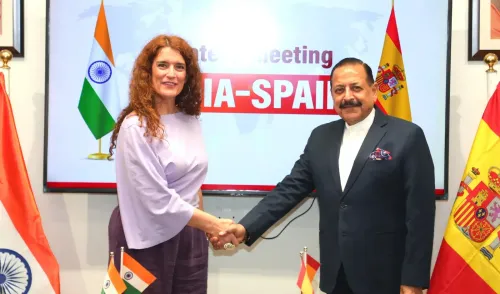
Dr. Jitendra Singh Holds Indo-French Science Meet
Synopsis
Union Science and Technology Minister Dr. Jitendra Singh convened an Indo-French bilateral meeting on 29 September 2026, reinforcing a partnership rooted in nearly four decades of structured research cooperation through CEFIPRA and a strategic partnership dating to 1998.
Key Takeaways
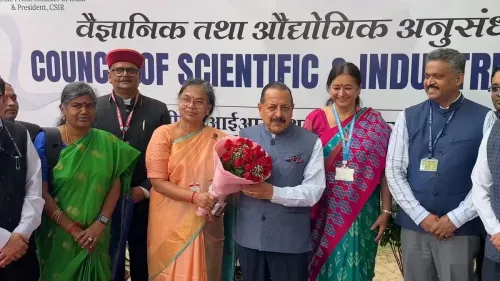
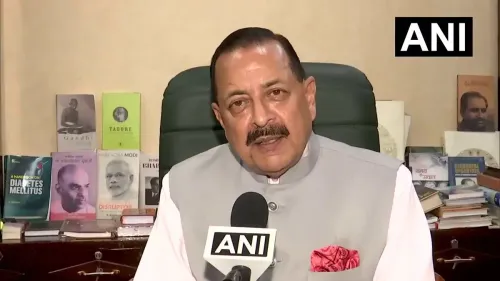
Jitendra Singh , Union Minister of Science and Technology, held an Indo-French bilateral meet on 29 September 2026 .
India and France have maintained a structured science partnership since 1987 through the Indo-French Centre for the Promotion of Advanced Research (CEFIPRA) .
France has been a strategic partner of India since 1998 , with S&T as a consistent pillar alongside defence and space.
The meet is part of India's broader strategy to expand international science and technology collaboration with key global partners.
Specific outcomes — joint statements, research agreements, or working-group mandates — are yet to be officially announced.
A bilateral conversation between two of the world's most enduring science partners quietly advanced on Tuesday, 29 September 2026, as Union Science and Technology Minister Dr. Jitendra Singh convened an Indo-French meeting — adding a fresh chapter to a relationship that has been building since before most of today's researchers were born.
Nearly four decades of CEFIPRA as the bedrock
The institutional spine of this partnership is the Indo-French Centre for the Promotion of Advanced Research (CEFIPRA), established in 1987 — making it one of India's oldest and most active bilateral science bridges. Funded jointly by both governments, CEFIPRA has over the decades co-funded hundreds of research projects spanning mathematics, biology, materials science, and climate studies, giving Indian and French researchers a shared infrastructure that most bilateral relationships take generations to build.
France was elevated to a 'strategic partner' of India in 1998, and science and technology cooperation has been a consistent thread running through that partnership, alongside the more prominent pillars of defence procurement and space collaboration. The Indo-French science corridor, in other words, is no diplomatic novelty — it is a well-oiled mechanism that periodically needs a ministerial push to keep momentum.
Where this meet fits in India's broader S&T diplomacy
India has been systematically widening its international science partnerships over the past several years, signing cooperation frameworks with the United States, European Union, Japan, and Australia, among others. France occupies a distinct position in this constellation — it brings deep expertise in nuclear science, space systems, oceanography, and artificial intelligence, all of which intersect directly with Dr. Jitendra Singh's portfolio covering Science and Technology, Earth Sciences, and the Prime Minister's Office.
The specific agenda and any outcomes of today's meeting have not been officially detailed yet. What to watch: whether joint statements, new research grants through CEFIPRA, or bilateral working-group mandates emerge as follow-up deliverables in the days ahead.
When two governments with nearly forty years of structured scientific collaboration sit down again, the conversation rarely starts from scratch — it picks up exactly where the last one left off, and that accumulated trust is precisely what makes these meetings matter.
Point of View
Not merely a ceremonial footnote. With CEFIPRA approaching its fortieth year, both governments appear intent on deepening — rather than simply maintaining — institutional ties in research and technology. For India, France is a particularly valuable partner because it offers access to European scientific networks alongside independent expertise in nuclear, space, and AI domains. The ministerial-level engagement suggests New Delhi is treating scientific diplomacy with the same seriousness as strategic or defence talks.
NationPress
29 Sept 2026
Frequently Asked Questions
What is the Indo-French CEFIPRA and why does it matter?
CEFIPRA — the Indo-French Centre for the Promotion of Advanced Research — was established in 1987 and is jointly funded by the Indian and French governments to co-fund bilateral research projects. It is one of India's longest-running and most active science cooperation mechanisms, covering fields from mathematics to climate science.
What is Dr. Jitendra Singh's role in India's science ministry?
Dr. Jitendra Singh holds the position of Union Minister of State (Independent Charge) for Science and Technology and Earth Sciences , and also serves as MoS in the Prime Minister's Office and for Personnel — giving him oversight of India's major research agencies and science diplomacy.
When did India and France become strategic partners?
India and France declared a strategic partnership in 1998 , embedding science, technology, space, and nuclear cooperation as core pillars alongside defence ties.
What could come out of the Indo-French meet held by Dr. Jitendra Singh?
Potential outcomes include joint research statements, new funding rounds through CEFIPRA, bilateral working-group mandates, or agreements in areas like artificial intelligence, oceanography, or space science. Official details are yet to be announced.
How does India's France partnership fit into its broader science diplomacy?
France is part of India's wider strategy to diversify international science partnerships. India has active S&T cooperation frameworks with the US, EU, Japan, and Australia, with France offering distinct expertise in nuclear science, space, and AI.