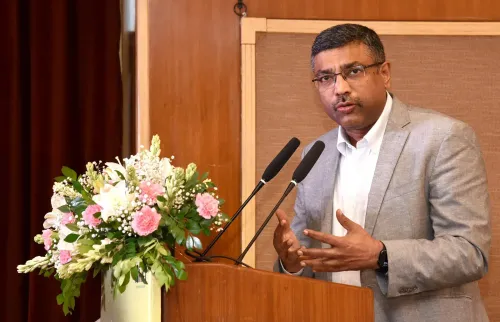
India rises as global digital infrastructure and internet security hub: Experts

Synopsis
At the 62nd APNIC meeting in Mumbai, India's top tech policymakers and industry leaders declared the country is no longer just a massive internet market — it is actively shaping global digital architecture, routing security, and AI-driven infrastructure. With IRINN turning 12 and the government deepening ties with APNIC, India's bid for a seat at the table of global internet governance is no longer aspirational.
Key Takeaways
India was spotlighted as a rising global force in digital infrastructure and internet security at the 62nd APNIC meeting in Mumbai on 8 September .
MeitY Joint Secretary Sushil Pal said the government is prioritising internet routing security and collaborating with APNIC to build a more resilient digital ecosystem.
NIXI CEO Devesh Tyagi called the APNIC meeting a milestone, noting it is being held in India after nearly 12 years .
IRINN , established in 2012 with NIXI's support, was cited as a key driver of India's internet infrastructure growth.
Rapid adoption of AI and quantum computing is creating new cybersecurity challenges, with cybercriminals using increasingly sophisticated tools, according to officials.
APNIC Executive Council Chairman Kenny Huang described the Asia-Pacific as one of the world's most dynamic centres of digital innovation, with India central to that growth.
India is rapidly cementing its position as a major global force in digital infrastructure, internet security, and the digital economy, according to industry leaders and policymakers who gathered in Mumbai on the sidelines of the 62nd Asia Pacific Network Information Centre (APNIC) meeting on 8 September. Experts said the country has moved well beyond being one of the world's largest internet markets and is now increasingly shaping the future of global connectivity.
India's Evolving Role in Digital Infrastructure
Sushil Pal, Joint Secretary in the Ministry of Electronics and Information Technology (MeitY), said the internet has transformed from a basic communication tool into critical and strategic infrastructure that underpins a significant portion of government services. He noted that its importance is expanding into areas such as national security and defence, making the resilience and security of digital networks a matter of growing urgency.
Pal also pointed to the rapid spread of internet access and the accelerating adoption of artificial intelligence (AI) and emerging technologies such as quantum computing as factors creating new and complex cybersecurity challenges. Cybercriminals, he said, are increasingly leveraging sophisticated tools to develop novel methods of carrying out cyberattacks and digital fraud.
Government's Cybersecurity Push and APNIC Collaboration
According to Pal, the government is working closely with technology experts and industry stakeholders to strengthen India's cybersecurity framework. Particular emphasis is being placed on internet routing security to minimise the risks of route hijacking and network disruptions — vulnerabilities that can have cascading consequences for both public services and private enterprise.
He added that the government is actively collaborating with APNIC to build a more resilient internet ecosystem, signalling a deepening of India's engagement with multilateral bodies that govern global internet architecture.
APNIC Meeting: A Milestone for India's Internet Community
Devesh Tyagi, Chief Executive Officer of the National Internet Exchange of India (NIXI), described the hosting of APNIC's 62nd meeting in India as a significant milestone. He noted that the event is being held in India after nearly 12 years, offering a critical platform for the country's internet community to engage with global network operators and stakeholders.
Notably, the choice of Mumbai as the venue underscores the city's growing stature as a hub for digital and financial technology in the Asia-Pacific region.
IRINN and the National Internet Registry Initiative
Rajesh Chharia, President of the Internet Service Providers Association of India (ISPAI), highlighted the foundational role of the National Internet Registry initiative in India's internet expansion. He pointed specifically to the establishment of IRINN in 2012 — backed by NIXI — as a development that gave significant momentum to the growth of India's internet infrastructure.
This institutional foundation, experts argued, has been instrumental in enabling India to manage its own IP address allocation and reduce dependence on external registries, a step that carries both economic and strategic implications.
Asia-Pacific's Digital Dynamism and India's Place in It
Kenny Huang, Chairman of the APNIC Executive Council, said the Asia-Pacific region has emerged as one of the world's most dynamic centres of digital growth and technological innovation — and India, he indicated, is increasingly central to that story. This comes amid a broader global race to secure digital supply chains and assert influence over internet governance frameworks.
As AI adoption accelerates and quantum computing edges closer to practical deployment, India's ability to shape international standards and routing security protocols will likely determine how much strategic leverage it commands in the next phase of the global digital order.
Point of View
But symbolism alone does not translate into strategic influence over internet governance. India's routing security vulnerabilities remain a live concern — route hijacking incidents have affected Indian networks before, and the government's collaboration with APNIC, while welcome, is still in early stages. The deeper question is whether India can move from being a large consumer of global internet architecture to an active rule-setter — and that requires not just policy intent but sustained technical capacity-building and a credible presence in bodies like IETF and ICANN, where the real standard-setting happens.
NationPress
24 Oct 2026
Frequently Asked Questions
What was the 62nd APNIC meeting in Mumbai about?
The 62nd Asia Pacific Network Information Centre (APNIC) meeting, held in Mumbai on 8 September, brought together global network operators, policymakers, and industry leaders to discuss internet infrastructure, routing security, and digital innovation. It was the first time India hosted the event in nearly 12 years.
Why is India's role in internet security growing?
India's internet ecosystem has expanded rapidly, with AI adoption and quantum computing creating new cybersecurity challenges. The government is strengthening its cybersecurity framework, focusing on routing security to prevent route hijacking, and collaborating with APNIC to build a more resilient digital infrastructure.
What is IRINN and why does it matter?
IRINN, or the Indian Registry for Internet Names and Numbers, was established in 2012 with the support of NIXI. It manages IP address allocation within India, reducing the country's dependence on external registries and giving it greater control over its own internet infrastructure.
Who are the key figures driving India's digital infrastructure agenda?
Key figures include MeitY Joint Secretary Sushil Pal, who is overseeing cybersecurity and routing security policy; NIXI CEO Devesh Tyagi, who highlighted India's growing engagement with global internet bodies; and ISPAI President Rajesh Chharia, who underscored the role of IRINN in expanding India's internet ecosystem.
What cybersecurity challenges is India facing as digital adoption grows?
According to MeitY's Sushil Pal, the rapid expansion of internet access alongside AI and quantum computing adoption is enabling cybercriminals to develop more sophisticated cyberattack methods and digital fraud schemes. The government is working with industry stakeholders to address these threats, with a particular focus on internet routing security.