How Are India and Japan's Technological Ties Shaping the Digital Future?

Synopsis
Discover how the growing technological alliance between India and Japan is set to redefine the digital landscape. Explore the synergies in semiconductor manufacturing and digital infrastructure that are shaping a resilient future.
Key Takeaways
Strengthening Ties: The alliance enhances economic and strategic relations.
Digital Transformation: India Stack showcases scalable digital solutions.
Manufacturing Collaboration: Tata-ROHM exemplifies successful joint ventures.
Strategic Independence: India aims to reduce reliance on foreign hardware.
Future Focus: Investments in semiconductor ecosystems are vital for growth.
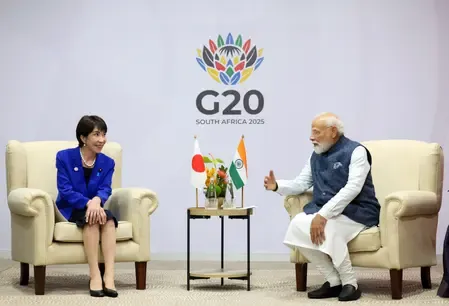
New Delhi, Feb 20 (NationPress) The strengthening technological relationship between India and Japan in the electronics hardware sector is becoming a crucial element in reinforcing the robust economic and strategic bonds between the world’s most populous democracy and Asia’s technology powerhouse.
As semiconductors, generative Artificial Intelligence (AI), and digital public infrastructure (DPI) transform global dynamics, this emerging “tech alliance” represents the most significant strategic collaboration in the area. The conclusion of the 15th India-Japan Annual Summit in late 2025 underscores that this partnership transcends mere trade; it aims to create a framework for a free and open digital future, as noted in an article from India Narrative.
India offers a vast reach and a youthful population, while Japan brings in the reliability of its advanced manufacturing and long-term investment. Together, they form a resilient democratic counterbalance to authoritarian digital regimes, as highlighted in the article.
The power of this alliance is rooted in its complementary capabilities. India has emerged as a premier testing ground for large-scale digital transformation. The “India Stack,” which integrates Aadhaar’s biometric identification, the Unified Payments Interface (UPI), and the innovative “Agri-Stack,” has successfully integrated a billion people into the formal economy. These technologies have enabled India to overcome traditional infrastructure challenges, demonstrating that digital public goods can foster inclusive growth, according to the article.
The article points to the collaboration between Tata Electronics and ROHM Co., Ltd., a Japanese semiconductor leader, established in December 2025, as an instance of this synergy. Through this partnership, Tata is leveraging its newly launched $3.2 billion (Rs 27,000 crore) facility in Jagiroad, Assam, to assemble and test automotive-grade power semiconductors designed in India, essential for the production of next-generation electric vehicles. By merging ROHM’s advanced technology with Tata's Outsourced Semiconductor Assembly and Test (OSAT) capabilities, they have shortened lead times for the Indian automotive sector. This collaboration, which began mass production in early 2026, exemplifies the “Silicon Shield,” proving that Indian manufacturing can adhere to Japanese precision standards for a global audience.
While India’s software capabilities are well-recognized, its historical reliance on foreign hardware has posed a strategic vulnerability. The supply chain disruptions of the early 2020s served as a harsh reminder: technology can be weaponized. Japan’s expertise in semiconductor materials, photoresists, and lithography equipment—where it maintains a dominant share of the global market—provides a timely solution, the article explains.
Through the India Semiconductor Mission (ISM) 2.0, launched in the February 2026 Budget, the two nations have transitioned to a co-dependent ecosystem merging Indian chip design skills with Japanese industrial expertise, the article notes.
The 2026-27 Union Budget further reinforced this strategy by expanding the Electronics Components Manufacturing Scheme (ECMS) with a budget of Rs 40,000 crore. This initiative specifically targets the “missing middle” of the supply chain, incentivizing Japanese small and medium enterprises to establish specialized manufacturing facilities in India’s new electronics hubs in Dholera and Sanand. This initiative goes beyond mere device assembly; it emphasizes owning the Intellectual Property (IP) for chips that power everything from smart cities to defense systems, according to the article.
Point of View
The evolving technological partnership between India and Japan signifies a pivotal shift towards a collaborative future. It enhances both nations' strengths, paving the way for a robust digital economy while navigating the challenges posed by global supply chain vulnerabilities. This alliance is not merely transactional; it represents a strategic commitment to innovation and resilience.
NationPress
1 Oct 2026
Frequently Asked Questions
What is the significance of the India-Japan tech alliance?
The India-Japan tech alliance is crucial for strengthening economic ties and establishing a framework for a free digital future, particularly in the semiconductor and AI sectors.
How does the India Stack contribute to digital transformation?
The India Stack integrates biometric identification and payment systems, allowing large-scale digital inclusion and economic integration.
What are the benefits of the Tata-ROHM partnership?
The Tata-ROHM collaboration enhances India's semiconductor production capabilities, reducing lead times and ensuring adherence to Japanese precision standards.
What role does Japan play in the semiconductor market?
Japan is a leader in semiconductor materials and manufacturing technologies, providing critical support to India's semiconductor ambitions.
How does the Electronics Components Manufacturing Scheme benefit India?
The scheme aims to attract Japanese SMEs to establish manufacturing units in India, focusing on chip IP ownership and enhancing local production.