India in talks with US to access Anthropic's Project Glasswing for cybersecurity

Synopsis
India is negotiating access to Anthropic's Project Glasswing — a Big Tech coalition covering AWS, Google, Microsoft, Apple, and NVIDIA — to stress-test its critical digital infrastructure against frontier AI threats. MeitY says 60–70% of testing is already underway with existing tools, but the remaining gap hinges on a bilateral deal with Washington.
Key Takeaways
Krishnan confirmed on 3 July that India is in talks with the US to access Anthropic's Project Glasswing for cybersecurity testing.
India has already begun testing critical systems with available AI models, covering roughly 60–70% of the planned testing scope.
Project Glasswing , announced in April 2025 , unites 12 major technology and financial firms including AWS , Google , Microsoft , Apple , and NVIDIA .
Apple is reportedly fast-tracking iOS security updates outside its usual major-release cycle in response to AI-enabled hacking threats.
The move reflects India's shift toward proactive, AI-driven cyber resilience rather than reactive patching.
India is in active talks with the United States to secure access to Anthropic's Project Glasswing, an advanced AI initiative aimed at securing critical software infrastructure, a senior government official said on Friday, 3 July. The move is part of India's broader effort to stress-test its digital systems against frontier artificial intelligence capabilities.
What Officials Said
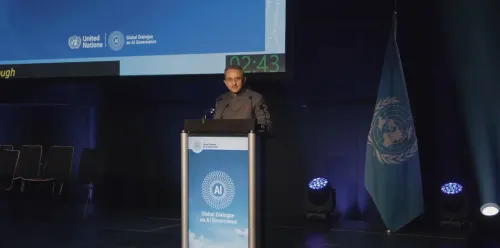
Ministry of Electronics and Information Technology (MeitY) Secretary S. Krishnan, speaking at the Confederation of Indian Industry (CII) Cybersecurity Summit in New Delhi, said India is engaged with American counterparts to obtain access to the AI model. 'We are talking with American counterparts to get access for Project Glasswing,' Krishnan said, adding that it would enable India to 'stress-test our systems on Anthropic's systems.'
India Not Waiting on Sidelines
Krishnan was clear that India is not holding its breath for the bilateral discussions to conclude. The country has already begun cybersecurity testing of critical systems using AI models currently at its disposal. According to Krishnan, roughly 60–70 per cent of the cybersecurity testing exercise can be completed with existing AI tools, even as negotiations over Project Glasswing access continue.
What Is Project Glasswing
In April 2025, Anthropic announced Project Glasswing — a coalition effort to secure the world's most critical software. The initiative brings together Amazon Web Services, Apple, Broadcom, Cisco, CrowdStrike, Google, JPMorgan Chase, the Linux Foundation, Microsoft, NVIDIA, and Palo Alto Networks under a single framework. The consortium represents a rare convergence of Big Tech, financial services, and cybersecurity firms around a shared AI-security objective.
Apple's Parallel Security Push
Separately, technology firm Apple is reportedly accelerating the rollout of software updates to strengthen user security, as artificial intelligence makes it easier for cybercriminals to develop hacking tools. The iPhone maker is said to be releasing updates that would previously have been bundled into a major iOS release, making them available to users earlier than in previous update cycles — a structural shift in its security cadence.
Why This Matters for India
Krishnan's remarks come amid India's intensifying focus on cyber resilience as AI systems grow increasingly capable of identifying vulnerabilities in digital infrastructure. This is the latest in a series of moves by MeitY to position India as a proactive actor in global AI governance and security frameworks, rather than a passive recipient of technology. Notably, securing access to a frontier AI model for defensive testing — rather than commercial deployment — signals a maturing approach to national cybersecurity strategy. How quickly the India-US access agreement materialises will determine whether the remaining 30–40 per cent of the testing gap can be closed in time to address rapidly evolving AI-enabled threats.
Point of View
But the remaining gap is precisely where frontier AI threats — the kind Glasswing is designed to probe — will strike first. The real question is whether India's access, if granted, will be read-only stress-testing or a deeper integration that gives Indian engineers genuine insight into frontier AI attack surfaces. The former is useful; the latter would be a strategic leap.
NationPress
2 Oct 2026
Frequently Asked Questions
What is Anthropic's Project Glasswing?
Project Glasswing is an AI-driven cybersecurity initiative announced by Anthropic in April 2025, designed to secure the world's most critical software. It is a coalition that includes Amazon Web Services, Apple, Broadcom, Cisco, CrowdStrike, Google, JPMorgan Chase, the Linux Foundation, Microsoft, NVIDIA, and Palo Alto Networks.
Why does India want access to Project Glasswing?
India wants to use Project Glasswing to stress-test its critical digital infrastructure against frontier AI capabilities, identifying vulnerabilities that existing AI models may not be advanced enough to detect. MeitY Secretary S. Krishnan said access would help India probe its systems at the cutting edge of AI threat simulation.
How much of India's cybersecurity testing is already underway?
According to MeitY Secretary S. Krishnan, approximately 60–70 per cent of the planned cybersecurity testing exercise is already being carried out using AI models currently available to India, without waiting for Project Glasswing access to be finalised.
Who announced Project Glasswing and when?
Anthropic announced Project Glasswing in April 2025. The initiative brought together 12 major technology, financial, and cybersecurity organisations to collectively address vulnerabilities in critical global software infrastructure.
What is Apple doing separately on cybersecurity?
Apple is reportedly accelerating the release of security-focused software updates outside its usual major iOS release cycle, responding to the growing threat of AI-assisted hacking tools. Updates that would previously have been held for a major release are now being made available to users earlier.