Why Did the Indian Stock Market Open Lower with IT Stocks Leading the Losses?
Synopsis
On December 23, the Indian stock market opened on a downturn as IT stocks suffered losses amid a resurgence in AI stocks from the US. With mixed trends across indices, analysts are observing closely how macroeconomic conditions and international factors influence market movements.
Key Takeaways
Indian stock market opens lower due to IT sector losses.
Sensex and Nifty experience declines.
Mixed performance observed among broad cap indices.
Oil and gas sectors show resilience amid downturn.
Geopolitical tensions affecting investor sentiment.
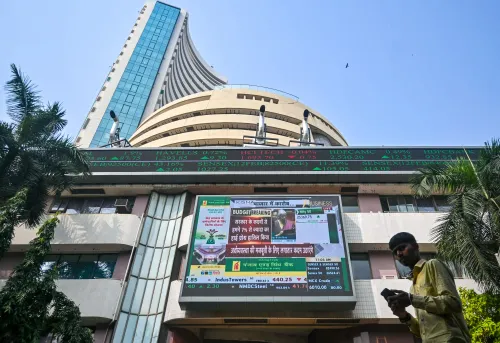
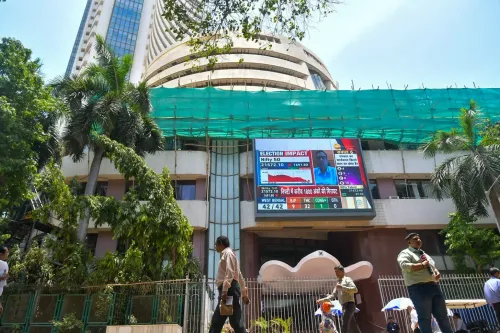
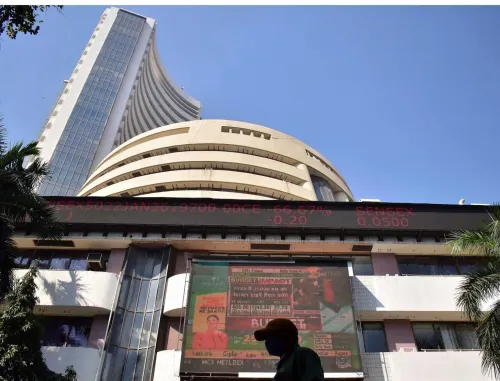
Mumbai, Dec 23 (NationPress) The Indian stock market began on a negative note on Tuesday, impacted by declines in IT stocks following a rebound of artificial intelligence (AI) stocks in the United States.
As of 9:30 AM, the Sensex fell by 159 points, or 0.19 percent, settling at 85,407, while the Nifty decreased by 32 points, or 0.13 percent, to reach 26,139.
The primary broad cap indices exhibited mixed results, with the Nifty Midcap 100 down by 0.18 percent, contrasted by a slight gain of 0.07 percent in the Nifty Smallcap 100.
Among the notable gainers in the Nifty pack were ONGC, Tata Steel, and NTPC, while Max Healthcare, TCS, Tech Mahindra, Asian Paints, and ICICI Bank were among the losers.
Sector-wise, indices on the NSE demonstrated a mixed performance, with the IT sector leading the losses, down by 1.21 percent. Conversely, the oil and gas as well as metal sectors showed significant gains, up by approximately 0.43 and 0.41 percent, respectively.
Analysts noted that immediate resistance levels for the Nifty are situated between 26,300 and 26,350, while substantial support lies within the 26,000 to 26,050 range.
Market analysts identified two key factors likely to influence market dynamics in the near term: robust macroeconomic indicators and the revival of AI trading. Strong macro data may encourage bulls to propel both the Nifty and Sensex to unprecedented heights. However, the proliferation of AI trading may pose a mild external challenge, potentially delaying any anticipated reversal of foreign institutional investor (FII) outflows, they added.
Defence stocks appear to be on the mend, suggesting further growth potential in this sector, while the IT sector has also demonstrated resilience, according to analysts.
In the Asia-Pacific region, markets reported moderate gains on Tuesday, buoyed by the uplift from AI trading which positively impacted major Wall Street indices the previous night.
In Asian markets, China's Shanghai index rose by 0.34 percent, while Shenzhen climbed 0.65 percent. Japan's Nikkei saw a marginal increase of 0.02 percent, and Hong Kong's Hang Seng Index gained 0.33 percent. South Korea's Kospi was up 0.45 percent.
The US markets concluded mostly in the green overnight, with the Nasdaq advancing by 0.52 percent, the S&P 500 rising by 0.64 percent, and the Dow increasing by 0.47 percent.
Investors are closely monitoring escalating geopolitical tensions, particularly between the US and Venezuela, as well as delays in peace negotiations concerning Russia and Ukraine. The assassination of a Russian army general in a bombing on Monday has heightened concerns regarding the peace dialogue, consequently supporting crude oil prices.
On Monday, foreign institutional investors (FIIs) divested equities worth Rs 516 crore, while domestic institutional investors (DIIs) emerged as net buyers, acquiring equities worth Rs 3,898 crore.
Point of View
It is essential to maintain a balanced perspective. While the declines in the IT sector may raise concerns, the overall resilience of the market and the potential for recovery in defence stocks suggest that there are still opportunities for investors. As always, staying informed and adaptable is crucial in navigating the complexities of the financial landscape.
NationPress
7 Oct 2026
Frequently Asked Questions
What caused the decline in the Indian stock market?
The decline is primarily attributed to losses in IT stocks following a revival of AI stocks in the US.
How did the Sensex and Nifty perform?
As of 9:30 AM, the Sensex fell by 159 points to 85,407, while the Nifty decreased by 32 points to 26,139.
What sectors showed gains amid the downturn?
The oil and gas, as well as metal sectors, registered gains of approximately 0.43 and 0.41 percent, respectively.
What are the immediate resistance and support levels for the Nifty?
Immediate resistance for the Nifty is observed between 26,300 and 26,350, while key support lies in the 26,000 to 26,050 range.
What impact does geopolitical tension have on the market?
Escalating geopolitical tensions can create uncertainty in the market, potentially affecting investor confidence and market movements.