South Korea overdraft loans hit 3-year high as KOSPI surges 70%
Synopsis
South Korea's stock market boom is being fuelled — and measured — by a surge in borrowed money. Overdraft balances at the country's five biggest banks have hit a three-year high of 40.5 trillion won, while demand deposits are draining fast. With the KOSPI up over 70% and retail investors placing record large orders, the question is no longer whether the rally is real — it's whether the leverage behind it is sustainable.
Key Takeaways
Overdraft loan balances at South Korea's five major banks reached 40.5 trillion won as of Thursday — the highest since January 2023 .
Balances rose by 715.2 billion won in just three business days after the end of April .
Demand deposits fell by 3.36 trillion won in April alone, suggesting a shift of funds into equities.
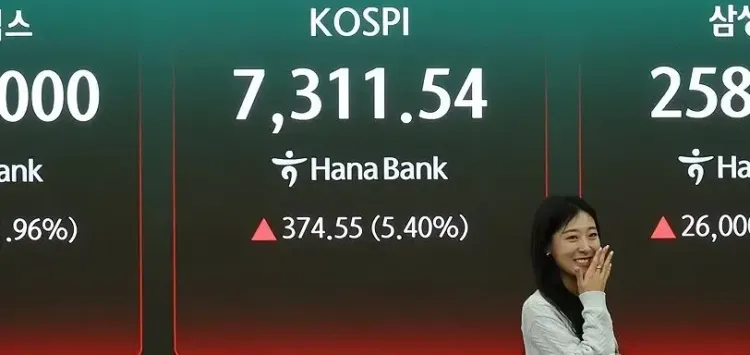
The KOSPI has surged more than 70% this year, hitting a record high of 7,498 on Friday.
Retail investors placed a record 1,193,158 large orders (over 100 million won each) on the KOSPI in April .
Overdraft credit loans at South Korea's five major commercial banks have surged to their highest level in over three years, as retail investors tap short-term liquidity to ride a booming stock market. Data released on Sunday, 10 May showed the balance of personal overdraft loans — commonly known as "minus accounts" — stood at 40.5 trillion won (approximately US$27.64 billion) as of Thursday.
Overdraft Balances at a Three-Year Peak
The combined overdraft loan balance at KB Kookmin, Shinhan, Hana, Woori, and NH Nonghyup banks marks the largest figure since January 2023, when the total reached 40.54 trillion won. In just the three business days since the end of April, the balance climbed by 715.2 billion won, indicating a sharp acceleration in borrowing activity.
Demand Deposits Declining in Parallel
Simultaneously, demand deposits — traditionally viewed as standby funds — have continued to fall, pointing to a broader reallocation of capital from savings into equities. As of Thursday, combined demand deposit balances at the five lenders totalled 696.06 trillion won, down 501.3 billion won from the end of last month. In April alone, the balance fell by 3.36 trillion won.
"As the stock market rallies, a growing number of investors appear to be using short-term liquidity for stock investments," a bank official said. "Due to tighter government regulations on household loans, there also appears to be demand for credit loans to supplement housing-related funding needs."
KOSPI Among World's Best-Performing Indices
The surge in borrowing is closely tied to the remarkable performance of South Korea's benchmark Korea Composite Stock Price Index (KOSPI), which has been among the world's best-performing equity indices this year. The index has surged more than 70 percent, driven largely by strong gains in semiconductor stocks. On Friday, the KOSPI reached a fresh record high of 7,498.
Notably, the rally has drawn in retail investors at an unprecedented scale. The number of large orders worth over 100 million won placed by retail investors on the KOSPI totalled 1,193,158 in April — the highest monthly figure ever recorded, according to data from the bourse operator, the Korea Exchange.
Regulatory Backdrop and What Comes Next
The uptick in credit loans also reflects tighter government regulations on household lending, which have pushed some borrowers toward overdraft facilities to meet housing-related funding needs. Analysts will be watching whether the Bank of Korea or financial regulators respond to the rapid build-up in leveraged equity positions, particularly if market volatility returns. A sustained KOSPI correction could expose overleveraged retail investors to significant losses, making the current borrowing trend a key risk indicator for South Korea's financial stability.
Point of View
They are actively going into debt to chase equity gains. South Korea's KOSPI has been a standout performer globally this year, but a 70% rally powered significantly by semiconductor euphoria and borrowed money is a combination that warrants scrutiny. Regulators tightening household loan rules while overdraft balances quietly hit multi-year highs is a policy contradiction worth watching. If the semiconductor cycle turns or global risk appetite fades, the unwinding of this leveraged retail position could amplify any market correction sharply.
NationPress
23 Sept 2026
Frequently Asked Questions
Why have South Korea's overdraft loans hit a three-year high?
Overdraft loans at South Korea's five major banks reached 40.5 trillion won as investors borrow short-term funds to invest in a surging stock market. Tighter government regulations on household loans have also pushed some borrowers toward overdraft facilities for housing-related needs.
How has the KOSPI performed in 2025?
The KOSPI has surged more than 70% in 2025, driven largely by strong gains in semiconductor stocks. The index hit a fresh record high of 7,498 on Friday, making it one of the world's best-performing equity benchmarks this year.
What is a 'minus account' in South Korea?
A 'minus account' is a personal overdraft loan product offered by South Korean banks, allowing account holders to borrow up to a pre-approved credit limit directly from their bank account. It functions as a flexible, short-term credit line commonly used for liquidity needs.
Are South Korean retail investors increasingly active in the stock market?
Yes. Retail investors placed a record 1,193,158 large orders worth over 100 million won each on the KOSPI in April — the highest monthly figure ever recorded, according to the Korea Exchange.
What risks does rising overdraft borrowing pose to South Korea's financial system?
If the KOSPI rally reverses, leveraged retail investors could face significant losses and be forced to repay overdraft loans quickly, potentially amplifying market volatility. Regulators and the Bank of Korea are likely monitoring the build-up in leveraged equity positions as a financial stability risk.