Indian women lead globally in AI skill adoption, outpace US and UK: Stanford Report

Synopsis
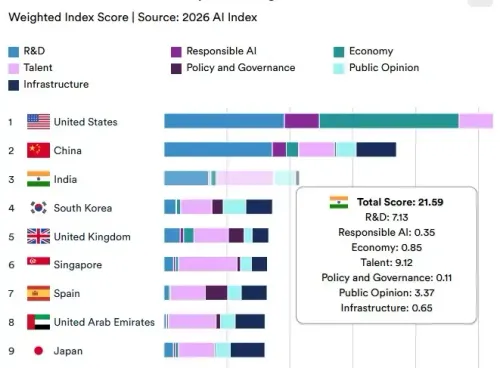
Indian women now lead the world in AI skill penetration with a score of 1.9 — ahead of the US, Canada, and the UK — and use AI at work more frequently than Indian men. Combined with India's record 80 per cent weekly AI adoption rate, the Stanford AI Index 2026 and ADP Research data together paint India as the world's most AI-engaged workforce, even as a productivity paradox quietly complicates the picture.
Key Takeaways
Indian women scored 1.9 on AI skill penetration — highest globally, ahead of the US (1.71) , Canada (0.97) , and UK (0.90) , per the Stanford AI Index 2026 .
The score improved from 1.61 in the previous year's index, marking year-on-year growth.
44 per cent of Indian women use AI nearly every day at work, compared to 40 per cent of men.
80 per cent of Indian employees use AI at least multiple times a week — the highest across all surveyed markets, according to ADP Research .
India accounts for 5.2 per cent of open-source AI projects with at least 10 stars , with its share rising steadily.
Daily AI users were four times more likely than non-users to report feeling less productive, flagging a growing productivity paradox.
Indian women have recorded the highest AI skill penetration rate among women globally, scoring 1.9 on the metric — surpassing women in the United States (1.71), Canada (0.97), and the United Kingdom (0.90), according to the Stanford AI Index 2026. The figure also marks a notable climb from 1.61 recorded in the previous year's edition of the same index.
India's AI Skill Surge Among Women
The Stanford AI Index 2026 tracks AI-related learning activity across countries, and India's women now lead every major economy on this measure. The year-on-year jump from 1.61 to 1.9 signals accelerating momentum, not a statistical outlier. Notably, the gap between India and the next-highest country — the United States at 1.71 — has widened compared to prior years, suggesting structural, not incidental, growth.
This comes amid a broader surge in AI adoption across the Indian workforce. According to a separate report by ADP Research, 80 per cent of employees in India use AI at least multiple times a week — the highest level recorded across all surveyed markets globally. 41 per cent of Indian employees reported using AI nearly every day, with Nigeria (39 per cent) and Vietnam (36 per cent) trailing behind.
Women Outpacing Men in Daily AI Use
Within India, women are using AI more frequently than their male counterparts at the workplace. 44 per cent of women reported using AI nearly every day at work, compared to 40 per cent of men. This reverses a pattern seen in many other economies, where men tend to lead on technology adoption at the workplace.
The data points to a shift in how Indian women are engaging with emerging technologies — driven, analysts suggest, by the expansion of AI-integrated tools in sectors where women are strongly represented, including services, education, and healthcare.
India's Growing Open-Source AI Footprint
Beyond skill adoption, India is also expanding its presence in the global open-source AI ecosystem. The Stanford AI Index 2026 found that India accounted for 5.2 per cent of AI projects with at least 10 stars on open-source platforms in 2025 — a share that has grown steadily over recent years.
The United States remained the dominant contributor at 31.7 per cent, though that figure has declined sharply from nearly 80 per cent in 2011 as developers across Asia and other regions have increased their presence. China's share has levelled off since 2019, while India's continues to rise.
The Productivity Paradox
The findings are not without complication. The ADP Research report flagged a growing disconnect between AI adoption and perceived productivity. While 30 per cent of daily AI users reported being fully engaged at work, they were four times more likely than non-users to feel less productive.
As AI tools take over routine tasks, employees reportedly found it harder to quantify and demonstrate their contributions — a challenge that organisations and policymakers will need to address as adoption deepens. This tension between tool usage and measurable output is emerging as one of the defining workforce questions of the AI era.
What This Means Going Forward
India's combination of high AI adoption rates and leading AI skill penetration among women positions the country as a significant force in the global AI workforce landscape. Whether this translates into economic gains — in wages, productivity, and innovation output — will depend on how employers structure roles and how the education system builds on this momentum. The next edition of the Stanford AI Index will be a key benchmark to watch.
Point of View
But it demands scrutiny of what the metric actually measures — learning activity on platforms, not necessarily applied capability or economic return. The productivity paradox buried in the ADP Research findings is the more consequential story: if daily AI users feel less productive, organisations may be layering tools onto workflows without redesigning work itself. India's AI adoption lead is real, but translating usage rates into wage growth and innovation output requires structural changes that neither report addresses. The headline number flatters; the footnotes warn.
NationPress
26 Sept 2026
Frequently Asked Questions
What did the Stanford AI Index 2026 find about Indian women and AI skills?
The Stanford AI Index 2026 found that Indian women scored 1.9 on AI skill penetration — the highest among women globally — surpassing the United States (1.71), Canada (0.97), and the United Kingdom (0.90). The score also improved from 1.61 recorded in the previous year's index.
How does India's overall AI adoption compare to other countries?
According to ADP Research, 80 per cent of Indian employees use AI at least multiple times a week, the highest level recorded across all surveyed markets. Additionally, 41 per cent use AI nearly every day, ahead of Nigeria (39 per cent) and Vietnam (36 per cent).
Are Indian women using AI more than Indian men at work?
Yes. According to the ADP Research report, 44 per cent of Indian women use AI nearly every day at work, compared to 40 per cent of men — a reversal of the pattern seen in many other countries.
What is the productivity paradox flagged in the report?
The ADP Research report found that 30 per cent of daily AI users reported being fully engaged, but they were four times more likely than non-users to feel less productive. As AI handles routine tasks, employees reportedly find it harder to quantify their contributions.
How significant is India's contribution to open-source AI projects?
India accounted for 5.2 per cent of AI projects with at least 10 stars on open-source platforms in 2025, according to the Stanford AI Index 2026. The United States led with 31.7 per cent, though its share has fallen sharply from nearly 80 per cent in 2011.