India ranked 3rd in Global AI Vibrancy as ₹10,372 crore Mission reshapes strategy

Synopsis
India has broken into the top three of Stanford's Global AI Vibrancy Ranking, backed by a ₹10,372 crore national mission and a shared GPU pool designed to democratise access to compute. The real differentiator, according to the report, is not just scale — it is India's choice to govern AI through a balanced framework rather than heavy regulation, a bet that could define whether India becomes a rule-maker or a rule-taker in the global AI order.
Key Takeaways
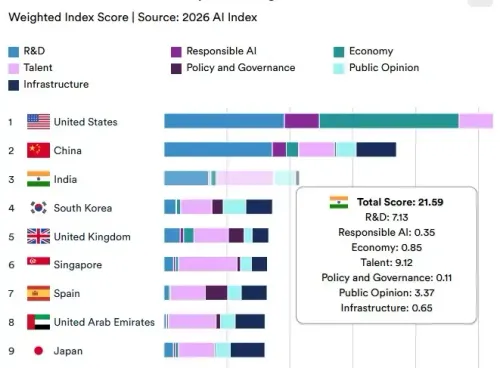
India ranked third in Stanford University's 2025 Global AI Vibrancy Ranking , behind the US and China.
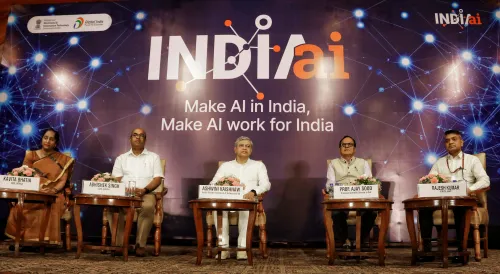
The India AI Mission , backed by ₹10,372 crore , targets computing capacity, research, startup support, and skilling.
Shared computing facilities with over 38,000 GPUs aim to prevent concentration of AI resources among large corporations.
87 per cent of Indian enterprises have adopted AI solutions; the market is projected at $131.31 billion by 2032 .
India's Digital Public Infrastructure — Aadhaar, UPI, DigiLocker, BHASHINI — is cited as a global model underpinning AI-driven public services.
India has chosen a light-touch AI governance framework rather than restrictive legislation, drawing both praise and cautionary notes from observers.
India is rapidly consolidating its position as a global artificial intelligence powerhouse, combining large-scale public investment, shared computing infrastructure, and a governance framework designed to balance innovation with democratic safeguards, according to a recent report. The country ranked third in Stanford University's 2025 Global AI Vibrancy Ranking, trailing only the United States and China.
India AI Mission: The ₹10,372 Crore Blueprint
At the centre of this transformation is the India AI Mission, backed by an outlay of ₹10,372 crore. The initiative marks a strategic pivot — from India's long-established identity as the world's software services hub to an ambition of becoming a globally competitive AI leader. The mission targets four pillars: computing capacity, research acceleration, startup support, and large-scale skilling.
A defining feature of the mission is its emphasis on shared computing infrastructure, with plans for over 38,000 GPUs in pooled facilities. This architecture is intended to prevent AI resources from concentrating in the hands of a few large corporations — a concern that has grown globally as compute costs become a key barrier to entry.
Market Scale and Enterprise Adoption
India's AI momentum is also being driven from the private sector. According to the report, 87 per cent of Indian enterprises have already adopted AI solutions. The domestic AI market is projected to reach $131.31 billion by 2032, positioning India as a significant engine of global AI growth.
India's deep talent pool and rapid enterprise uptake are cited as structural strengths that distinguish it from other emerging AI economies. Notably, this adoption rate is among the highest recorded for a developing economy of India's scale.
Global Diplomacy and AI's Rising Profile
AI has also moved to the centre of India's foreign policy engagements. During Prime Minister Narendra Modi's visits to France and the G7 Summit, artificial intelligence featured prominently in discussions covering innovation, digital infrastructure, research collaboration, and responsible technology deployment, according to the report.
The Bharat Innovates 2026 event further amplified India's international profile, showcasing capabilities across AI, fintech, healthcare, space, and deep technology to a global audience.
Governance Model: Innovation Without Over-Regulation
The report specifically commended India's distinct approach to AI governance. Rather than imposing restrictive legislation — the path taken by the European Union with its AI Act — India has opted for what the report describes as a 'balanced framework that promotes innovation while addressing concerns over privacy, bias, misinformation, cybersecurity and digital sovereignty.'
This light-touch regulatory posture has drawn both praise and scrutiny. Proponents argue it preserves the agility that Indian startups need to compete globally. Critics, however, caution that the absence of binding rules could leave citizens exposed to algorithmic bias and data misuse as AI deployment scales rapidly.
Digital Public Infrastructure as AI's Foundation
India's existing Digital Public Infrastructure (DPI) — encompassing Aadhaar, UPI, DigiLocker, and BHASHINI — provides a ready foundation for AI-driven public services. These platforms are increasingly cited internationally as scalable and affordable models for digital governance, giving India a structural head-start in deploying AI at population scale.
With its Stanford ranking, mission funding, and DPI base now aligned, India's next test will be translating policy ambition into verifiable outcomes — particularly on skilling, startup success rates, and equitable access to AI benefits across income groups.
Point of View
But rankings measure vibrancy — not outcomes. The ₹10,372 crore mission is well-structured on paper, yet the shared GPU model will only democratise AI if access protocols are transparent and startup onboarding is genuinely frictionless. More critically, India's deliberate choice to avoid binding AI regulation is a double-edged wager: it preserves startup agility but leaves a regulatory vacuum that could be exploited as AI systems scale into healthcare, credit, and law enforcement. The EU's AI Act, for all its friction, at least creates accountability trails. India's 'balanced framework' needs enforceable teeth — or the innovation story risks being undermined by the first major algorithmic harm incident.
NationPress
24 Sept 2026
Frequently Asked Questions
What is the India AI Mission and how much has been allocated to it?
The India AI Mission is a national initiative backed by an outlay of ₹10,372 crore, aimed at building computing capacity, accelerating research, supporting startups, and developing AI skills at scale. It includes shared GPU facilities with over 38,000 units to ensure broad access to compute resources.
Where does India rank in the Stanford Global AI Vibrancy Ranking 2025?
India ranked third in Stanford University's 2025 Global AI Vibrancy Ranking, behind the United States and China. The ranking reflects India's growing strengths in AI talent, enterprise adoption, and public digital infrastructure.
How large is India's AI market expected to become?
India's AI market is projected to reach $131.31 billion by 2032, according to the report. Currently, 87 per cent of Indian enterprises have already adopted AI solutions, one of the highest adoption rates among large developing economies.
How does India's AI governance approach differ from other countries?
Rather than imposing restrictive legislation like the EU's AI Act, India has adopted a balanced framework that promotes innovation while addressing concerns over privacy, bias, misinformation, cybersecurity, and digital sovereignty. Critics caution that the absence of binding rules could leave citizens exposed to harm as AI deployment scales.
What role does India's Digital Public Infrastructure play in its AI strategy?
Platforms such as Aadhaar, UPI, DigiLocker, and BHASHINI form the foundational layer for AI-driven public services in India. These are internationally recognised as scalable and affordable models for digital governance, giving India a structural advantage in deploying AI at population scale.