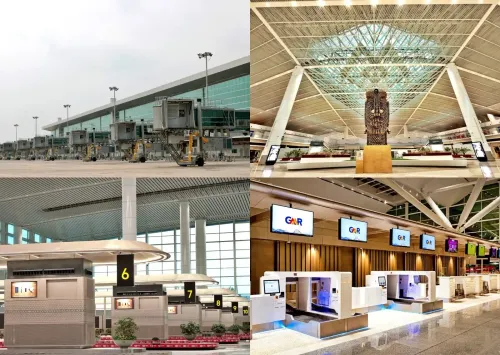
India's Alternate Airports Set for 40 Million Passengers by 2026

Synopsis
India's alternate airports are on track to handle 40 million passengers annually by 2026, driven by rising air travel needs. A new report underscores the significance of expanding these airports to ease congestion in major cities.
Key Takeaways
Projected capacity: 40 million passengers by 2026.
Growth factors: Increased air travel demand and improved connectivity.
Future expansion: Capacity may reach 45-50 million by fiscal 2030.
Regional focus: Development in NCR, MMR, and Goa.
Financial sustainability: Critical for new airports' operational success.
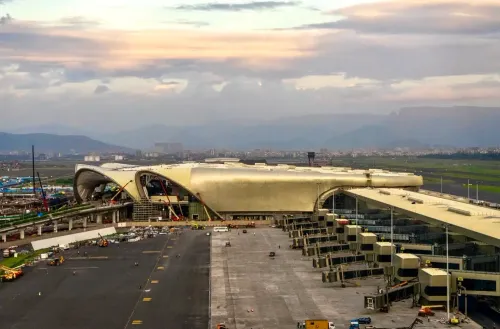
New Delhi, Feb 24 (NationPress) The alternate airports in India, designed to alleviate congestion at busy metropolitan hubs, are anticipated to achieve a collective annual passenger capacity of approximately 40 million by the close of 2026, according to a recent report released on Tuesday.
These airports are positioned to be vital in accommodating the growing demand for air travel, especially as older airports in critical metropolitan areas reach near their full capacity, as highlighted by a study from Crisil Ratings.
The report indicates that within the next four fiscal years, further development at these alternate airports could enhance their total capacity to manage between 45-50 million passengers each year by fiscal 2030.
This expansion will be fueled by pent-up demand resulting from the bottleneck at existing airports and the gradual extension of their service areas as connectivity improves.
Nonetheless, the report warns that a timely increase in operations will be essential for maintaining financial viability.
Crisil's analysis examines both operational and upcoming alternate airports situated in proximity to older airports, including those in the Delhi National Capital Region (NCR), the Mumbai Metropolitan Region (MMR), and Goa.
In metropolitan areas like NCR and MMR, older airports are already functioning at around 87% of their designed capacity as of the previous fiscal year.
Due to spatial limitations, these airports have minimal potential for large-scale expansion.
Ankit Hakhu, Director at Crisil Ratings, mentioned that alternate airports in urban centers are projected to manage 20-25% of the total regional air traffic by fiscal 2030.
He emphasized that increasing both aeronautical and non-aeronautical revenue during the initial control period will be crucial for these new airports.
The report observed that the older airport in Mumbai experienced slower growth post-fiscal 2017 due to capacity restrictions, as it could not offer additional peak-hour slots to airlines.
In contrast, Delhi's airport continued its upward trajectory during that same timeframe. However, Delhi too would have faced similar challenges in the medium term without the establishment of an additional airport in the area.
On the other hand, several other metro airports still have room for growth. Airports in Bengaluru and Hyderabad operated at about 65% of their design capacity in the last fiscal year, indicating potential for future expansion.
Looking forward, India's total airport passenger traffic is expected to rise from roughly 415 million this fiscal year to nearly 580 million by fiscal 2030, representing a compound annual growth rate of 8-9%.
This growth will be driven by robust economic activity, unfulfilled demand for air travel, and the alleviation of capacity constraints at major airports.
Gauri Gupta, Team Leader at Crisil Ratings, mentioned that alternate airports also encounter various risks.
Point of View
The growth of alternate airports in India is a strategic move to address the increasing demand for air travel. The focus on expanding infrastructure will not only alleviate congestion but also stimulate economic growth and enhance connectivity across regions.
NationPress
26 Sept 2026
Frequently Asked Questions
What is the projected capacity of India's alternate airports by 2026?
India's alternate airports are expected to reach a combined annual capacity of around 40 million passengers by the end of 2026.
Why are alternate airports important for India?
Alternate airports are crucial for managing rising air travel demand and reducing congestion at existing metropolitan airports.
What factors will drive the growth of these airports?
The growth will be driven by pent-up demand, improved connectivity, and the need to alleviate congestion at older airports.
What is the expected passenger traffic growth by 2030?
India's total airport passenger traffic is projected to increase from about 415 million this fiscal year to nearly 580 million by fiscal 2030.
What risks do alternate airports face?
Alternate airports face various operational risks, including the need for timely ramp-up of services to ensure financial stability.