India data centre boom: AI and cloud drive capacity to 5x growth by 2030

Synopsis
India's data centre industry is set for a potential five-fold capacity expansion by 2030, with the country's digital economy targeting $1 trillion in the same year. Google's proposed $15 billion, one-gigawatt hyperscale hub in Visakhapatnam — potentially one of its largest outside the US — crystallises just how strategically global hyperscalers are now betting on India's infrastructure story.
Key Takeaways
India's digital economy is projected to reach $1 trillion by 2030 , fuelled by AI, cloud, and digital payments growth.
The country currently operates around 271 data centres with installed capacity of 1.57–1.79 GW .
Data-centre capacity could double in two years and grow five-fold by 2030 , according to industry projections.
Mumbai leads with approximately 650 MW of installed IT capacity; other key hubs include Chennai, Delhi-NCR, Bengaluru, Hyderabad, and Kolkata.
Google has proposed a $15 billion , 1 GW hyperscale data-centre hub in Visakhapatnam , expected to be among its largest outside the US.
India's IT and business services market reached $69 billion in FY26 ; nationwide IT spending is forecast at $176.3 billion in 2026 .
India's data centre industry is undergoing a structural transformation, emerging as the backbone of the country's digital economy, which is projected to reach $1 trillion by 2030, according to a recent industry report. The rapid scaling of cloud services, artificial intelligence applications, digital payments, and online public infrastructure is generating unprecedented volumes of data and sharply accelerating demand for computing capacity across the country.
Scale of the Digital Economy
India's IT and business services market reached $69 billion in FY26, while nationwide IT spending is projected to climb to $176.3 billion in 2026. Industry estimates further suggest the software products sector alone could exceed $100 billion by 2030, underpinned by expanding adoption of cloud computing, AI, data analytics, and digital services across sectors ranging from banking to healthcare.
This comes amid a broader acceleration in India's technology ecosystem, where the proliferation of e-commerce platforms, unified payments infrastructure, and enterprise software has fundamentally altered the country's data consumption profile.
Data Centre Capacity and Key Hubs
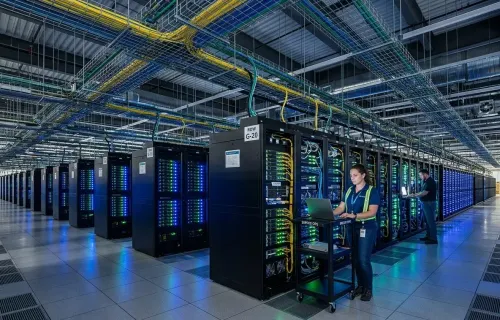
India currently operates around 271 data centres with an installed capacity estimated between 1.57 GW and 1.79 GW. According to industry projections, this capacity could double within two years and potentially increase as much as five-fold by 2030 as demand for digital services continues to accelerate.
Mumbai remains India's largest data-centre market, accounting for roughly 650 MW of installed IT capacity. The city's appeal is driven by competitive power costs, robust connectivity infrastructure, and direct access to international submarine cable networks. Other major hubs — Chennai, Delhi-NCR, Bengaluru, Hyderabad, and Kolkata — collectively host the bulk of the country's operational capacity.
Global and Domestic Investment Inflows
The sector is drawing significant capital from global technology majors and Indian conglomerates alike. Amazon, Google, and Microsoft are all expanding their data-centre footprints across India to support growing cloud and AI workloads, according to the report.
Among the most consequential announced projects is Google's proposed $15 billion investment in a one-gigawatt data-centre hub and hyperscale ecosystem in Visakhapatnam, Andhra Pradesh. The facility is expected to become one of Google's largest outside the United States and is also linked to the development of a proposed AI City initiative in Andhra Pradesh.
Why This Matters
Data centres have evolved well beyond back-end support functions — they now form the foundational layer for cloud platforms, digital payment rails, enterprise software, streaming services, and AI-powered applications. Notably, India's five-fold capacity expansion target by 2030 would represent one of the most ambitious infrastructure build-outs in the Asia-Pacific region.
The scale of announced investments also signals that global hyperscalers view India not merely as a consumer market, but increasingly as a strategic node in their global infrastructure networks. How quickly land acquisition, power supply, and regulatory clearances keep pace with investment commitments will determine whether projected timelines hold.
Point of View
But two structural bottlenecks — reliable power supply and land acquisition at scale — have historically slowed Indian infrastructure timelines. Google's $15 billion Visakhapatnam commitment is the single clearest signal yet that hyperscalers are treating India as a tier-one infrastructure destination, not just a software talent pool. What mainstream coverage underplays is the energy intensity of this build-out: a one-gigawatt data-centre ecosystem demands a power grid that several Indian states are not yet equipped to deliver consistently. The real story by 2027 will not be investment announcements, but whether megawatt targets are actually commissioned on schedule.
NationPress
21 Oct 2026
Frequently Asked Questions
How large is India's data centre industry today?
India currently has around 271 operational data centres with an installed capacity estimated between 1.57 GW and 1.79 GW. Mumbai is the largest single market, accounting for roughly 650 MW of installed IT capacity.
How fast is India's data centre capacity expected to grow?
Industry projections suggest India's data-centre capacity could double within two years and grow as much as five-fold by 2030, driven by accelerating demand for cloud, AI, and digital services.
What is Google's planned data centre investment in India?
Google has proposed a $15 billion investment in a one-gigawatt data-centre hub and hyperscale ecosystem in Visakhapatnam, Andhra Pradesh. The facility is expected to be among Google's largest outside the United States and is linked to a proposed AI City initiative in the state.
Which cities are the main data centre hubs in India?
Mumbai leads as India's largest data-centre market, followed by Chennai, Delhi-NCR, Bengaluru, Hyderabad, and Kolkata, which together host the majority of the country's operational capacity.
What is driving demand for data centres in India?
The primary drivers include rapid adoption of cloud computing, artificial intelligence, digital payments, e-commerce, and online public infrastructure. India's IT spending is projected to reach $176.3 billion in 2026, generating massive volumes of data that require expanding computing infrastructure.