India races to lead global AI data centre boom, 6.5GW capacity by 2030

Synopsis
India is no longer just a software services giant — it is fast becoming a core node in the global AI compute stack. With Google, Microsoft, Amazon, and the Adani Group collectively committing hundreds of billions of dollars, and government tax holidays running to 2047, India's data centre capacity is on course to hit 6.5GW by 2030, placing it third globally behind only the US and China.
Key Takeaways
India is among the leading global destinations for AI data centre investment, attracting commitments from Google , Microsoft , and Amazon .
Google has committed $15 billion to the region; the Adani Group has announced a $100 billion investment to build a 5GW AI platform by 2035 .
India's operational data centre capacity is projected to reach 6.5GW by 2030 .
Key hubs include coastal cities Mumbai , Chennai , and Visakhapatnam , with inland expansion in Hyderabad and Pune .
The government offers tax holidays until 2047 and concessional financing for companies investing in green AI infrastructure.
India is on course to rank third globally in AI competitiveness, behind only the US and China .
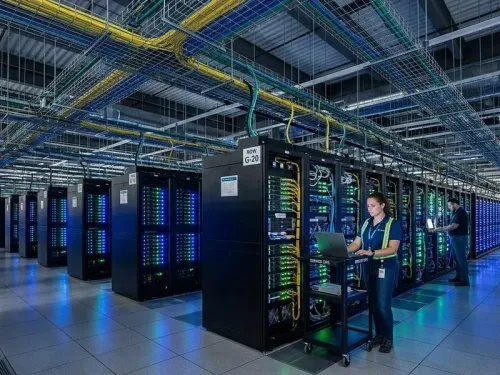
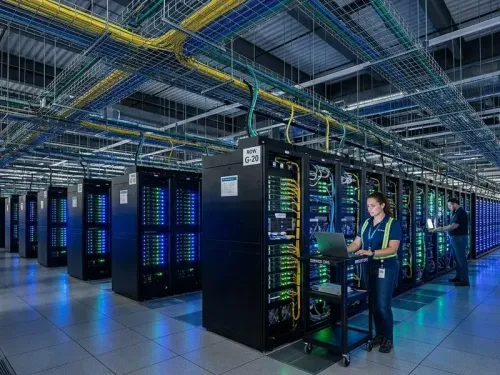
India has emerged as one of the world's foremost destinations for AI data centre investment, with global technology giants — Google, Microsoft, and Amazon — alongside major domestic conglomerates committing billions of dollars to build next-generation computing infrastructure across the country, according to a report in The Citizen. The country's operational data centre capacity is projected to reach approximately 6.5GW by the end of the decade, a scale that would rank India behind only the United States and China in global AI competitiveness.
Why India Is Winning the Location Race
Much of the incoming investment is gravitating toward coastal cities, particularly Mumbai and Chennai, whose proximity to undersea fibre-optic cable networks makes them natural anchors for hyperscale data centre campuses. Visakhapatnam (Vizag), the economic hub of the southern coastal state of Andhra Pradesh, is also emerging as a significant node in this expanding grid.
These facilities are infrastructure-intensive by nature — they demand vast quantities of electricity, large volumes of water for cooling heat-generating computing hardware, high-capacity fibre connectivity, and increasingly, access to renewable energy sources. India's coastline, with its cable-landing advantages and growing renewable capacity, fits that profile.
The Scale of Commitments
Google has committed $15 billion to the region, while the Adani Group has announced plans to invest $100 billion in building a 5GW AI platform by 2035. Inland technology centres — Hyderabad and Pune in particular — are simultaneously scaling up their cloud computing and AI infrastructure, broadening India's digital footprint well beyond its coastline.
Notably, this convergence of global and domestic capital marks a qualitative shift from India's earlier role as a back-office and software services hub toward becoming a core node in the global AI compute stack.
Government Policy as a Catalyst
India's supportive regulatory environment is a key driver behind the investment surge. The government has introduced concessional long-term financing for data centre developers and extended generous tax incentives — including tax holidays until 2047 — for companies investing in green AI infrastructure. This policy architecture has lowered the cost of entry for hyperscale operators and accelerated project timelines.
This comes amid a broader global scramble for AI compute capacity, where access to reliable power grids, fibre networks, and cooling water has become as strategically important as semiconductor supply chains. India's combination of scale, policy support, and coastal geography positions it to capture a disproportionate share of this buildout.
What Comes Next
With the 6.5GW capacity target set for 2030, the pace of construction and grid expansion will be closely watched. Analysts and industry observers note that execution — particularly on renewable energy supply and water access — will determine whether India's AI data centre ambitions translate into sustained operational leadership or remain concentrated in headline investment figures.
Point of View
But the 6.5GW target by 2030 will stress-test two chronic vulnerabilities: grid reliability and water availability. Hyperscale facilities are among the most power- and water-intensive assets on earth, and India's renewable capacity additions — while accelerating — have not consistently matched demand forecasts. The Adani Group's $100 billion commitment is eye-catching, but a single conglomerate anchoring that much of a strategic infrastructure sector raises concentration risk that policymakers have not publicly addressed. The tax holiday until 2047 is generous; the question is whether it is also smart — or whether India is leaving fiscal headroom on the table at a moment when global AI firms would invest here regardless.
NationPress
8 Oct 2026
Frequently Asked Questions
Why is India attracting so much AI data centre investment?
India offers a combination of coastal geography with access to undersea cable networks, a large and growing digital market, competitive land and labour costs, and a supportive government policy framework that includes tax holidays until 2047 and concessional financing for green AI infrastructure. Global technology firms including Google, Microsoft, and Amazon have all committed major investments in the country.
Which cities in India are becoming AI data centre hubs?
Mumbai and Chennai are the primary coastal hubs due to their proximity to undersea fibre-optic cable landing stations. Visakhapatnam in Andhra Pradesh is an emerging eastern coastal hub. Inland cities Hyderabad and Pune are also rapidly expanding their cloud computing and AI infrastructure.
What is the Adani Group's AI data centre plan?
The Adani Group has announced plans to invest $100 billion in building a 5GW AI platform by 2035, making it one of the largest single commitments to AI infrastructure in India.
What is India's projected data centre capacity by 2030?
India's operational data centre capacity is projected to reach approximately 6.5GW by the end of the decade, which would place the country among the top three globally in AI infrastructure scale, behind only the United States and China.
What government incentives are driving data centre investment in India?
The Indian government has introduced concessional long-term financing for data centre developers and tax holidays running until 2047 for companies that invest in green AI infrastructure. These measures have significantly lowered the cost of entry for hyperscale operators and accelerated project timelines.