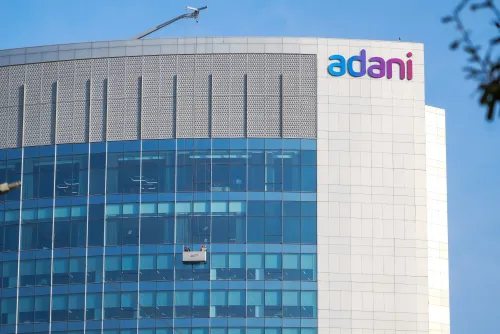
Adani Group's $100 Billion Renewable AI Data Centre Vision: A Transformative Force for India

Synopsis
Discover how the Adani Group's groundbreaking $100 billion investment in renewable-powered AI data centres could redefine India's position in the global AI landscape. This bold initiative promises to create a massive AI infrastructure ecosystem, marking a pivotal shift in the country's technological prowess.
Key Takeaways
$100 billion investment in AI data centres by Adani Group.
Potential to create a $250 billion AI infrastructure ecosystem.
Strategic partnerships with major tech companies.
Integration of renewable energy with AI computing.
Focus on data sovereignty and self-sufficiency.
New Delhi, March 3 (NationPress) The ambitious initiative by the Adani Group to invest $100 billion in renewable-powered, AI-optimized hyperscale data centres by 2035 could significantly alter India's position in the international AI market, as reported by the Carbon Credits.com news portal.
“What stands out prominently is the sheer scale of investment. Adani's direct commitment of $100 billion is anticipated to spark an additional $150 billion in sectors like server manufacturing, advanced electrical systems, sovereign cloud platforms, and more. This could lead to the formation of a $250 billion AI infrastructure ecosystem in India over the next decade,” the article notes.
The Adani Group aims to scale its current 2 GW national footprint to a target of 5 GW. As a result, India is positioned to become one of the largest integrated renewable-powered AI data centre platforms globally.
Strategic collaborations are highlighted, including a partnership with the US tech giant Google to establish a gigawatt-scale AI data centre campus in Visakhapatnam and a joint effort with Microsoft for major campuses in Hyderabad and Pune. Furthermore, discussions with Flipkart are underway for a second AI-focused facility designed for high-performance digital commerce and expansive AI workloads.
The article emphasizes that, in contrast to conventional data centre approaches, this 5 GW initiative integrates renewable energy generation, transmission networks, storage systems, and hyperscale AI computing into a unified architecture. This integration allows for the essential energy backup to grow alongside the power-intensive compute capacity.
“This strategy is crucial as AI workloads are increasingly demanding in terms of energy. Contemporary AI racks can consume 30 kW or more per unit,” the article states.
Data sovereignty remains a critical focus. The dedicated compute capacity will bolster Indian large language models and national data initiatives, ensuring sensitive data remains within the nation while leveraging global infrastructure.
The growth of AI is intrinsically linked to energy accessibility. The worldwide increase in AI usage has raised concerns regarding escalating electricity demands and carbon emissions. Adani plans to anchor its AI advancements on renewable energy sources, with a pivotal component being the 30 GW Khavda renewable project in Gujarat, of which over 10 GW is already operational. Additionally, the Group has committed an extra $55 billion to enhance its renewable portfolio, which includes one of the world's largest battery energy storage systems.
Global disruptions have revealed weaknesses in obtaining transformers, power electronics, and grid systems. Thus, Adani intends to co-invest in domestic manufacturing partnerships to create high-capacity transformers, advanced power electronics, inverters, and industrial thermal management solutions within India. This initiative aims to reduce external reliance while fortifying India's industrial foundation.
“In the long run, India could transition from being merely a data hub to becoming a producer and exporter of next-generation AI infrastructure,” the article concluded.
Point of View
The Adani Group's ambitious investment in AI and renewable energy is a significant step towards establishing India as a leader in the global technology landscape. By integrating renewable energy with advanced AI infrastructure, India can not only achieve self-sufficiency but also enhance its competitive edge in the rapidly evolving digital economy.
NationPress
29 Sept 2026
Frequently Asked Questions
What is the Adani Group's investment plan for AI data centres?
The Adani Group plans to invest $100 billion in renewable-powered, AI-ready hyperscale data centres by 2035.
How much additional investment could this project generate?
This project is expected to catalyze an additional $150 billion in related sectors, leading to a potential $250 billion AI infrastructure ecosystem in India.
What are the key partnerships involved in this initiative?
The Adani Group has formed strategic partnerships with Google and Microsoft for AI data centres and is in talks with Flipkart for an AI-focused facility.
How does this project address energy demands?
The initiative integrates renewable energy generation with AI computing to meet the increasing energy demands of modern AI workloads.
What is the significance of data sovereignty in this project?
The project supports Indian large language models and national data initiatives, ensuring sensitive data is retained within the country.