How is India’s Digital Public Infrastructure Enhancing Public Finance Management Services?
Click to start listening
Synopsis
India's innovative approach to public finance management, leveraging digital infrastructure, is setting a new standard in fiscal discipline and efficiency. Discover how these initiatives are reshaping capital expenditures and enhancing governance outcomes.
Key Takeaways
- Digital public financial management is key to India's fiscal savings.
- The PFMS facilitates real-time monitoring of fund flows.
- Integration with DBT minimizes subsidy leakages.
- Digital tools enhance revenue generation and compliance.
- Fiscal discipline is critical for maintaining economic stability.
New Delhi, Dec 6 (NationPress) India's public finance management practices are fundamentally anchored in digital public financial management, leading to significant fiscal savings. This development paves the way for increased growth-oriented capital expenditures while upholding fiscal discipline, as stated by a senior government official.
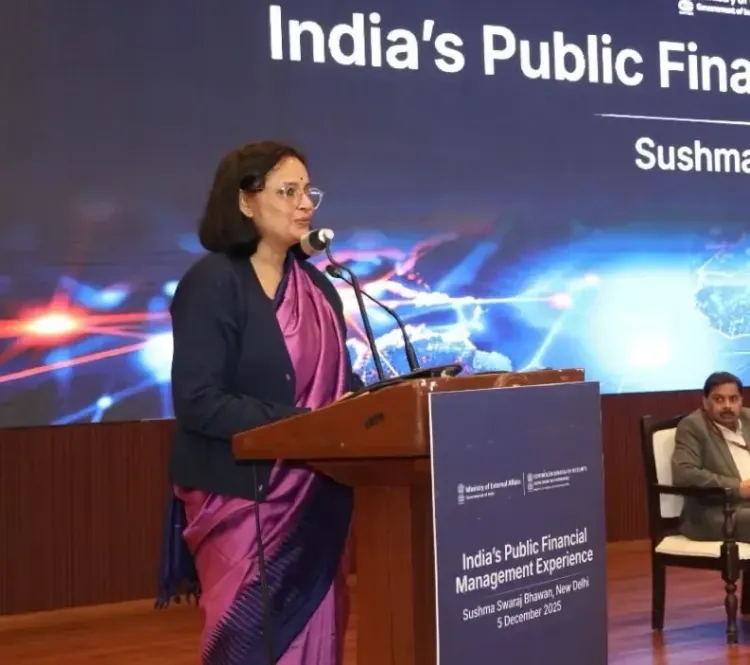
Anuradha Thakur, Secretary of the Department of Economic Affairs, remarked that establishing a solid implementation framework through public finance management practices is just as critical as having a supportive policy environment.
She highlighted several key components of India's digital public financial management, particularly the Public Financial Management System (PFMS). This unified platform facilitates real-time monitoring of fund transfers from the Union Government to states, agencies, and beneficiaries.
While addressing a seminar dedicated to sharing India's PFMS experiences with the Global South, the Secretary also pointed out the essential role played by the Civil Accounts Organisation in managing the PFMS platform.
Thakur noted that the integration of PFMS with Digital Payments and Direct Benefit Transfer (DBT) has guaranteed that subsidies and welfare benefits are delivered directly to the population, effectively reducing leakages and preventing duplication.
Moreover, the utilization of digital tools for revenue generation, such as e-invoicing, e-way bills, and faceless assessments, has expanded the tax base and curtailed evasion. These initiatives collectively have bolstered revenue flows and improved fiscal balance without raising tax rates.
The Secretary encapsulated the lessons learned from India's fiscal consolidation, emphasizing that a rules-based fiscal policy fosters discipline and credibility; regular mandatory disclosures alleviate information asymmetries that support efficient decision-making; and effective federal coordination mechanisms enhance compliance and alignment of fiscal objectives between the federal government and its constituent units.
Sudhakar Dalela, Secretary for Economic Relations, praised India's globally acknowledged accomplishments in Digital Public Infrastructure (DPI), including identity systems, instant payments, and secure data-sharing layers, which have enhanced accountability and improved governance outcomes.
TCA Kalyani, Controller General of Accounts of India, underscored India's enduring commitment to custodial integrity in public finance, emphasizing the critical role of treasury discipline in governance.
Kalyani stressed that India's public finance management modernization is rooted in the principle of “Koshpoorvah Sarvarambhah”, which asserts that every government action must commence with a robust and accountable treasury.
Point of View
India's approach to modernizing public finance management through digital means showcases the country's commitment to transparency and efficiency. By prioritizing fiscal discipline and innovative tools, India is setting a benchmark for nations aiming to enhance governance and fiscal responsibility.
NationPress
06/12/2025
Frequently Asked Questions
What is the Public Financial Management System (PFMS)?
The PFMS is India's unified platform for real-time monitoring of fund transfers from the Union Government to various states, agencies, and beneficiaries, enhancing transparency and efficiency.
How does India ensure subsidies reach the population?
By integrating PFMS with Digital Payments and Direct Benefit Transfer (DBT), India ensures that subsidies and welfare benefits are delivered directly to the beneficiaries, minimizing leakages and duplication.
What role does the Civil Accounts Organisation play in PFMS?
The Civil Accounts Organisation is responsible for managing the PFMS platform, ensuring its effective implementation and operation.
What are the benefits of digital tools in revenue generation?
Digital tools like e-invoicing and e-way bills help expand the tax base, reduce evasion, and strengthen revenue flows without increasing tax rates.
What principle underpins India's public finance management modernization?
The modernization is based on the principle of 'Koshpoorvah Sarvarambhah', emphasizing that every government action must start with a strong and accountable treasury.