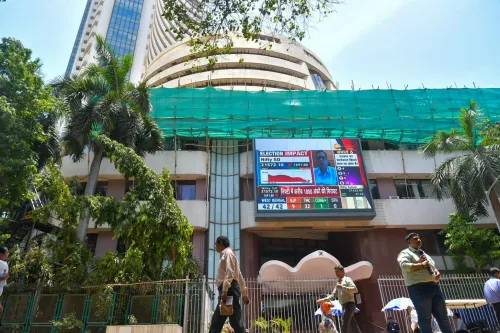
Is India’s Long-Term Outlook Truly Positive with Indices Approaching All-Time Highs in 2025?

Synopsis
India's long-term economic outlook is bright, driven by favorable demographics and policy stability. As 2025 approaches, while equity markets are near record highs, investors face mixed signals. This article delves into the nuances of the Indian stock market's performance and its future trajectory.
Key Takeaways
India's long-term economic outlook is positive.
Benchmark indices are close to record highs, but performance is mixed.
Large-cap stocks show stability, while small-caps struggle.
Investment strategies should focus on stock selection.
Macroeconomic factors support steady growth and moderate inflation.
New Delhi, Dec 16 (NationPress) India’s long-term prospects remain decidedly optimistic, bolstered by favorable demographics, policy stability, accelerated urbanization, and consistent productivity improvements, according to a report released on Tuesday.
As we near the end of 2025, the Indian equity markets exhibit mixed indicators. While benchmark indices are hovering near their all-time highs, a closer look reveals a more complex scenario.
According to the report by Smallcase Managers, valuations appear stretched throughout various market segments, smaller stocks are under pressure, and investors are becoming increasingly discerning about their capital allocation.
The report highlights that as US economic growth slows and the Federal Reserve shifts its stance, interest-rate differentials are likely to increasingly favor Emerging Markets, with India emerging as the most appealing choice.
Dhiren Shah, smallcase manager and Co-Founder of Kamayakya, stated, “We maintain a positive outlook on Indian equities for 2026, emphasizing stock selection over index performance. While public capital expenditure has fueled growth thus far, the next phase will stem from a resurgence in private capital expenditure as corporate balance sheets strengthen and capacity utilization increases, paving the way for the next chapter of India’s structural growth.”
India’s macroeconomic environment remains supportive, aided by easing inflation, the onset of a rate-cut cycle, and ongoing policy emphasis on manufacturing, infrastructure, and exports.
The report anticipates the economy will expand at a steady pace of 6-7 percent in real terms, with inflation stabilized around 4 percent, indicating a period of more stable, albeit slightly reduced, nominal growth compared to the previous decade.
“Concerns related to tariffs from the US, particularly regarding a possible return of Trump, pose more of a sentiment and liquidity risk for India rather than a structural threat. This situation could tighten global liquidity, increase volatility, and lead to temporary foreign institutional investment outflows, but it does not alter India’s fundamental growth narrative,” commented Vivek Sharma, smallcase manager and Investment Head at Estee Advisors.
Moreover, the AI-driven surge in several US mega-cap stocks has attracted a disproportionate share of global capital, leaving emerging markets underrepresented despite their solid fundamentals.
This situation has rendered Indian markets more susceptible to short-term, flow-driven fluctuations, even as domestic growth and earnings remain strong, Sharma noted.
The report indicates that in 2025, the performance of Indian equities has varied across different market segments.
Large-cap stocks have provided relatively stable returns of around 8 percent year-to-date (YTD), with valuations remaining steady at 22 times earnings.
“This suggests that gains are driven more by earnings resilience than by multiple expansion, reflecting investors’ preference for stability and robust balance sheets,” the report stated.
Mid-cap stocks have recorded modest returns of approximately 3 percent YTD, but have experienced a significant valuation reset, with P/E ratios compressing from 43 times to 33 times.
Small-cap stocks have performed even worse, declining 7.5 percent YTD, alongside a drop in valuations from 34 percent to 28 percent.
Overall, these trends indicate tighter liquidity, increasing risk aversion, and heightened scrutiny of earnings quality across the broader market, as highlighted by Smallcase managers.
Point of View
It's crucial to recognize that India's economic landscape is marked by both opportunities and challenges. The favorable demographic trends and policy consistency hold potential for growth, yet the mixed signals from the equity markets necessitate a cautious approach. Our commitment to providing accurate and timely information ensures that we navigate these complexities with integrity and expertise.
NationPress
6 Oct 2026
Frequently Asked Questions
What factors support India's positive economic outlook?
India's positive economic outlook is supported by factors such as favorable demographics, policy continuity, rapid urbanization, and sustained productivity gains.
How are Indian equity markets performing as of 2025?
As of 2025, Indian equity markets are near record highs, but performance varies across market segments with large-cap stocks delivering stable returns while small-caps are under pressure.
What is expected for India's economic growth in the coming years?
The economy is expected to grow at a steady rate of 6-7 percent in real terms, with inflation stabilized around 4 percent.
How do global factors influence India's market?
Global factors, including US economic shifts and tariff-related concerns, pose sentiment risks but do not fundamentally alter India's growth story.
What investment strategies are recommended for 2026?
Investors are encouraged to focus on stock selection rather than index levels, especially with an expected revival in private capital expenditure.