How is India Diversifying Currency and FTAs Amid U.S. IPEF Withdrawal?
Synopsis
India is on a mission to diversify its currency and strengthen its global economic position by expanding free trade agreements in response to the U.S. withdrawal from the Indo-Pacific Economic Framework. Discover how these efforts are reshaping the economic landscape of the region.
Key Takeaways
India is diversifying its currency to enhance economic security.
The e-rupee is gaining popularity in retail transactions.
FTAs are a strategy for geopolitical gains .
Interoperability among BRICS currencies could boost trade.
India is reducing reliance on the U.S. dollar .
Mumbai, Feb 21 (NationPress) India is actively pursuing currency diversification while also working to enhance supply chains and boost exports via free trade agreements (FTAs) as a response to the U.S. administration's retreat from the Indo-Pacific Economic Framework for Prosperity (IPEF), according to a recent report.
The report from Think China emphasized that currency diversification plays a crucial role in ensuring national economic security, especially as the goals of reducing external dependencies and fostering self-reliance have become imperative.
Furthermore, India's sovereign digital currency, the e‑rupee, is gaining popularity as it is increasingly utilized in retail transactions, the report noted.
It highlighted that the growing acceptance of the e-rupee and the interoperability among digital currencies within the BRICS nations could facilitate its more extensive use in international trade. This trend could emerge among countries that are testing their own sovereign digital currencies, such as China, Russia, Brazil, South Africa, Saudi Arabia, Qatar, Indonesia, and the UAE, most of which are BRICS members.
The report stated, "In addition to safeguarding supply chains and pursuing multiple FTAs, India's initiatives to lessen economic dependence have prompted it to conduct more trade using its local currency."
Besides the economic advantages, India is also seeking FTAs for geopolitical benefits, serving as political confidence-building measures among nations.
FTAs can enhance strategic influence by building a broader network of global allies, especially in a time when the global order is rapidly fragmenting, the report stated.
During President Trump’s second term, there was a noticeable disinterest in the IPEF, leading to a reduction in momentum for the China plus one diversification strategy.
The report pointed out that the unilateral trade restrictions imposed by the U.S. in 2025 made India and other significant economies aware of the necessity to diversify away from reliance on the U.S.
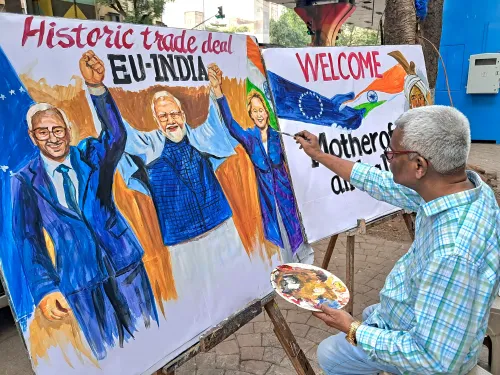
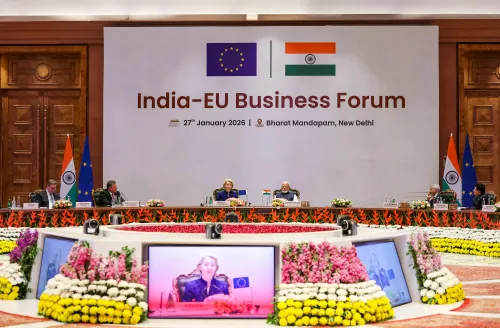
India has accelerated its FTA negotiations to broaden its market scope, successfully concluding agreements with the UK, New Zealand, Oman, and the EU. In recent years, it has also signed trade agreements with Australia, the UAE, and the European Free Trade Association (EFTA) group, while negotiations for FTAs with Israel, Chile, and the Gulf Cooperation Council (GCC) countries are ongoing.
Point of View
It's clear that India's drive for currency diversification and FTAs is not merely a response to geopolitical shifts but a strategic move to ensure economic self-reliance and stability in a rapidly changing global economic environment. The nation is prioritizing long-term resilience over short-term gains.
NationPress
6 Oct 2026
Frequently Asked Questions
What is the purpose of India's currency diversification?
India's currency diversification aims to enhance national economic security and reduce dependence on external currencies, fostering greater self-reliance.
How is the e-rupee being utilized?
The e-rupee is increasingly used in retail transactions and is gaining traction as more consumers adopt it for everyday purchases.
What are the benefits of India's FTAs?
FTAs provide economic advantages by expanding trade opportunities and serve as geopolitical tools to strengthen alliances and enhance strategic influence.
Which countries are involved in digital currency interoperability?
Countries exploring interoperability of their digital currencies include China, Russia, Brazil, South Africa, Saudi Arabia, Qatar, Indonesia, and the UAE, among others.
What impact did U.S. policies have on India's trade strategy?
U.S. unilateral trade restrictions prompted India and other economies to recognize the need for diversifying trade relationships and reducing reliance on the U.S.