India's ethanol blending beyond E20: feedstock, flex-fuel and policy gaps
Synopsis
India hit the E20 ethanol blending target ahead of schedule — but a new KPMG report argues the harder work starts now. Feedstock concentration in sugarcane, infrastructure gaps for higher blends, and slow flex-fuel vehicle uptake are the three fault lines that could stall the next phase of India's biofuel ambition.
Key Takeaways
India has operationalised E20 petrol — a 20% ethanol blend — nationwide, ahead of the original schedule.
A KPMG in India report released on 13 June says the sector must now shift from 'scale creation to system intelligence.' Second-generation (2G) ethanol from non-food biomass and alternative feedstocks such as maize and agricultural residues are identified as critical to future supply growth.
Blending and distribution infrastructure must evolve into multi-grade systems to support blends beyond E20.
Scaling flex-fuel vehicle (FFV) adoption is highlighted as a key demand-side enabler.
Policy coherence across agriculture, petroleum, and transport ministries — and stable ethanol pricing — are flagged as prerequisites for sustained progress.
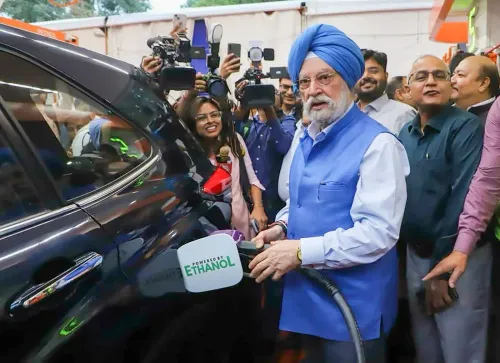
India's ethanol blending programme has crossed a landmark threshold, with E20 — a 20 per cent ethanol blend in petrol — operationalised nationwide ahead of schedule, according to a report released on Saturday, 13 June by KPMG in India. The report examines what comes next as the biofuel sector moves beyond this milestone and into a structurally more complex phase of growth.
From Scale to System Intelligence
The central argument of the KPMG report is that India's ethanol journey has outgrown its original mandate. Achieving E20 was a supply-side victory; sustaining momentum now demands a qualitative shift. Anish De, Global Head of Energy, Natural Resources and Chemicals at KPMG International, put it directly: 'Having achieved the E20 milestone ahead of schedule, the imperative now is to move from scale creation to system intelligence — where ethanol transitions from a blending mandate to a foundational pillar of a resilient, flexible and future-ready transport fuel ecosystem.'
This framing marks a significant evolution in how policymakers and industry are expected to approach the programme going forward.
Feedstock Diversification: The Critical Gap
The report identifies feedstock availability as one of the most pressing structural challenges. India's ethanol supply has historically leaned heavily on sugarcane and its derivatives — a first-generation pathway that carries inherent food-fuel competition risks. The KPMG findings call for expanded adoption of alternative feedstocks, including maize and agricultural residues, alongside a meaningful scale-up of second-generation (2G) ethanol production.
2G ethanol, derived from non-food biomass such as crop stubble and wood waste, is seen as the most viable route to incremental supply without straining food security. However, production efficiency improvements and technology investments remain prerequisites before 2G can contribute at scale.
Infrastructure and Supply Chain Readiness
Beyond feedstock, the report highlights significant gaps in blending and distribution infrastructure. Moving to higher blends — beyond E20 toward E25 or E30 — will require storage, transportation and distribution systems capable of handling multi-grade fuel simultaneously. Current infrastructure, largely designed around single-grade supply chains, is not yet equipped for that complexity.
Improved coordination, transparency and system-level visibility across the ethanol value chain are identified as critical enablers. Without these, operational inefficiencies and supply disruptions could undermine the reliability of higher-blend rollouts.
Demand-Side Flexibility and Flex-Fuel Vehicles
Vivek Rahi, Partner and National Head, Oil and Gas at KPMG in India, stressed that demand-side flexibility is equally important: 'India's ethanol journey has evolved from a targeted blending directive to a structurally significant component of the nation's transport energy architecture. As the sector advances beyond E20, the strategic priority must shift toward feedstock diversification, demand-side flexibility and infrastructure alignment at scale.'
A key lever on the demand side is the scaling of flex-fuel vehicle (FFV) adoption. Flex-fuel vehicles can run on any blend of petrol and ethanol, giving consumers and distributors greater flexibility as blend ratios evolve. Broader FFV penetration would also reduce the risk of consumer-side resistance to higher blends.
Policy Alignment and Pricing Mechanisms
The report underscores that policy coherence — across ministries handling agriculture, petroleum, and transport — will be decisive. Pricing mechanisms for ethanol procurement need to be stable and predictable enough to incentivise investment in 2G capacity and alternative feedstocks without creating market distortions. Addressing the food-fuel balance in a country where agricultural policy is deeply politically sensitive adds another layer of complexity that technical solutions alone cannot resolve.
As India charts its post-E20 trajectory, the KPMG findings suggest the next phase will be defined less by blending targets and more by the depth of systemic reform across feedstock, infrastructure, and policy architecture.
Point of View
But it risks becoming a ceiling rather than a launchpad if the structural gaps go unaddressed. India's ethanol programme is still overwhelmingly dependent on sugarcane — a single-crop, water-intensive, politically managed feedstock that cannot carry the load of higher blends indefinitely. The KPMG report's call for 2G ethanol and maize-based supply is correct, but 2G has been 'on the horizon' in India for nearly a decade without achieving commercial scale. The more uncomfortable question the report stops short of asking is whether ethanol pricing policy has been stable enough to attract the long-cycle capital that 2G plants require. Without that, feedstock diversification stays a slide in a presentation rather than a tonne in a tank.
NationPress
19 Sept 2026
Frequently Asked Questions
What is E20 petrol and has India achieved it?
E20 petrol is a blend of 20% ethanol and 80% petrol . Yes — India has operationalised E20 nationwide, reportedly ahead of its original target schedule, according to a KPMG in India report released on 13 June.
What does the KPMG ethanol report recommend for India beyond E20?
The report recommends a shift toward feedstock diversification — including maize and agricultural residues — greater investment in second-generation (2G) ethanol, scaling flex-fuel vehicle adoption, upgrading blending and distribution infrastructure to multi-grade systems, and stronger policy coherence across ministries.
What is second-generation (2G) ethanol and why does it matter?
2G ethanol is produced from non-food biomass such as crop stubble, wood waste, and agricultural residues, unlike first-generation ethanol derived from sugarcane or food crops. It matters because it can expand ethanol supply without intensifying food-fuel competition — a key concern as India targets blends beyond E20.
What are flex-fuel vehicles and why are they relevant to India's ethanol programme?
Flex-fuel vehicles (FFVs) can operate on any blend of petrol and ethanol, offering flexibility as blend ratios increase. The KPMG report identifies broader FFV adoption as a critical demand-side enabler for higher ethanol blends beyond E20.
What are the main risks to India's ethanol blending programme going forward?
The report identifies feedstock concentration in sugarcane, food-fuel balance pressures, infrastructure gaps for multi-grade distribution, inadequate storage and transportation capacity, and policy misalignment across ministries as the primary risks to sustaining momentum beyond the E20 milestone.