How Does India's Steel Sector Reflect the Nation's Economic Transformation?
Click to start listening
Synopsis
Discover how India's steel sector is not just a pillar of growth but a testament to the nation's economic evolution. Union Minister HD Kumaraswamy discusses ambitious goals, international collaboration, and the future of steel production in India at the upcoming 'Bharat Steel 2026' conference.
Key Takeaways
- India's steel sector plays a crucial role in the nation's economic transformation.
- It contributes approximately 2.5% to the GDP and supports 2.8 million jobs.
- Ambitious targets aim for 300 million tonnes of capacity by 2030 and 500 million tonnes by 2047.
- International collaboration is essential for future growth.
- 'Bharat Steel 2026' will serve as a global platform for stakeholders.
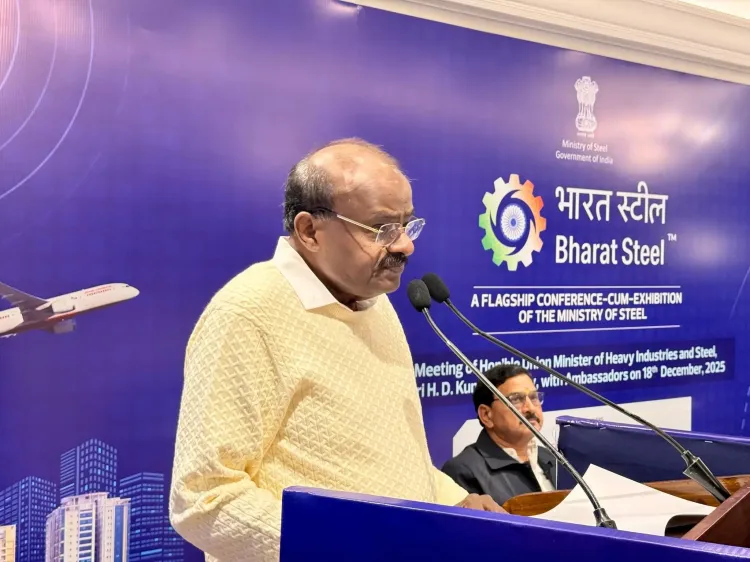
New Delhi, Dec 19 (NationPress) The steel industry in India is a reflection of the nation's overall economic evolution and has become a cornerstone of development, adaptability, and global participation, stated Union Minister for Steel and Heavy Industries, HD Kumaraswamy.
The minister pointed out that India stands as the world’s second-largest steel manufacturer, a milestone accomplished due to ongoing reforms, consistent investments, and a defined long-term vision centered on modernization, self-sufficiency, and sustainability.
He emphasized that the steel industry contributes approximately 2.5 percent to India’s GDP and provides support for nearly 2.8 million jobs, driven by the demand arising from infrastructure growth, manufacturing expansion, and critical sectors like defense and transportation.
During an interactive session with ambassadors and representatives from key partner nations, the minister encouraged their active involvement in ‘Bharat Steel 2026’, set to take place in April 2026.
This meeting is part of the ministry's initiatives to enhance international collaboration and strengthen India's ties with both global steel producers and consumers.
Kumaraswamy expressed gratitude to the ambassadors for attending, acknowledging that their involvement underscores the significance India places on reliable international partnerships.
Referring to the ‘National Steel Policy 2017’ and the visionary direction of Prime Minister Narendra Modi, Kumaraswamy stated that India is steadily advancing towards a steel production capacity of 300 million tonnes by 2030, with an even more ambitious goal of 500 million tonnes by 2047.
These objectives, he added, would further integrate India into global steel supply chains and create new opportunities for international cooperation.
The Ministry of Steel has committed to establishing an annual flagship International Conference-cum-Exhibition named “Bharat Steel.”
Kumaraswamy elaborated that 'Bharat Steel 2026' aims to serve as a global forum bringing together policymakers, industry leaders, investors, technology providers, and buyers from around the world.
A prominent aspect of the event will be a dedicated Reverse Buyer-Seller Meet designed to facilitate structured B2B interactions and nurture lasting partnerships. The conference will focus on expanding steel consumption, promoting sustainability and the circular economy, securing raw material supply chains, accelerating technological innovation, and enabling investments for capacity growth.
Point of View
The advancements in India's steel industry signify not only economic growth but also the potential for global leadership. The government's commitment to sustainability and self-reliance positions India favorably in the global market. As the sector opens avenues for international collaboration, it is crucial to maintain transparency and foster partnerships that benefit all stakeholders involved.
NationPress
21/12/2025
Frequently Asked Questions
What is India’s current position in global steel production?
India is currently the world’s second-largest steel producer, a position achieved through ongoing reforms and investments.
How does the steel sector contribute to India’s economy?
The steel sector contributes approximately 2.5% to India’s GDP and supports nearly 2.8 million jobs.
What are the goals of the 'Bharat Steel 2026' conference?
'Bharat Steel 2026' aims to facilitate international cooperation and bring together stakeholders from the steel industry to discuss innovation and sustainability.
What is the significance of the National Steel Policy 2017?
The National Steel Policy 2017 outlines India's vision for achieving a steel capacity of 300 million tonnes by 2030 and 500 million tonnes by 2047.
What initiatives are being taken to promote sustainability in the steel sector?
The conference will focus on promoting sustainability, securing raw material supply chains, and enhancing technological innovations.