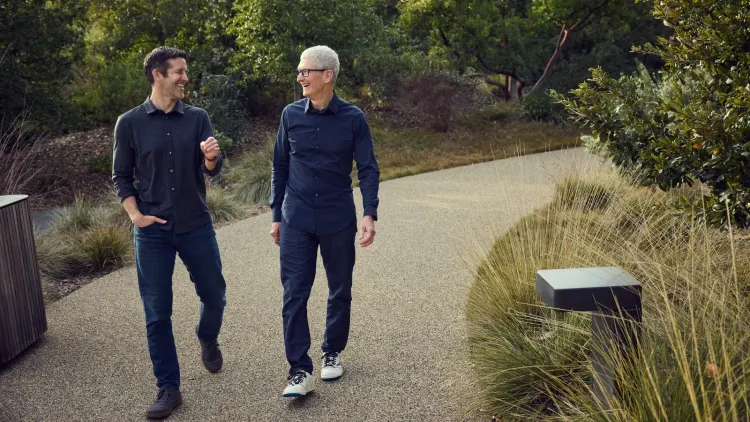
John Ternus takes over as Apple CEO, succeeding Tim Cook after 15 years
Synopsis
Apple has a new CEO for only the third time in its history. John Ternus — the hardware engineer behind the iPhone Air and MacBook Neo — takes the helm as Tim Cook steps back to executive chairman. The transition is orderly, but the challenge is not: Apple must now mount a credible AI offensive while defending a $4 trillion empire built on ecosystem lock-in.
Key Takeaways
John Ternus became Apple's CEO effective 1 September , succeeding Tim Cook after 15 years .
Tim Cook moves to a newly created executive chairman role, focusing on global policy engagement.
Under Cook, Apple's market cap grew from roughly $350 billion to around $4 trillion ; annual revenue rose from $108 billion to more than $400 billion .
Ternus joined Apple in 2001 and became SVP of hardware engineering in 2021 , overseeing the iPhone, Mac, iPad, and AirPods lines.
Apple's services segment — App Store, Apple Music, Apple Pay — now generates more than $100 billion annually.
Ternus inherits the challenge of accelerating Apple's AI strategy against intensifying competition.
John Ternus became Apple's new chief executive officer effective 1 September, succeeding Tim Cook who steered the world's most valuable technology company for 15 years. The leadership transition marks the dawn of only the third CEO era in Apple's history, arriving at a moment when artificial intelligence is reshaping the technology industry's competitive order.
A New Era Begins
Cook transitions to a newly created role of executive chairman, where he will focus on engaging with global policymakers and assisting with select company matters. Ternus has simultaneously joined Apple's board of directors, consolidating both executive and governance responsibility in the incoming chief.
The handover had been signalled months in advance. Cook announced the transition in April, describing Ternus as possessing 'the mind of an engineer, the soul of an innovator and the heart to lead with integrity.' He added: 'It has been the greatest privilege of my life to be the CEO of Apple.'
Who Is John Ternus
Ternus is a two-decade Apple veteran who joined the company's product design team in 2001. He was elevated to senior vice president of hardware engineering in 2021, overseeing the full spectrum of Apple's hardware portfolio. His fingerprints are on multiple generations of the iPhone, Mac, iPad, and AirPods. Most recently, his team launched the ultrathin iPhone Air and the new MacBook Neo.
The Cook Legacy by the Numbers
Cook's tenure reshaped Apple's financial profile in ways that few predicted when he stepped in after co-founder Steve Jobs departed in August 2011. Apple's market capitalisation grew from roughly $350 billion at that point to around $4 trillion, while annual revenue expanded from approximately $108 billion in 2011 to more than $400 billion. The services segment — encompassing the App Store, Apple Music, and Apple Pay — emerged as a structural growth engine, generating more than $100 billion annually.
The AI Challenge Ternus Inherits
The transition arrives at a critical juncture. Artificial intelligence has become the defining strategic battleground for every major technology platform, and Apple's AI roadmap has drawn scrutiny from analysts and investors alike. Ternus will need to accelerate the company's AI strategy while preserving the tightly integrated ecosystem model and the enormous installed customer base that underpin Apple's pricing power and margins. This comes amid intensifying competition from Google, Microsoft, and a wave of AI-native challengers — making the stakes of Apple's next product cycle unusually high.
What Comes Next
With Cook remaining on the board as executive chairman, Apple's transition is structured as an evolution rather than a rupture — similar in architecture to how Steve Ballmer gave way to Satya Nadella at Microsoft in 2014. Industry observers will watch closely whether Ternus, a hardware engineer by background, broadens Apple's software and services ambitions or doubles down on the premium device experience that has defined the brand. The first major product cycle under his leadership will be the clearest signal of strategic direction.
Point of View
$100 billion in services revenue, and a device ecosystem with no obvious exit for its users. But Apple's AI positioning has lagged the pace set by Google and Microsoft, and the window to close that gap is narrowing. The executive chairman structure keeps Cook close, which provides continuity but also risks blurring accountability if Apple's AI bets misfire. The first product cycle Ternus owns outright will tell us whether Apple is catching up or doubling down on what already works.
NationPress
16 Oct 2026
Frequently Asked Questions
Who is John Ternus, Apple's new CEO?
John Ternus is a 24-year Apple veteran who joined the company's product design team in 2001 and became senior vice president of hardware engineering in 2021. He has overseen the development of multiple iPhone, Mac, iPad, and AirPods generations, and most recently led the launch of the iPhone Air and MacBook Neo.
What role does Tim Cook move to after stepping down as CEO?
Tim Cook transitions to the newly created role of executive chairman, where he will focus on engaging with global policymakers and assisting with select company matters. He will no longer serve as chief executive.
When did John Ternus officially become Apple's CEO?
Ternus became Apple's CEO effective 1 September. The transition was announced by Cook in April, giving the company and markets several months of advance notice.
What is Tim Cook's legacy at Apple?
During Cook's 15-year tenure, Apple's market capitalisation grew from roughly $350 billion to around $4 trillion, and annual revenue expanded from approximately $108 billion in 2011 to more than $400 billion. The services business — including the App Store, Apple Music, and Apple Pay — grew to generate more than $100 billion annually.
What is the biggest challenge facing Ternus as Apple's new CEO?
Ternus inherits the task of accelerating Apple's artificial intelligence strategy while maintaining the company's ecosystem-driven business model and its vast installed customer base. Analysts regard AI as the defining competitive battleground for major technology platforms, and Apple's positioning in that race will be closely scrutinised.