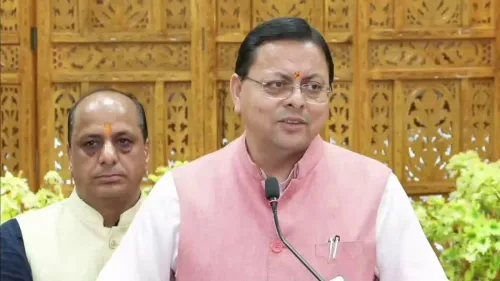
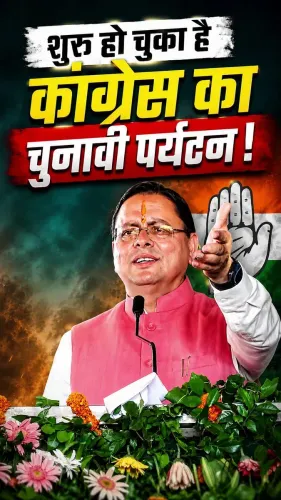
CM Dhami Slams Congress Over 'Bangladesh-Style' Power Change Talk
Synopsis
Uttarakhand CM Pushkar Singh Dhami accused Congress and allies of pursuing 'Bangladesh-style' regime change through anarchy, questioning their trust in democratic mandates and defending post-2014 governance gains.
Key Takeaways
Pushkar Singh Dhami posted a sharp political attack on October 16, 2026 , targeting Congress and its allies .
He invoked the Bangladesh political upheaval as a parallel to what he alleged Congress was attempting in India.
Dhami accused the opposition of using three tactics: undermining constitutional institutions, stoking unrest, and obstructing development.
He used the term shahzade ('prince') to reference Congress leadership, a well-established BJP rhetorical device.
The post reaffirmed the BJP's core post- 2014 contrast: governance and progress under the NDA versus alleged corruption under Congress.
Dhami declared that 'the path to power in a democracy runs through votes, not anarchy.'
A pointed political broadside landed on Friday, October 16, 2026, when Uttarakhand Chief Minister Pushkar Singh Dhami took to X to accuse the Indian National Congress and its allies of pursuing power through 'anarchy' rather than the ballot — invoking the spectre of Bangladesh to sharpen the charge.
Dhami's post did not mince words. 'The intentions of Congress and its allies are no longer hidden from anyone,' he wrote, raising a direct question: 'Those who speak of a Bangladesh-style regime change in India — why don't they trust the people's mandate?' The barb was aimed squarely at what he called Congress's shahzade — 'prince', a long-running BJP epithet for Rahul Gandhi — alleging that having failed to win power democratically, the opposition was now 'searching for a route to power through chaos.'
The Bangladesh Comparison and What It Signals
The 'Bangladesh-style change' reference carries unmistakable weight. Bangladesh witnessed a dramatic political upheaval that toppled a long-entrenched government through street mobilisation rather than a scheduled election — a sequence that sent shockwaves across South Asia. By invoking that precedent, Dhami frames the opposition's alleged tactics not merely as aggressive politics but as a threat to constitutional order itself.
He listed three specific instruments he accused the Congress of deploying: questioning constitutional institutions, manufacturing an atmosphere of unrest, and obstructing India's development. 'Ambitions of capturing power by raising questions over constitutional bodies, creating an atmosphere of unrest in the country, and putting obstacles in India's development journey will never succeed,' he declared.
The Post-2014 Contrast at the Heart of the Attack
The post's second thrust is a familiar BJP electoral narrative — but Dhami delivers it with fresh urgency. He argued that since 2014, when the BJP-led NDA first swept to a Lok Sabha majority under Narendra Modi, citizens have witnessed 'development and progress' where they once saw 'only corruption and loot' under Congress rule. It is a contrast the party has refined across three general elections, and state-level leaders like Dhami routinely amplify it as national messaging filters down to campaign ground.
The closing line functions as both a warning and a democratic credo: 'In a democracy, the path to power runs through the votes of the people — not through anarchy.'
Why This Moment, Why This Language
BJP leaders frequently deploy constitutional-institutions rhetoric when they perceive the opposition as delegitimising courts, the Election Commission, or investigative agencies. The specific timing of Dhami's post — the immediate trigger of which has not been independently verified — suggests it is a response to opposition statements or actions in the current political cycle. With Uttarakhand eyeing its place in a crowded state-election calendar, a chief minister who speaks in the national register keeps his party's core narrative alive at the grassroots level.
Congress and its INDIA bloc partners have not yet issued a formal response to Dhami's post. Their reply — or the silence — will tell its own story in the days ahead. In Indian politics, a sharp enough attack that goes unanswered rarely stays unanswered for long.
Point of View
Dhami attempts to shift the debate from policy grievances to constitutional legitimacy. The 'anarchy vs ballot' binary is a durable BJP frame, but its repeated invocation also signals that the party sees opposition momentum — real or potential — as worth pre-empting aggressively. Whether Congress responds with a counter-narrative or lets the charge hang will determine whether this exchange shapes the next news cycle or fades as routine political noise.
NationPress
16 Oct 2026
Frequently Asked Questions
What did CM Dhami say about Congress and Bangladesh?
Dhami accused Congress and its allies of seeking a 'Bangladesh-style' regime change in India through anarchy rather than democratic elections, questioning why they do not trust the people's mandate.
Who is the 'shahzade' Dhami referred to in his post?
'Shahzade,' meaning 'prince' in Hindi and Urdu, is a BJP epithet regularly used to refer to Congress leader Rahul Gandhi, implying dynastic rather than democratic legitimacy.
What does the Bangladesh reference mean in Indian politics?
Bangladesh experienced a dramatic government change driven by street protests rather than a scheduled election. BJP leaders use this as a cautionary parallel when accusing opponents of attempting to destabilise India outside electoral processes.
What is Dhami's argument about post-2014 India?
Dhami argues that since the BJP-led NDA came to power in 2014, citizens have seen development and progress, contrasting with what he characterises as corruption and misgovernance under the preceding Congress-led era.
What is the significance of Dhami's statement on constitutional institutions?
BJP leaders frequently invoke the defence of constitutional institutions — courts, the Election Commission, investigative agencies — when accusing the opposition of delegitimising these bodies to create political instability.