Shekhawat: 'Regime Change' talk exposes anarchy agenda, not reform
Synopsis
Culture Minister Gajendra Singh Shekhawat accused the opposition on October 16 of using 'Regime Change' language to reveal a conspiracy to manufacture anarchy and grab power, dismissing their electoral reform claims as cover for destabilisation.
Key Takeaways
Gajendra Singh Shekhawat posted on October 16, 2026 accusing the opposition of plotting anarchy under the guise of electoral reform.
He argued that the phrase 'Regime Change' exposes the real motive: seizing power by destabilising the country.
The minister stated the opposition's fight is not genuinely for electoral reforms, SIR, Gyanesh Kumar, or youth welfare.
The BJP has a recurring pattern of framing opposition electoral agitation as destabilisation rather than institutional reform.
Shekhawat explicitly invoked the country's youth and their future as a moral stake the opposition is ignoring.
The phrase 'Regime Change' has become the flashpoint. Union Culture and Tourism Minister Gajendra Singh Shekhawat on Friday, October 16, 2026, levelled a sharp accusation at the opposition, arguing that the use of such language strips away the pretence of electoral reform advocacy and reveals a deeper design — engineering anarchy to seize power.
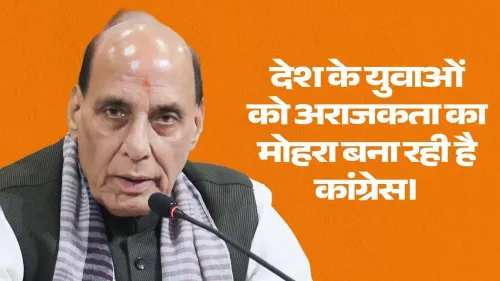
Posting in Hindi on X, Shekhawat stated: 'Regime Change jaise shabdon ke prayog se spasht ho jaata hai' — 'The use of words like Regime Change makes it clear that their fight is not for electoral reforms, not for SIR, not for Gyanesh Kumar, not for the bright future of the country's youth. Rather, this is their conspiracy to create anarchy in the country and seize power.'
The 'Regime Change' charge and what it signals
Shekhawat's post zeroes in on vocabulary as evidence of intent. His argument is structurally pointed: if the opposition's stated causes — electoral reform, a specific process identified as SIR, and a named official Gyanesh Kumar — were the real motivations, the language of 'Regime Change' would be unnecessary. By invoking it instead, he contends, the mask slips.
The minister's framing is a direct escalation in an ongoing political contest over the legitimacy of opposition agitation. It reframes what critics present as institutional accountability campaigns as destabilisation plays — a characterisation the BJP has deployed with consistency across multiple election-adjacent controversies.
A recurring BJP counter-narrative on electoral protests
This is not the first time the ruling party has drawn this equivalence. Indian political discourse has seen a recurring pattern: when opposition parties mount pressure campaigns around electoral processes — whether targeting the Election Commission, voter roll procedures, or official appointments — the BJP's response has frequently been to question the underlying motive rather than engage only on the substantive demand.
The tactic has strategic logic. It shifts the debate from the specific grievance to the broader character of the opposition's politics, placing the burden on critics to distance themselves from radical framing even as they press their institutional demands. Shekhawat's post fits squarely within that playbook — but the explicit invocation of 'anarchy' and 'conspiracy' marks a notably blunt register.
Youth futures as the moral stake
One element of Shekhawat's post that goes beyond pure political counter-punch is the mention of the country's youth. By listing 'the bright future of the country's young people' as something the opposition's fight is not actually about, he inserts a generational dimension — framing whatever agitation is underway not merely as anti-government, but as indifferent or even hostile to aspirational India.
It is a rhetorical move with electoral geography in mind: Jodhpur, Shekhawat's own constituency in Rajasthan, has a substantial young voter base, and youth employment and opportunity are live concerns across the state. Landing the 'anarchy vs. future' contrast in this context is deliberate.
Whether the opposition responds by defending the 'Regime Change' framing or distancing itself from it, the terms of the next round of this debate have now been set — by a minister who chose words as carefully as he accused his rivals of choosing theirs.
Point of View
Connecting the anarchy charge to aspirational voters the party cannot afford to lose. If the opposition fails to distance itself from the contested phrase or define it clearly, Shekhawat's framing may prove sticky ahead of any electoral cycle.
NationPress
16 Oct 2026
Frequently Asked Questions
What did Gajendra Singh Shekhawat say about 'Regime Change'?
Shekhawat argued on October 16, 2026 that the opposition's use of the phrase 'Regime Change' proves their real goal is not electoral reform but creating anarchy to seize power.
Who is Gajendra Singh Shekhawat?
Gajendra Singh Shekhawat is India's Union Minister of Culture and Tourism, a senior BJP leader and Lok Sabha MP from Jodhpur, Rajasthan.
What is the BJP's position on opposition electoral reform demands?
The BJP, including ministers like Shekhawat, has consistently argued that opposition agitation around electoral processes is aimed at destabilising the government rather than genuine institutional reform.
What is SIR in Indian election politics?
The exact context of 'SIR' as referenced in Shekhawat's post relates to a specific electoral process; full details from the post could not be independently verified from available background.
Why did Shekhawat mention India's youth in his post?
Shekhawat mentioned youth to argue that the opposition's actions, framed as a power-grab through anarchy, betray the interests of young Indians who deserve a stable and bright future.