Lalan Singh flags transparency, last-mile delivery in governance push
Synopsis
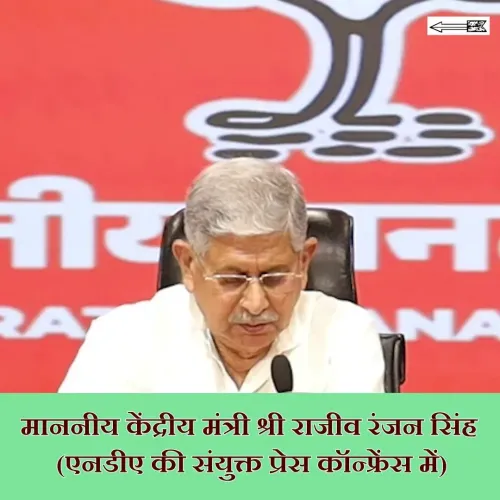
Union Minister Rajiv Ranjan Singh (Lalan Singh) posted on 16 October 2026 reiterating his ministry's commitment to transparency, accountability, and last-mile delivery of welfare schemes across Panchayati Raj and Fisheries sectors.
Key Takeaways
Rajiv Ranjan Singh (Lalan Singh), Union Minister for Panchayati Raj and Fisheries, posted a governance directive on 16 October 2026 .
The post calls for 'better coordination, transparency and accountability' in delivering welfare schemes to the last beneficiary .
The tag to @FisheriesGoI signals the message is aimed at departmental delivery machinery, not just public messaging.
The Ministry of Panchayati Raj has been running the Rashtriya Gram Swaraj Abhiyan since 2018 to strengthen local governance and fund-flow transparency.
Key stakeholders include panchayat bodies and fishermen communities who depend on smooth inter-ministerial and state-level coordination.
Better coordination, transparency, and accountability — Union Panchayati Raj and Fisheries Minister Rajiv Ranjan Singh, popularly known as Lalan Singh, distilled his ministry's core ambition into a single post on Friday, 16 October 2026, tagging the Department of Fisheries and signalling a renewed push to ensure welfare schemes reach the last person in the chain.
The minister's post, in Hindi, reads: 'Behtar samanvay, paardarshhita aur jawabdehi' — 'Better coordination, transparency and accountability — our endeavour is that the benefits of public welfare schemes reach the last person, and development work gains new momentum.' The tag to @FisheriesGoI makes clear this is not just a political platitude; it is a directional message aimed squarely at the delivery machinery of his own ministries.
The last-mile delivery challenge in rural welfare
The phrase 'last person' — antim vyakti — carries a deliberate weight in Indian policy discourse, echoing the Gandhian test of whether governance reaches those at the very bottom of the social and economic ladder. For a minister who oversees both Panchayati Raj and Fisheries, those last persons are often a gram sabha member in a remote block or a fisherman on a coastal estuary far from a district headquarters.
The Ministry of Panchayati Raj has pushed e-governance and transparency tools under the Rashtriya Gram Swaraj Abhiyan since 2018 to strengthen local bodies — tracking fund flow, monitoring scheme implementation, and building capacity at the grassroots. The fisheries sector, meanwhile, houses millions of small and marginal fishing households whose access to government support depends heavily on how well state departments and panchayat bodies coordinate on the ground.
Coordination between ministries and panchayats — the persistent gap
Singh's emphasis on 'better coordination' is telling. Welfare schemes in India routinely face a structural gap: policy designed at the Union level must pass through state governments, district administrations, and finally panchayats before a beneficiary ever sees a rupee or a subsidy. Each layer is a potential bottleneck. The minister's call is effectively a public reminder — to his own department officials and to state counterparts — that this chain must tighten.
The post's brevity is itself a signal. No specific scheme is named, no statistic is cited. This is a values statement from a senior Janata Dal (United) leader who knows his constituency: rural Bihar and the broader village India that depends on welfare delivery not as an aspiration but as daily arithmetic.
Point of View
And the 'last person' framing is a recurring political device that grounds technocratic governance messaging in moral urgency. As Bihar heads deeper into its development narrative ahead of electoral cycles, a JDU minister loudly championing grassroots delivery is also reinforcing the alliance's rural-welfare credentials. The real test, as always, will be whether review mechanisms and field-level coordination actually sharpen — or whether this remains a well-intentioned headline.
NationPress
16 Oct 2026
Frequently Asked Questions
What did Lalan Singh post about on 16 October 2026?
Lalan Singh posted in Hindi emphasising that better coordination, transparency, and accountability must ensure welfare scheme benefits reach the last beneficiary, tagging the Department of Fisheries.
Who is Lalan Singh and what ministries does he head?
Lalan Singh is the popular name of Rajiv Ranjan Singh , a senior Janata Dal (United) leader who serves as Union Minister of Panchayati Raj, Fisheries, Animal Husbandry and Dairying.
What is the Rashtriya Gram Swaraj Abhiyan?
The Rashtriya Gram Swaraj Abhiyan is a Ministry of Panchayati Raj scheme launched in 2018 to strengthen local governance bodies through e-governance tools, capacity building, and improved fund-flow transparency at the panchayat level.
What does 'last-mile delivery' mean in Indian welfare schemes?
Last-mile delivery refers to ensuring that government benefits — subsidies, funds, or services — actually reach the intended rural or marginalised beneficiary rather than getting absorbed or delayed at intermediate administrative layers.
Which communities are affected by the Fisheries Ministry's welfare schemes?
The Department of Fisheries primarily serves small and marginal fishing households across coastal and inland water regions, who depend on government support through subsidies, insurance schemes, and infrastructure programmes.